
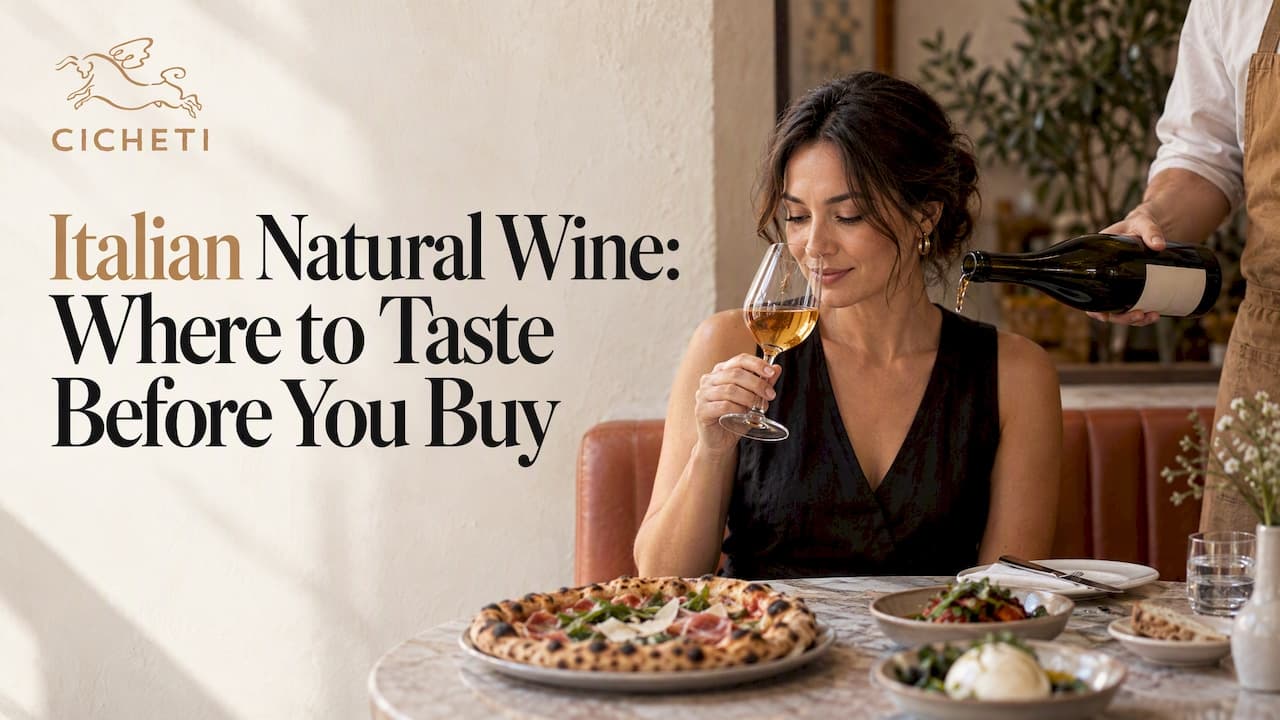
In Italy, natural wine generally means wine from organically or biodynamically farmed grapes, made with minimal cellar intervention and little or no added sulphites. Expect a wide range of expressions rather than one style: lively fruit, texture, the odd quirk. A useful way in is to taste. Look for specialist shops, curated restaurant lists or a guided tasting, and you can explore the styles beyond what a label tells you.
TL;DR:
- Italy has no universal legal definition of natural wine, and VinNatur, AVN, and SAINS interpret it differently; ask about farming and cellar practices.
- Ask whether fermentation uses native yeasts, filtration is limited, and sulphites are absent or added at bottling; those details distinguish producers.
- Haze can reflect limited filtration, while a sour milk or popcorn aftertaste signals mousiness, a technical fault; let reductive aromas breathe before judging.
- Explore Etna, Veneto, Piedmont, and Campania through specialist shops or restaurant lists, since small producers’ bottles may be hard to find again.
- Taste a small pour before buying, and ask how the vintage varies, how the wine was stored, and whether it traveled in cool conditions.
Table of Contents
- What does natural wine mean in Italy?
- How are natural Italian wines made?
- What do natural Italian wines taste like, and how do you judge them?
- Which Italian regions and producers should you explore?
- Where can you buy or taste Italian natural wines?
- What are the common misconceptions about natural wine?
- Where did the natural wine movement in Italy begin?
- How do natural, organic and biodynamic wines differ in Italy?
- What should you pair with natural Italian wines through the seasons?
- Who are the notable natural wine sommeliers and advocates in Italy?
- How has natural wine affected Italian winemaking culture and local communities?
- Why do natural Italian wines belong at our table?
- Taste Italian natural wines with our sommelier
- FAQ
- Sources
What does natural wine mean in Italy?
Start with an honest caveat: there is no single, universally agreed definition. Natural wine is a movement shaped by producers and their associations far more than by consistent law, and VinePair makes the same point when it notes that common principles circulate (grapes farmed without pesticides, minimal cellar additives, native-yeast fermentation, limited filtration) without any one rulebook behind them.
Italy has several independent groups. VinNatur, AVN and SAINS each hold slightly different interpretations of "natural", though they usually converge on sustainable farming and a light touch in the cellar. That means two bottles carrying the word "natural" can sit quite far apart in practice.
Formal certification has not settled the matter either. Policy analysis in Frontiers in Sustainable Food Systems describes controversy around voluntary labels in Europe, with pushback from industry organisations, and concludes that certification does not create one accepted legal definition.
So what does this mean when you are standing in front of a shelf or a wine list? Treat the word "natural" as an invitation to ask questions, not as a guarantee. Look for the producer's own notes on vineyard practice and cellar process. Ask the grower or seller how the grapes were farmed, what yeast was used and whether anything was added at bottling.
How are natural Italian wines made?
The best clues come from two places: the vineyard and the cellar. Once you know what to listen for, a sommelier's description or a producer's technical sheet starts to reveal a great deal.
In the vineyard, look for:
- Organic or biodynamic farming, often with no synthetic pesticides
- Ask whether the grapes were harvested by hand or machine
- Ask whether production is small-scale or larger
- A farm-first philosophy, where the grower sees themselves as a farmer rather than an industrial winemaker, a stance WSET describes as an ethical response to the industrialisation of agriculture
In the cellar, the signals are quieter but just as telling:
- Spontaneous fermentation with native yeasts from the vineyard
- No added sulphites, or only a very small amount at bottling
- Limited filtration or none at all, which is why some bottles look slightly hazy
- Minimal technological intervention, with time and patience doing the work
None of this is easy. Making wine this way is more demanding and leaves the finished wine exposed to greater stylistic variability, as Decanter's tasting coverage points out. Differences in vintage, fermentation and storage can contribute to stylistic variation.
Why do small producers accept the trade-off? Because the result can taste unmistakably of its place: a particular slope, a particular year, a particular pair of hands.
Pro Tip: Ask whether sulphites were added at all, and when. "None" and "a touch at bottling" are very different answers, and a thoughtful seller will know which applies.
What do natural Italian wines taste like, and how do you judge them?
Set aside the expectation of polished clarity. Sommeliers quoted by National Geographic advise recalibrating: favour expressive fruit, texture and a sense of place over high-gloss homogeneity. You may meet bright primary fruit, a savoury grip, a little cloudiness, lifted volatile aromatics or a reductive whiff (think struck match) that often blows off with air.
Faults are another matter. Judge a bottle against a "natural-wine norm" if you like, but Wine Folly is clear on the limit: blatant spoilage is a winemaking error, not a stylistic intention. Take "mousiness", a sour milk or popcorn-like aftertaste, which is universally considered a technical fault.
A simple routine keeps you honest:
- Pour into a decent, wide glass and look first: haze is fine, murkiness with a stale smell is not.
- Serve lightly cooled; many reds enjoy a short chill, and whites should not be ice-cold.
- Smell, then wait. Give a closed or reductive bottle some time, or decant it briefly.
- Taste for balance: does the fruit, acidity and texture hang together?
- Check the finish. A clean, savoury or fruity finish may be appealing; a sour, lingering aftertaste may indicate a fault.
Mousiness, the sour milk or popcorn-like aftertaste, is universally considered a technical fault, per Wine Folly. Knowing that one marker helps you tell a flawed bottle from an unusual one.
Which Italian regions and producers should you explore?
Think of regions as a map of styles. These snapshots are signposts, not a shopping list.
- Etna, Sicily: explore local reds and whites, and ask a seller about their character and origins.
- Veneto and Soave: ask about local Garganega and the range of styles available.
- Piedmont: ask about regional varieties such as Nebbiolo, Barbera and Dolcetto, and how individual producers approach them.
- Emilia-Romagna: ask about local sparkling wines and reds, and what foods the seller recommends pairing with them.
- Campania: ask about regional varieties such as Aglianico and Fiano, and how their styles vary by producer.
Decanter's coverage notes that the category spans both historic producers and many very small growers, so names matter less than the habit of asking who made the bottle and how. Within each region you will find a few estates that natural-wine fans return to again and again; a good importer or sommelier can point you to them.
Availability is the real hurdle. It can vary, so a bottle you loved may not always be easy to find again. Your best routes are specialist importers, independent shops, wine fairs run by the producer associations and restaurants with curated lists. When you find a grower you like, note the importer's name; it often unlocks the rest of the range.
Where can you buy or taste Italian natural wines?
Natural wine tends to live in a handful of places: dedicated natural-wine shops, wine bars, restaurants with thoughtful lists and online specialist retailers. Tasting first, then buying, saves money and disappointment.
Whoever is selling, a few questions get you to the truth quickly:
- How was the vineyard farmed, and is it organic or biodynamic?
- What happened in the cellar: native yeast, filtration, any sulphites?
- How variable is the vintage, and how should this bottle be stored?
- Has the wine travelled and been kept cool?
A guided tasting accelerates everything. At Cicheti, our sommelier selection and wine tasting classes offer ways to explore wine. It is the low-commitment way to learn your own preferences before you spend on a full bottle.
Pro Tip: Ask for a small pour first. A single taste tells you whether a wine suits you before you commit to the bottle.
What are the common misconceptions about natural wine?
"Natural wine always smells odd." Not so. Decanter's tasting coverage reports that many natural wines are faultless, alongside a minority that show technical problems. The odd bottle gives the whole category a reputation it has not earned.
"Natural wine means no sulphites at all." Often, yes, but not always. Some producers add a tiny amount at bottling. The principle is minimal intervention, not a single numerical rule.
"It is a single style." Far from it. Natural wine covers crisp whites, skin-contact orange wines, light reds, bold reds and sparklers. What links them is a method and a mindset, not a flavour.
"It must be cloudy." Some bottles are hazy because of limited filtration, but plenty are clear and bright. Cloudiness is a possibility, never a requirement.
"Natural means certified." As the Frontiers analysis shows, certification remains contested and there is no universal legal definition. Treat any label as a starting point for conversation.
"It is a passing fad." The ideas behind it (farming with care, intervening lightly, letting a place speak) draw on longstanding approaches to winemaking. Some growers describe their work as continuing family practices.
Where did the natural wine movement in Italy begin?
The roots of the movement are often associated with longstanding farming and winemaking practices in Italy. The movement is often framed as a response to industrialised agriculture and winemaking, with some growers choosing less interventionist methods.
This approach is often framed as an ethical stance. As WSET describes it, the movement can be read as a reaction against the industrialisation of agriculture, with producers stressing their role as farmers rather than technicians.
Independent associations such as VinNatur, AVN and SAINS provide ways for growers to connect and share their approaches. Each interprets "natural" a little differently, as VinePair notes, which is partly why the scene feels so varied and so personal.
Today the movement sits comfortably alongside Italy's famed regional traditions. It includes both established family producers and newer growers working with low-intervention approaches. Both camps share a conviction that the vineyard, not the cellar, should do most of the talking.
How do natural, organic and biodynamic wines differ in Italy?
These terms overlap, yet they are not interchangeable, and sorting them out helps you read a label.

Organic concerns farming practices. It tells you about the vineyard, but does not by itself describe the producer's cellar practices.
Biodynamic describes an approach to farming that treats the farm as a connected system and may include specific preparations and practices. Many natural winemakers follow biodynamic principles, but, as VinePair points out, it is not universally required.
Natural is the broadest and loosest of the three. It typically combines careful farming with a minimal-intervention cellar: native yeasts, limited filtration, little or no added sulphites. Because there is no single legal definition, the term rests on the producer's practice and reputation.
In practice, a wine can be organic without being natural, and natural without carrying any certificate. What you gain from knowing the difference is the right question to ask. If you are curious about the farm, ask about organic or biodynamic work. If you are curious about the glass, ask about the cellar.
Where certification matters to you, check for an official mark and read the producer's own notes. Where it does not, trust a seller who can describe precisely what happens from vine to bottle.
What should you pair with natural Italian wines through the seasons?
Natural wines can pair well with food. Consider their freshness, texture and tannin when choosing a dish.
Spring: a bright, herbal white from Veneto beside fresh peas, asparagus or a light risotto. Keep the weight low and the acidity lively.
Summer: a chilled light red or a frizzante from Emilia-Romagna with cured meats, tomato salads and anything from the grill. Serve it cool and drink it young.
Autumn: a skin-contact orange wine with mushrooms, roast squash or handmade pasta in a buttery sauce. Its grip and savoury edge cope well with earthy flavours.

Winter: a structured Piedmont red alongside slow braises, hearty ragù or aged cheese. Decant briefly and let it open up by the fire.
At the table, a few habits help. Pour small glasses so you can sample as the meal shifts. Match weight with weight: delicate dishes with delicate wines, richer plates with fuller bottles. And let regional logic guide you: the wine and the dish from the same place usually agree.
If you would like to try this without hunting down bottles yourself, our dine-in menus and Venetian-style small plates make an easy playground for pairing.
Who are the notable natural wine sommeliers and advocates in Italy?
Naming individuals carries a responsibility to name only what can be verified, so rather than a list of personalities, here is how to recognise the kind of advocate worth following.
The most useful voices tend to be a mix. There are growers who open their cellars to visitors and speak candidly about hard vintages. There are importers who spend months on the road matching small estates with markets that can appreciate them. And there are sommeliers who build wine lists around lesser-known varietals and teach guests how to taste them.
The producer associations (VinNatur, AVN and SAINS) are also advocates in their own right, organising gatherings where you can meet growers face to face. Professional tasting coverage such as the Decanter piece shows how critics now assess the category with the same rigour applied elsewhere in wine.
What marks a good advocate? Honesty about faults, curiosity about place and a willingness to say when a bottle simply is not working. Sommeliers quoted by National Geographic stress recalibrating expectations rather than defending every bottle.
That is also how we approach our own sommelier selection: pour a little, explain a lot and let you decide. Seek out the people who make you curious, not the ones who make you feel you should already know.
How has natural wine affected Italian winemaking culture and local communities?
Natural wine can introduce small producers to new audiences. For some estates, reaching new customers may help support continued vineyard work.
It has also sparked healthy debate within the wider trade. Conventional and natural growers sit side by side in many appellations, and the conversation about farming practice, additives and honesty on labels has nudged the whole industry to explain itself more clearly. Decanter's coverage notes that the category includes both historic producers and very small growers, which shows how broad the movement has become.
Natural-wine producers and venues may support local work, interest in regional grape varieties and tourism, though the effects vary by place.
There is tension, too. Uneven labelling, as the Frontiers analysis explains, makes it hard for drinkers to know what they are buying, and demand can strain tiny production volumes.
For some producers and drinkers, natural wine can encourage a renewed interest in local identity. When a diner asks about the grower behind a glass, the conversation connects the table to the hillside, which is exactly what traditional Italian winemaking has always stood for.
Why do natural Italian wines belong at our table?
We keep returning to lesser-known Italian varietals because they taste of somewhere. A curated list gives you a gentle way in: you do not need to know a grape to enjoy it, only to be curious enough to take a small pour and see where it leads.
Our advice is simple. Try a glass beside something rustic (a wood-fired pizza, a plate of handmade pasta) and notice how the texture of the wine meets the food. Then try another, and compare. Tasting events make this even easier, because the risk is small and the learning is quick.
— Cicheti
Taste Italian natural wines with our sommelier
Reading about natural wine only takes you so far; the real understanding arrives in the glass. Our sommelier selection of the day offers a way to explore Italian wines. Join one of our wine tasting classes to go deeper, then keep your newfound confidence for your own shopping.

Browse our drinks menu to see what is pouring now, or book a table and ask us what is open tonight.
FAQ
What is natural wine in Italy?
It is wine from organically or biodynamically farmed grapes, made with minimal cellar intervention and little or no added sulphites. There is no single legal definition, so the meaning rests largely on producers and their associations.
What is special about natural wine?
Natural wine can show expressive fruit, texture and a sense of place, though styles vary. Sommeliers quoted by National Geographic suggest recalibrating expectations in that direction. Each bottle can differ noticeably from vintage to vintage.
What are some natural Italian wines available?
Look to regions such as Etna in Sicily, Veneto and Soave, Piedmont, Emilia-Romagna and Campania, which all have growers working in this style. A specialist shop or sommelier can name current bottles, since small production means availability changes quickly.
Which is the best natural wine?
There is no single best bottle, because natural wine spans many grapes, regions and styles. The best choice is the one that suits your taste and your meal, and tasting small pours is the quickest way to find it.
Sources
- Winefolly
- Nationalgeographic
- Frontiers | Certification of Natural Wine: Policy Controversies and Future Prospects
- Baudains: ‘Natural wines don’t stink’, part 2 | Decanter