
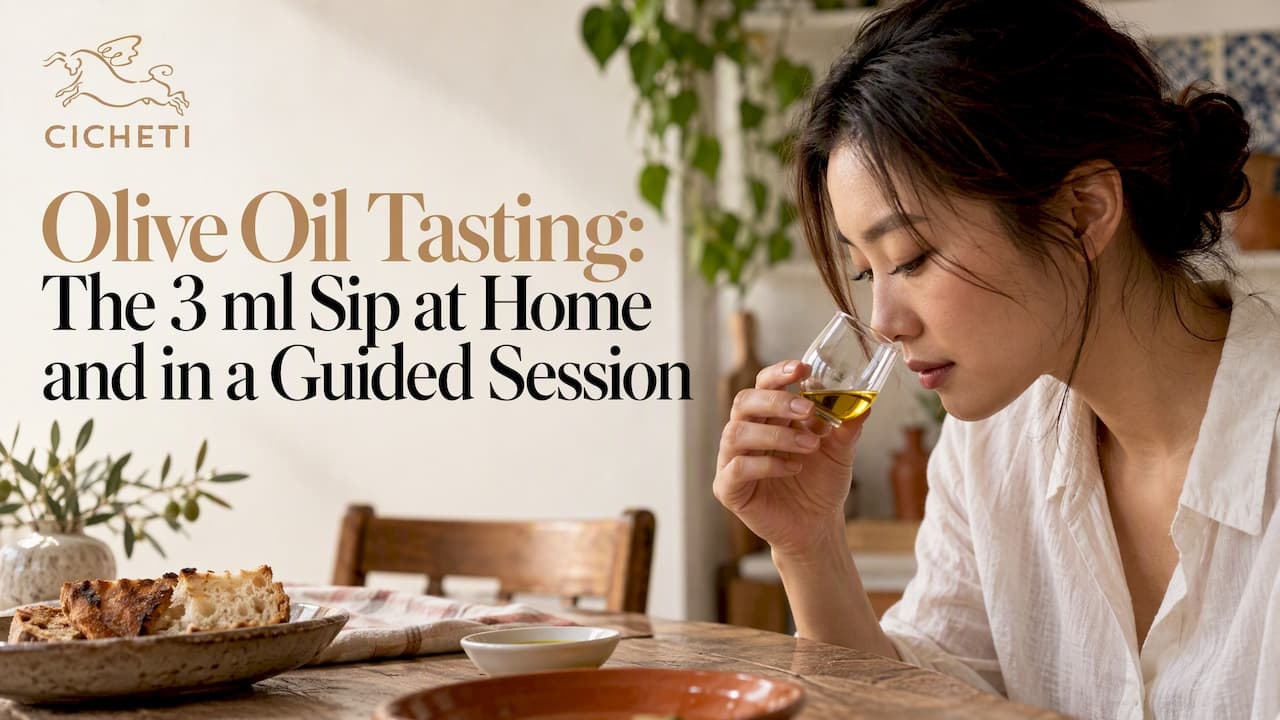
To taste olive oil properly, warm a small sample in a covered glass, sniff, then sip about 3 ml and slurp while drawing air to judge fruitiness, bitterness and pungency. Olive oil tasting is a sensory assessment of aroma, flavour, bitterness and pungency. It follows the IOC tasting method and works equally well at your kitchen table or in a guided session.
TL;DR:
- Warm a covered sample to about 28°C, smell it for no more than 30 seconds, then sip roughly 3 ml and slurp gently.
- The IOC classifies each attribute on its intensity scale as delicate below 3.0, medium from 3.0 to 6.0, or robust above 6.0.
- Use a separate glass for each oil when possible, and avoid strong room odors, perfume, candles, coffee, mints, and spicy food before tasting.
- Reset your palate with Granny Smith apple and water between oils; bread can mask the oil’s profile, so save it for pairing.
- Taste the oil neat first, then try it with raw vegetables, fresh cheese, grilled fish, or plain pasta to see how food changes its profile.
Table of Contents
- What do you need for an olive oil tasting?
- How do you taste olive oil, step by step?
- What are fruitiness, bitterness and pungency?
- What happens at a guided olive oil tasting?
- How do you reset your palate and pair olive oil with food?
- What should you have ready when you host a tasting?
- Where does olive oil tasting come from?
- Which olive oil varieties taste like what?
- How should you store olive oil so it tastes its best?
- A host's note on why this matters at the table
- Want a hosted tasting with food and wine?
- FAQ
- Sources
What do you need for an olive oil tasting?
You need less than you might think, but the conditions matter more than the kit. We like to say a neutral room is a piece of equipment, because strong smells will flatten the aromas you are trying to catch.
- Glass: a professional blue tasting glass is ideal because it hides colour, which is a distracting and unreliable cue. A wine glass is a practical substitute, as the California Olive Oil Council notes.
- Temperature: the IOC method warms formal samples to about 28°C. At home, cupping the glass in your palm gently warms it.
- One glass per oil where you can, so flavours don't carry over.
- A quiet, odour-free room: no cooking smells, no candles, and no perfume on the people tasting.
- A plain palate: skip strong coffee, mints or spicy food beforehand.
Cover each glass with a saucer or your hand until you are ready to smell. The aromas gather under the cover, and you want them waiting for you.
How do you taste olive oil, step by step?
Follow this sequence and you will taste much like a participant in a guided class. Take your time. Rushing is the most common mistake.
- Pour a small amount of oil into the glass, enough to cover the bottom.
- Cover the glass, then rotate it so the oil coats the inner surface.
- Warm it gently in your hand.
- Remove the cover and smell. The IOC method says smelling should not exceed 30 seconds, so take a few slow breaths and stop.
- Sip roughly 3 ml.
- Slurp gently while drawing air in through your lips. This spreads the oil across your mouth and carries aromas up to your nose from the back of the throat.
- Move the oil slowly over your tongue, the roof of your mouth and the sides.
- Swallow a little and pay attention to your throat. This is where pungency shows itself.
- Write down what you noticed: aroma, flavour, bitterness, pungency.
Keep each session manageable and rest between sessions, because your palate can tire. Record your notes straight after each sample, while the impression is fresh.
Pro Tip: Don't panic if you cough or your throat tickles. A scratchy throat is not automatically a fault: the California Olive Oil Council points out it can be pungency, a legitimate characteristic of a good oil.
What are fruitiness, bitterness and pungency?
These are the three positive attributes tasters look for, and the IOC's tasting standard defines them in plain terms.
- Fruitiness: the aroma of healthy, fresh olives. Words you might reach for: green apple, tomato leaf, fresh herbs, almond, artichoke.
- Bitterness: a taste felt mostly at the back of the tongue, associated with green or turning olives. Think of the bite of rocket or radicchio.
- Pungency: the peppery, tingling sensation in the throat. It is a tactile sensation rather than a flavour.
Balance matters more than strength. A bold oil is not automatically a better one, and a delicate oil can be lovely if its flavours are clean and in harmony.
Under the IOC intensity scale, delicate is below 3.0, medium is 3.0 to 6.0, and robust is above 6.0 for these attributes, according to the IOC's method. That gives you a shared language for describing how loud an oil is.
A consumer tasting is about enjoyment and recognition. The IOC's hedonic guidance makes a useful distinction: you can learn to recognise quality and defects, but the purpose is pleasure, not reproducing a laboratory panel at the dinner table.
What happens at a guided olive oil tasting?
A consumer tasting is relaxed, guided and educational. It is not an examination. The IOC's hedonic guide frames it as an enjoyable experience, and trained panels do something quite different: professional panels are trained to detect defects, while ordinary tasters, as the North American Olive Oil Association explains, can focus on the positive nuances.
Expect these elements:
- Several extra virgin olive oils, chosen for variety and interest, often from different regions or olive varieties.
- A short introduction to how the oils were made, led by a professional taster or producer.
- A look at colour, just for fun, followed by the smelling and tasting phases.
- Palate cleansing between oils, and often some suggested pairings.
- A progression through aroma, flavour, bitterness, pungency and balance.
Group tasting has a quiet advantage: different people notice different aromas, and the vocabulary builds as you compare notes.
Questions worth asking your host:
- Where did the oils come from, and what was the harvest date?
- Are any early-harvest or single-variety oils in the line-up?
- Are tasting notes or take-home samples available?
How do you reset your palate and pair olive oil with food?
Between samples, eat a slice of Granny Smith apple, then drink still or sparkling water. The California Olive Oil Council recommends exactly this. Bread is pleasant, but it can obscure the oil's own profile, so save it for later.
Always taste the oil neat first, so you know its character before food gets involved. Then try a few simple pairings:
- Raw vegetables, such as fennel or tomato, where the oil's freshness shows.
- Fresh cheese, where a robust oil cuts through the creaminess.
- Grilled fish, finished with a drizzle.
- Plain pasta with a finishing drizzle, to see how heat and texture change your perception.
Notice what warmth does. A drizzle on hot food releases aromas that a cold taste hides.
What should you have ready when you host a tasting?
A tidy setup makes the evening. Run through this list:
- One glass per oil, labelled underneath.
- Oils ordered from delicate to robust.
- Apple slices and water for each guest.
- A note sheet and a pencil.
- A manageable number of oils in one session, with a rest between sessions.
Pro Tip: Include one early-harvest oil for contrast, and cover the labels so nobody is swayed by a famous name. EatingWell suggests choosing bottles with harvest dates and setting a theme, such as a single country or variety, so guests can spot patterns. Tinted bottles are a good sign too.
Where does olive oil tasting come from?
Olive oil has been judged by smell and taste for as long as people have pressed olives, long before anyone wrote a standard. A farmer deciding which oil to keep for the table and which for the lamp was, in effect, running a tasting. What changed in the modern era is the shared vocabulary.
The International Olive Council's method, with its covered glass, set temperature and defined attributes, turned personal preference into something producers across borders could compare. Its newer hedonic guidance goes the other way and invites the rest of us in, treating the consumer's pleasure as worth learning to describe.

Culturally, the habit sits close to wine tasting, and the comparison helps. Both ask you to slow down, smell before you sip and put words to what you notice. Olive oil has simply been later to the party, and its tasters are still happy to explain the basics. That is part of its charm: you can arrive knowing nothing and leave with a working vocabulary after one evening.
Which olive oil varieties taste like what?
Variety shapes flavour, though harvest time, soil and milling matter as well, so treat these as tendencies rather than rules. We have not tied specific varieties to published figures here, since the intensity of any bottle depends on the year and the producer.
- Robust, green and peppery oils often come from early harvests, where bitterness and pungency run higher. Expect cut grass, artichoke and a strong peppery finish.
- Medium oils tend to balance green fruit with a gentler bite, with notes of tomato leaf, herbs and almond.
- Delicate oils are softer and rounder, often from later harvests, with ripe fruit, a little sweetness and only a light tingle.
The practical approach: ask the seller whether an oil is single-variety and when it was harvested, then taste a robust one beside a delicate one. Seeing them side by side teaches you more than any description will.
How should you store olive oil so it tastes its best?
Light, heat and air are the enemies. A beautiful oil left on a sunny windowsill next to the hob will taste flat within weeks, and you will wonder why your tasting notes have gone dull.
- Keep it dark: choose tinted bottles, and store them in a cupboard rather than on the counter.
- Keep it cool: away from the oven, the kettle and direct sun.
- Keep it sealed: close the cap firmly after each use to limit contact with air.
- Buy what you can use: check the harvest date and pick a size you will finish while the flavours are lively.
For a tasting, pour from a freshly opened bottle and keep a small amount in a closed container, rather than leaving a glass of oil sitting out. Fresh oil gives you the clearest picture of its fruitiness, bitterness and pungency.
A host's note on why this matters at the table
When our team learns to recognise a peppery finish or a grassy aroma, it shows in service. Staff choose finishing oils with more confidence, and diners notice when a delicate oil lands on delicate fish and a robust one meets something hearty. Tasting is a habit worth building, whether you are cooking at home or looking after a dining room.
— Cicheti
Want a hosted tasting with food and wine?
If you would rather learn with a glass in hand and someone else doing the pouring, we can help at Cicheti, 52 Kandahar Street. Ask us about:
- Private events, including wine-tasting classes, where olive oil pairing can come up in conversation.
- Our Sommelier Selection of the day, for an evening built around what's in the glass.
- Tell us what you have in mind when you book.
Have a look at our current dine-in menus first, then get in touch to plan your session.

FAQ
Is olive oil tasting a thing?
Yes. Professionals follow a formal method set out by the International Olive Council, and consumers can join relaxed, guided tastings built around enjoyment rather than grading.
Is olive oil supposed to have a taste?
It is. A good extra virgin olive oil shows fruitiness, some bitterness and a peppery kick in the throat. The IOC treats these three as the positive attributes of the oil.
What neutralizes the taste of olive oil?
A slice of Granny Smith apple followed by still or sparkling water resets your palate between samples, as the California Olive Oil Council advises. Bread can mask the oil's flavour, so use it for pairing rather than cleansing.
Is it normal for olive oil to have a bitter taste?
Yes, a little bitterness is normal and often a good sign, especially in oils made from green or turning olives. What matters is balance: bitterness should sit alongside fruitiness rather than overpower it.