
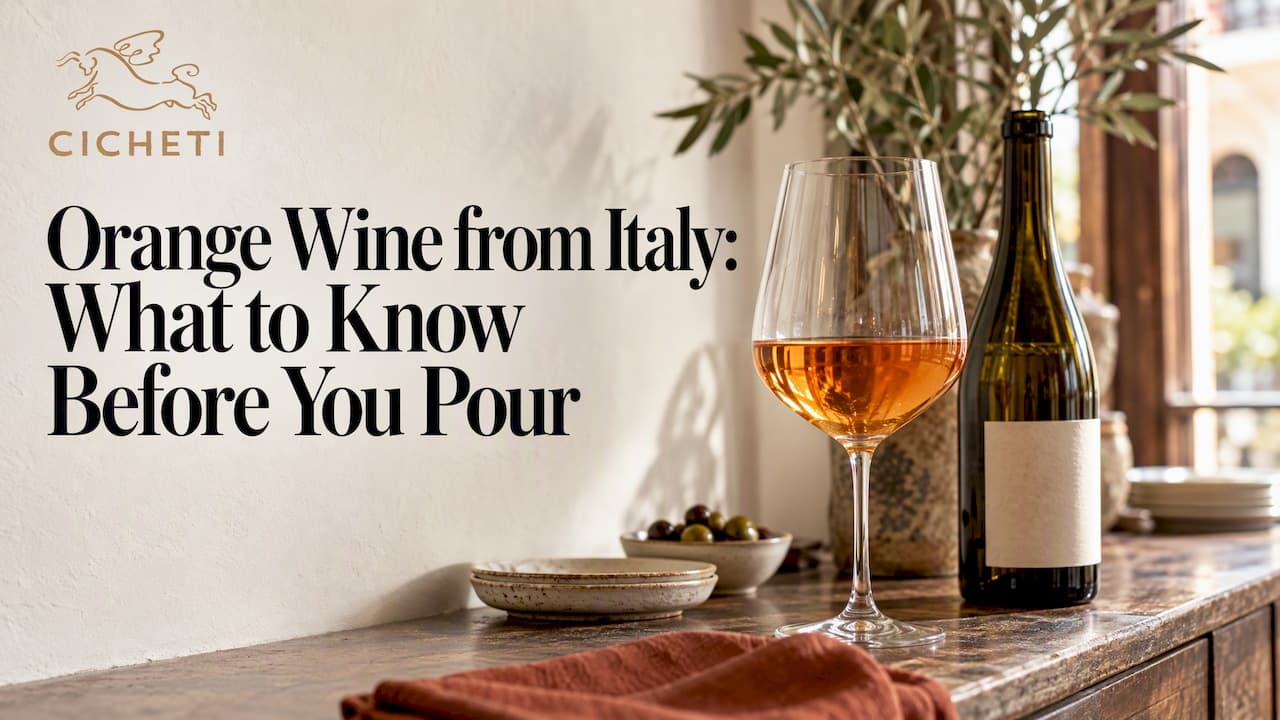
Orange wine is white wine made the way red wine is made: the grape skins stay in the tank with the juice, sometimes for days, sometimes for months. Nothing orange goes in, apart from the colour that comes out. Italy is where the modern revival took hold, above all in Friuli-Venezia Giulia on the Slovenian border, and these wines are happiest at the table with food that has some weight to it.
If you're deciding what to order, here's the short version. Start with a bottle or glass from Friuli, ask for something with moderate skin contact, and pair it with cured meats, aged cheese or a slow-cooked ragù rather than a delicate salad. The rest of this guide explains why, and how to find a glass in Singapore.
TL;DR
- Orange wine is a technique, not a grape: white grapes fermented on their skins, which adds colour, tannin and a savoury edge.
- Friuli-Venezia Giulia is the modern heartland, with Ribolla Gialla and Vitovska among the grapes to look for. Sicily has also made a name for itself with Grillo, Catarratto and Zibibbo.
- It is not stronger than other table wines, and the colour does not mean the wine is oxidised.
- Treat it as a food wine: cured meats, aged cheeses, ragù and richer pizzas suit it better than light starters.
- At Cicheti, 52 Kandahar Street, the Sommelier Selection of the day is the place to ask what's pouring.
Table of Contents
- What orange wine actually is
- Why Italy, and why Friuli
- How to taste it without feeling lost
- What to eat with orange wine
- Finding orange wine in Singapore
- Our view on orange wine
- Drinking orange wine at Cicheti
- A simple way to try three styles
- Orange wine FAQ
- Sources
What orange wine actually is
The label confuses people because it sounds like fruit. It isn't. Orange wine, also called skin-contact or amber wine, is white wine made with extended contact between the juice and the grape skins during fermentation, a method more usually associated with red winemaking.
That contact is the whole story. Skins carry pigment, tannin and aromatic compounds, and they hand them over to the wine. A conventional white wine is pressed quickly and the skins are discarded, which keeps it pale, clean and light. An orange wine keeps them, so you get something between the two: the freshness and acidity of a white, with the grip and structure you would normally expect from a red.

Two points are worth settling early, because they come up at every table.
The colour is not oxidation. Decanter explains that the colour comes from the skins, and that it ranges from deep gold to amber-orange depending on the grapes and the length of contact. A well-made bottle is carefully protected from air, so it can taste fresh and savoury rather than tired.
It is not stronger. Alcohol depends on grape sugar and how far fermentation runs, as with any table wine. An orange wine of 12.5% is no more potent than a white of 12.5%. Check the label rather than the colour.
Orange or amber?
You will see both words. The writer Simon Woolf, quoted in Decanter, describes orange wine as a technique rather than a style or a creed. Some growers, Paolo Vodopivec among them, prefer "amber" to stress elegance and precision. If a menu says amber, skin-contact or macerated white, it is describing the same family.
How long is long enough? There is no universal rule. Maceration can run from a few days to several months, and the length shapes the result far more than the label does. A few days of contact gives a pale copper wine with a light tannic touch. Several months, perhaps in amphora or large wooden vessels, gives something darker, tea-like and much more serious.
Why Italy, and why Friuli
Orange-style winemaking is ancient, and its oldest roots are usually traced to Georgia, where wine is fermented in clay qvevri. In Italy the modern story begins in the hills of Friuli-Venezia Giulia. According to Gambero Rosso, producers such as Joško Gravner and the late Stanko Radikon were central to bringing these techniques back, starting in the late 1990s, and the area around Oslavia is where the orange wave gathered pace.
Friuli is better known to most drinkers for pale, crisp Pinot Grigio, so its orange wines can be a surprise. A cellar-tour guide to the region notes the range runs from lightly grippy and saline bottles with a seaside character to dense, tea-like wines of real seriousness.
Grapes you will meet on an Italian list
| Grape | Where | What to expect |
|---|---|---|
| Ribolla Gialla | Friuli-Venezia Giulia | Gambero Rosso names it among the best; typically firm, citrusy and savoury with a dry finish |
| Vitovska | Friuli-Venezia Giulia, Carso area | Also named by Gambero Rosso; mineral, taut, often with a saline note |
| Friulano | Friuli-Venezia Giulia | A regional grape often used for skin-contact styles |
| Pinot Grigio | Friuli and elsewhere | Often labelled ramato, meaning auburn or copper; the colour comes from the greyish-pink skins |
| Grillo, Catarratto, Zibibbo | Sicily | Gambero Rosso notes Sicily has gained prominence for orange wines from these local varieties |
The flavour notes in the right-hand column are general tendencies, not tasting notes for any specific bottle. Producers differ widely, and a single grape can taste quite different with two days of skin contact or two months.
Ramato is worth a line of its own. It is the Italian word for copper-coloured, and it is used for Pinot Grigio that has had skin contact. If you see it, you are looking at a gentler, easier introduction to the style.
How to taste it without feeling lost
If you usually drink Sauvignon Blanc or Chablis, an orange wine can feel unfamiliar for the first sip or two. Here's what is going on.
- Serve it a little less cold than a white. Very cold temperatures mute the aromas and make the tannin feel harder. Cool, not icy, shows more.
- Look for texture before flavour. The first thing you notice is often a slight drying sensation on the gums, the same tannin you'd find in tea or red wine.
- Expect savoury, autumnal notes. Dried herbs, orange peel, tea leaf, nuts and baked apple turn up often. Decanter's expert describes these wines as savoury and autumnal in their aromatics.
- Take it with food. That is where the style makes sense.
The tannins and phenolic compounds from the skins also act as natural preservatives, so these wines tend to be more stable than ordinary whites, according to Decanter's guide. In practice that means a bottle can open up over an evening rather than fade, which is handy if you are sharing across a long table.
If you are new to the category, the WSET suggests starting with an orange-style wine from Friuli-Venezia Giulia, which tends to be more approachable and polished than the wilder styles found elsewhere.
What to eat with orange wine
This is the part that rewards a little thought. The same WSET guidance says these wines are fundamentally food wines. Their tannin and grip let them cut through dishes that would flatten a light, crisp white: cured meats, aged cheeses and slow-cooked ragù.
Here is how that translates into a Singapore dinner.
- Cured meats and salumi. Fat and salt meet tannin and acidity. The wine cleans the palate between slices.
- Aged cheeses. Hard, nutty cheeses match the nutty, oxidative-leaning notes of longer-macerated bottles. Soft, fresh cheeses suit paler, shorter-contact wines.
- Ragù and braised dishes. A meat sauce cooked for hours has depth and fat. A wine with structure holds its own.
- Wood-fired pizza with richer toppings. Char, melted cheese and cured toppings are all friendly to skin-contact wines. A simple margherita works too, though a very tannic bottle may feel heavy next to it.
- Venetian-style small plates. Cicheti, the small plates served in Venetian bàcari (wine bars), were designed to go with a glass of something. Salty, fried, pickled and creamy bites are natural partners for a wine with some texture.
What to avoid? Very delicate raw dishes, such as lightly dressed shellfish or plain sashimi, can be overpowered by tannin. Heavily spiced chilli dishes can also clash. Orange wine does well with savoury and umami-rich food, so a Singapore table of shared dishes is a better match than a single delicate course.
Finding orange wine in Singapore
Orange wine is not on every list, and even where it appears the offer changes with the bottles in stock. A few practical tips.
- Ask rather than scan. Staff will often know which bottle is skin-contact even when the list doesn't say so. Use the words orange, amber, skin-contact or macerated.
- Say what you like. Tell your host whether you prefer something fresh and light or deep and tannic. That is more useful than naming a grape.
- Order by the glass first. If you have never tried one, a single glass costs less than committing to a bottle.
- Check the delivery rules if you are ordering in. The Singapore Police Force's liquor licensing FAQ covers the rules for supplying alcohol. As a summary of its guidance, delivery of alcohol to public places is restricted to daily hours of 0700 to 2230, and age verification applies. Choose a vendor that holds a valid liquor licence.
It's also worth knowing how restaurants think about presenting wines like these. A guide on building a premium wine list is a decent look at how venues balance familiar bottles with something more unusual, which helps explain why a good host will often steer you towards a particular glass.
Our view on orange wine
We come at this from the table, not the cellar. Cicheti is a trattoria in a three-storey shophouse on Kandahar Street in Kampong Glam, and our kitchen team is entirely local. We cook wood-fired Neapolitan pizzas and Venetian-style small plates, and our wine list leans towards Italy's lesser-known varietals. That last point is why orange wine interests us: it belongs to the same family of wines that most guests haven't met yet.
Here is what we'd say to a curious guest across the table.
First, don't treat it as a novelty. Skin-contact wine is a technique with a long history, and its natural fit is with savoury, fatty, salty food. That is much of what our menu is built from: char from the oven, cured and cooked meats, cheese, and small plates meant to be shared.

Second, be a little suspicious of any claim that one bottle is the answer. Orange wine covers pale copper to deep amber, and the bottle you love may not be the one your friend does. Tasting two side by side is the quickest education, and it's one reason we like the idea of a daily selection rather than a fixed list.
Third, ask us. We can't promise that an orange wine is pouring on any given evening, because the Sommelier Selection of the day changes. But we can tell you what's open, and match it to what is on your table.
— Cicheti
Drinking orange wine at Cicheti
We publish a drinks menu and a downloadable wine and drinks PDF, and the Sommelier Selection of the day runs from $19 to $90. If skin-contact wine is what you're after, check the current menu or ask when you book, as availability changes from day to day.
For the food side, our dine-in menus and food menu show the pizzas and small plates. If you are coming with a group, the Cicheti Family-Style Menu is $85 per person, and the Feast of the Seven Fishes is $95 per person, both listed on our festive feasts page. Family-style sharing is the format that suits an unfamiliar bottle best, since everyone gets a taste alongside several dishes.
Planning a tasting with friends or colleagues? We also run wine tasting classes and private events, details of which are on our private events page. Prices for those aren't published, so enquire directly.
BOOK A TABLE at Cicheti, 52 Kandahar Street, through cicheti.com, and mention the wine you'd like to try.
A simple way to try three styles
If you want to understand the category rather than just sample it, try a small, structured comparison. You don't need special glasses or notes, just a few friends and a table of food.
- Start with a conventional crisp white. This is your reference point. Notice how clean and quick it finishes.
- Move to a lightly macerated orange wine. A copper-coloured ramato or a Friuli bottle with short contact is a gentle step. Look for a little grip.
- Finish with a deeper amber wine. Longer maceration brings darker colour, more tannin and tea-like savouriness.
Eat something from each category with each pour: a bite of cured meat, a piece of aged cheese, something from the oven. You will quickly learn which style you want with which dish. Most people discover that the middle wine is the easy crowd-pleaser, while the deepest amber bottle is the one they remember.
Orange wine FAQ
Why is orange wine special?
It sits between white and red. You get the acidity and freshness of a white wine together with tannin, structure and savoury depth from the skins. That combination makes it unusually good with food.
What kind of wine is orange?
It is a white wine made with skin contact, so the grapes are white but the method borrows from red winemaking. It isn't a grape or a flavoured wine, and it has nothing to do with oranges. Amber wine and skin-contact wine are other names for the same thing.
Is orange wine very alcoholic?
No, not by default. Alcohol depends on grape sugar and fermentation, as with other table wines, so the strength is on the label. Many bottles sit in the same range as ordinary dry whites and reds.
Which country makes the best orange wine?
There is no single answer, and "best" depends on taste. Italy, especially Friuli-Venezia Giulia, is regarded as the modern centre of the movement, and Sicily has risen in prominence too. Georgia has the oldest tradition, and many other wine regions now make their own versions.
Sources
- The 15 best Orange Wines chosen by Gambero Rosso
- What is orange wine? Understanding skin-contact white wines (WSET)
- What is orange wine? Ask Decanter
- The marvellous world of orange wines (Decanter)
- Rediscovering Friuli: Italy's Capital of Orange Wines
- Singapore Police Force: Liquor Licence FAQs