
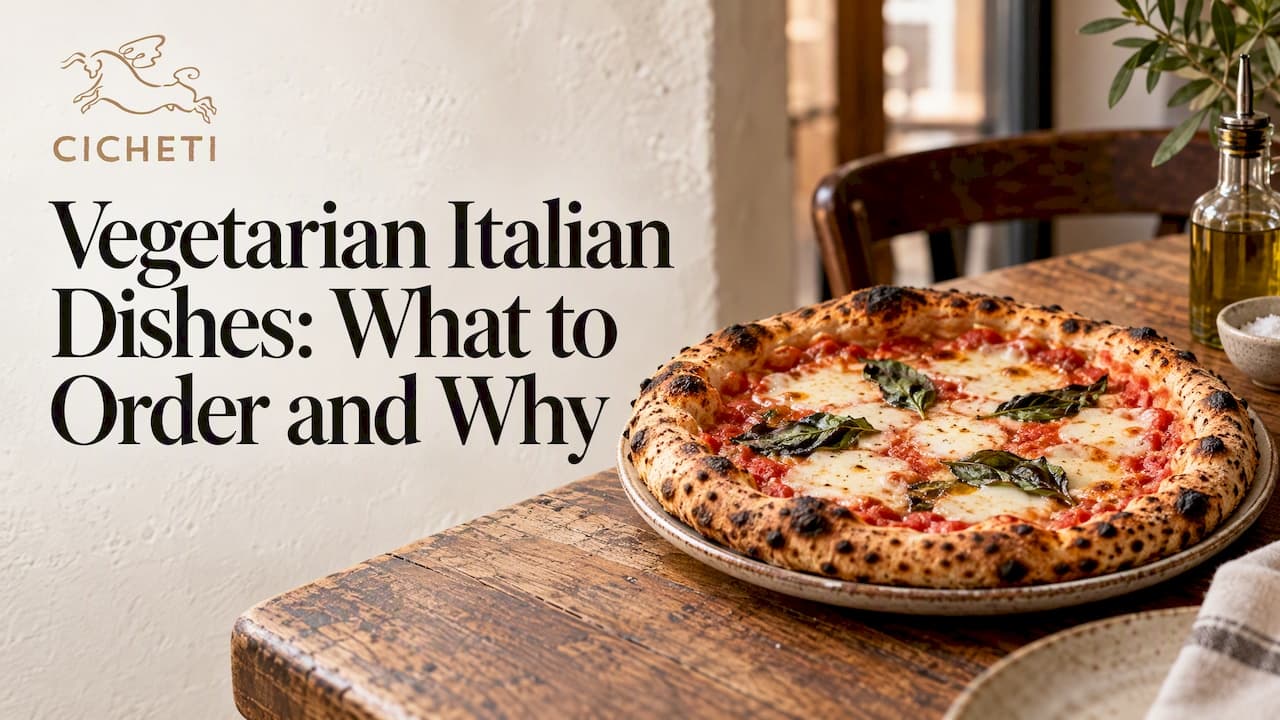
Most vegetarian Italian dishes aren't a workaround. Pasta with beans, a slow-cooked aubergine stew, artichokes braised with mint and garlic: these were written as meat-free recipes long before anyone used the word vegetarian. If you're choosing a meal in Singapore, the practical answer is to look for dishes built on vegetables, legumes, good cheese and bread, then ask the kitchen two or three simple questions about stock, fat and cheese. This guide covers which dishes to look for, what each one tastes like, and how we approach meat-free eating at Cicheti, our wood-fired trattoria at 52 Kandahar Street.
TL;DR
- Italian cooking has a long meat-free tradition, so you can order classic dishes rather than a stripped-down substitute.
- Look for regional vegetable dishes such as carciofi alla romana, caponata, minestrone and stuffed courgette flowers, plus pizza and pasta built on cheese, tomato and greens.
- Ask about stock, lard, anchovies and cheese before you order, because meat-free on paper isn't always meat-free in the pan.
- At Cicheti, check the current food menu and tell your server you're vegetarian when you book or sit down, so they can guide you.
- Menus change, so confirm dishes and dietary suitability with us rather than relying on any article, this one included.
Table of Contents
- Why Italian food suits vegetarians better than its reputation suggests
- Regional vegetarian Italian dishes worth knowing
- Pizza: where wood-firing earns its place
- Pasta and risotto: ask about the stock
- Small plates: the Venetian way of eating vegetables
- Eating with the seasons
- Our perspective on meat-free Italian eating
- How to order a vegetarian meal at Cicheti
- Eating well in a group with mixed diets
- A note on authenticity
- Book a table at Cicheti
- FAQ
- Sources
Why Italian food suits vegetarians better than its reputation suggests
The picture many of us carry is a plate of ragù, a slab of prosciutto, a meatball the size of a fist. It's a tidy image, and a partial one. Culinary writers point out that the idea of Italian food as meat-centred is largely a Western simplification. The traditional cucina povera, literally the poor kitchen, was plant-forward by necessity. It leaned on chickpeas, lentils, beans and seasonal greens, and those ingredients remain the backbone of many regional recipes across the peninsula.

That changes how you read a menu. A bowl of pasta e fagioli isn't a poor relation of a meat ragù. It's the original, and it has as strong a claim to the word authentic as anything else on the table. Once you stop treating vegetarian dishes as the exception, the choice gets wider and a good deal more interesting.
There's a second reason it works: Italian cooking is fussy about ingredients and relaxed about complexity. A good tomato, a fistful of basil, olive oil that tastes of something and cheese that has been aged properly will carry a dish without help. Vegetarian cooking that depends on those few things has nowhere to hide, which is rather the point.
Regional vegetarian Italian dishes worth knowing
Italy has 20 regions, and each has its own way with vegetables. SBS Food's regional guide is a good place to browse the full range. Here are the ones we think are most useful to know when you're reading a menu.
| Dish | Region | What it is |
|---|---|---|
| Carciofi alla romana | Lazio (Rome) | Artichokes seasoned with mint and garlic, cooked until tender |
| Caponata | Sicily | A vegetable stew built on aubergine (eggplant), with courgette, capers and pine nuts |
| Minestrone with rice | Lombardy | A thick vegetable soup, with rice rather than pasta |
| Stuffed courgette flowers | Tuscany | Delicate blossoms filled and cooked |
Those four details come from the SBS guide, and they show how different the regions are. Rome's artichoke dish is about one ingredient and two aromatics. Sicily's caponata is sweet, sour and salty at once, and tastes better the day after it's made. Lombardy's soup is a meal in a bowl. Tuscany's courgette flowers are a spring and summer treat that depends on how fresh the blossoms are.
A few other dishes turn up on Italian menus so often that they're worth knowing by name:
- Caprese: sliced tomato, fresh mozzarella and basil, dressed with olive oil. It lives or dies by the tomato.
- Pasta al pomodoro: pasta with a simple tomato sauce. If the sauce is good you don't need anything else.
- Cannelloni with ricotta and spinach: baked tubes of pasta with a soft, mild filling and a tomato or béchamel sauce.
- Risotto: rice cooked slowly with stock, stirred until creamy. Vegetable versions are common, but the stock is the thing to ask about.
- Gnocchi: soft potato dumplings, which take sauces well. Mushroom and ricotta is a common pairing.
Pizza: where wood-firing earns its place
Neapolitan pizza is a natural vegetarian meal, because its foundations are meat-free: dough, tomato, mozzarella, basil, olive oil. The classic margherita is the benchmark for a reason.
What does the wood-fired oven add? Very high heat, for a start. A pizza cooks fast in a wood-fired oven, so the crust blisters and chars in spots while the middle stays soft, and the toppings don't have time to dry out. The smoke is subtle, more a background note than a flavour you'd point at. That's why a simple vegetarian pizza, with few toppings, shows off the oven better than a loaded one.
At Cicheti, wood-fired Neapolitan pizza is what we're known for. We can't list every current pizza here, because the menu changes, so please check the food menu for what's on now. You can also read about our approach on the Cicheti homepage.
A 2016 review on a Singapore vegetarian food blog described a four-cheese pizza with parmesan, gorgonzola, ricotta and fior di latte at Cicheti, and noted that the kitchen was open to customising a pizza for a vegetarian. That's an older review, and the menu and prices have moved on since, so treat it as colour rather than a current menu. The principle holds, though: if a dish is nearly there, ask. Our kitchen team would rather adjust a plate than have you settle for second best.
Pasta and risotto: ask about the stock
Pasta is where most vegetarian Italian dishes live, and where most of the small traps hide too. A tomato sauce is usually straightforward. A bean soup might start with a pork-fat base. A risotto may be finished with a meat or fish stock. None of this is sinister, it's just how many kitchens work, and it's why a quick question helps.
Here are the questions worth asking, in the order they tend to matter:
- What's the stock? Vegetable, chicken or beef? This matters for risotto and soups.
- Is there cured pork or anchovy in the base? Some sauces and vegetable dishes start with a little pancetta, guanciale or anchovy for depth.
- Which cheese is it? Some hard cheeses are made with animal rennet. If that matters to you, say so, and our team can check what we're using.
- Can the dish be made without the meat element? Many can, as in the Pollo pizza example above.
We make pasta by hand at Cicheti, as listed on our private events page. Ask your server which pasta dishes on the current menu are vegetarian rather than guessing from the title. We'd rather answer ten questions than have you leave unsure.
Small plates: the Venetian way of eating vegetables
Our name comes from Venice. Cicheti (often spelt cicchetti) are the small plates served in the city's bàcari, its wine bars, and our guide to the bàcaro ritual explains how it works. The idea is simple: you order a few small things, share them, and drink something good alongside.
It's a format that suits vegetarians well. Instead of choosing one main course and hoping, you build a meal from several small dishes, so there's room to be adventurous. A plate of vegetables here, something with cheese there, bread to mop it all up. If one dish is a miss, you've lost a bite, not the evening.
At Cicheti, our small plates are Venetian-inspired, and the dishes change. Rather than promise a particular plate in an article, we'd point you to the dine-in menus, which show what we're serving now.
Eating with the seasons
Italian vegetable cooking works best when it follows what's in season. Artichokes, courgette flowers and tomatoes each have a window when they're at their best, and the great regional dishes were built around those windows. In Singapore, with imported produce all year round, the principle still helps: a good menu changes with what's good, not with the calendar on the wall.

The same thinking applies far beyond Italian restaurants. If you're interested in how kitchens plan plant-based dishes around the seasons, this piece on seasonal vegan menu ideas offers a different angle, with ideas for bowls, salads and wraps through the year. It isn't Italian, but the habit of cooking to the season is the same one that produced caponata and carciofi alla romana.
Our perspective on meat-free Italian eating
We cook in Singapore, in a shophouse street near Arab Street, with a local kitchen team, and that shapes how we think about vegetarian food. A few things we believe.
First, a vegetarian guest shouldn't have to ask for a favour. The best meat-free dishes are the ones that were never missing anything: a pizza whose character comes from the oven and the cheese, a plate of vegetables dressed well, a pasta that doesn't need a ragù to justify itself.
Second, regional matters more than the label. Italy isn't one cuisine, it's many, and the vegetable cooking of Rome, Sicily or Lombardy has little in common. We're a trattoria with Neapolitan pizza and Venetian-style small plates, so that's the lens we bring. We try to be honest about what we do, and we won't claim a dish or a tradition that isn't ours.
Third, the questions are welcome. Whether you're vegetarian for religious, ethical or health reasons, or simply eat less meat, tell us. We would much rather know at the start of your meal than find out at the end.
Finally, wine belongs in the conversation. We curate Italian wines with a leaning towards lesser-known varietals, and vegetable-led dishes often pair better than people expect, because acidity and freshness in a glass can lift something like caponata or a simple tomato pizza. If you're curious about the thinking, our piece on Italian natural wine is a good start, and our drinks list shows what's currently poured. The Sommelier Selection of the day is listed at $19 to $90, depending on the pour.
— Cicheti
How to order a vegetarian meal at Cicheti
Here's a simple way to plan a meal with us, whether you're all vegetarian or just one of you is.
- Look at the menu first. Browse the food menu or the dine-in menus to see what's currently offered.
- Say so when you book or sit down. A short note about vegetarian guests helps us guide you towards the right dishes.
- Start with small plates. Share two or three among the table and see what you like.
- Add a pizza or handmade pasta. Ask which are vegetarian and whether anything can be adjusted.
- Choose a drink to suit. Ask about the wines by the glass, and let the team suggest something that suits the vegetables.
If you're dining as a group, our Family-Style Menu is $85 per person, a sharing format. We haven't published whether it can be made vegetarian, so ask us before you book. The Feast of the Seven Fishes, at $95 per person, is a seafood menu, so it isn't the right choice for vegetarians.
For delivery, our dishes are also available through Oddle, which lists Cicheti for islandwide delivery. Check the listing for what's available to order at the time.
Eating well in a group with mixed diets
Mixed tables are where Italian food shines. Sharing is built into the way we cook: small plates arrive in the middle, pizzas get cut into slices, and the pasta is passed around. A vegetarian and a meat-eater can share most of the meal without either feeling they've compromised.
A few tips that work:
- Order the vegetable and cheese dishes for the whole table, not just for the vegetarian.
- Split the meat dishes between the people who want them, so the vegetarian's plate isn't an afterthought.
- Agree on a shared pizza or two before you add individual mains.
- Leave room for dessert. Italian desserts often sit comfortably in the vegetarian column, though it's still worth asking about gelatine.
If you're planning something bigger, such as a birthday or a team dinner, our private events team can talk through the menu and any dietary needs with you. We also run Pizza Making Workshops and wine tasting classes, listed on the same page, which are a pleasant way to spend an afternoon whether you eat meat or not.
A note on authenticity
People sometimes ask whether a vegetarian version of an Italian dish is authentic. Often the better question is which Italian dish you're thinking of. A margherita is authentic because it's made well, not because it has or hasn't got meat. A pasta with beans is as traditional as any ragù. The regional vegetable dishes in the table above are as old as the kitchens that made them.
What we'd gently push back on is the idea that authenticity is a badge. We're a Singapore restaurant with a local kitchen team, using Italian techniques and ingredients with respect. We cook Neapolitan pizza in a wood-fired oven and serve Venetian-style small plates, and we're clear that this is our interpretation, shaped by where we are.
Book a table at Cicheti
If you'd like to try meat-free Italian cooking made with a wood-fired oven and a handmade approach, we'd be glad to host you at 52 Kandahar Street. Book a table through our website, and mention any dietary needs so we can look after you properly.
FAQ
What is a good vegetarian Italian dish?
A margherita pizza, pasta al pomodoro, caprese or a vegetable stew such as caponata are all good starting points. They're meat-free by design, not by substitution. If you're unsure, ask the kitchen which dishes are vegetarian as written.
What are some popular vegetarian dishes in Italy?
Regional dishes include carciofi alla romana from Rome, Sicilian caponata, Lombard minestrone with rice and Tuscan stuffed courgette flowers. Pizza margherita, ricotta-filled pasta and risotto are also common across the country.
Is Italian cuisine vegetarian friendly?
Generally yes, because traditional Italian cooking uses plenty of legumes, seasonal greens and cheese. The caution is hidden animal products, such as meat stock in risotto or soups, or cured pork and anchovy in a sauce base. Always ask. Tripadvisor lists Cicheti as vegetarian friendly, and our team will talk you through the current menu.
Can Cicheti adjust a dish for vegetarians?
Often, yes, depending on the dish. We can't promise every plate can be changed, so please tell us when you book or sit down, and we'll advise on the options available that day.
Sources
- 20 vegetarian dishes from each of Italy's 20 regions, SBS Food
- Cicheti, Kandahar Street, Deelightfully Veg
- Cicheti, Singapore, Tripadvisor
- Cicheti delivery, Oddle Eats
- Seasonal Vegan Menu Ideas for Every Time of Year, Wild Foodz