
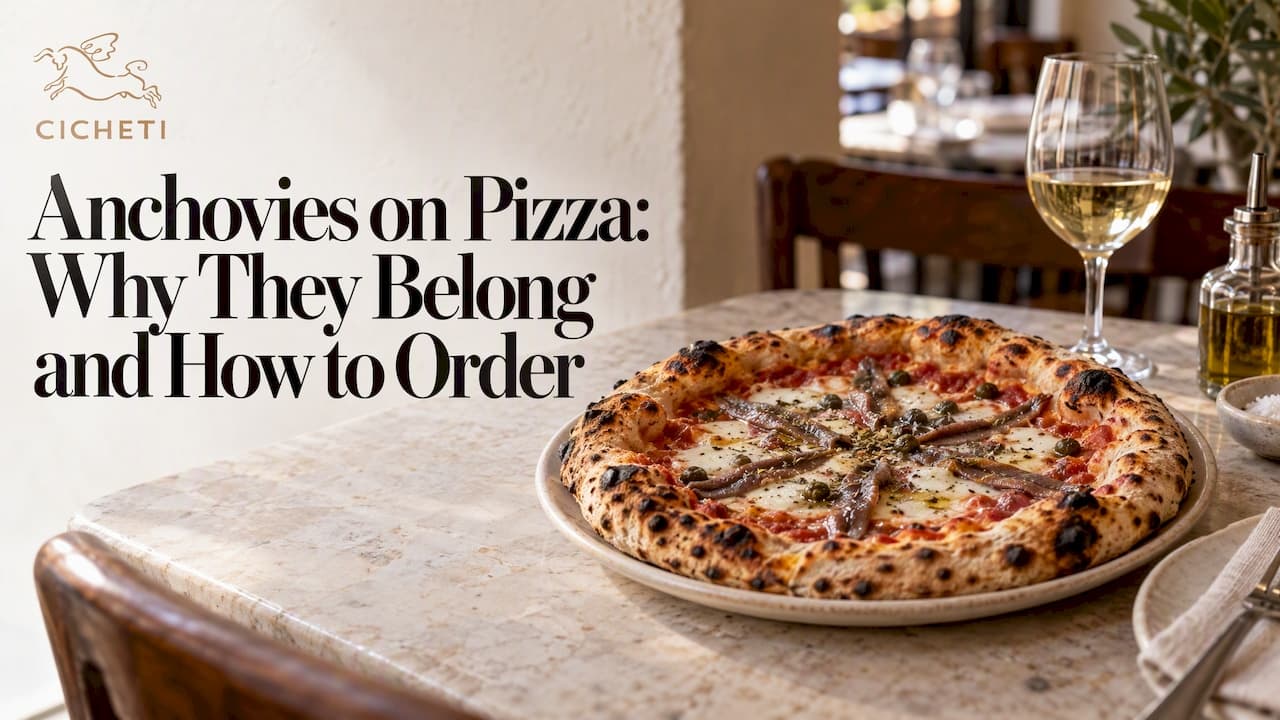
If you dislike anchovies on pizza, there's a decent chance you've only met a bad one: a tinned fillet baked until it turned metallic and harsh. Good salt-cured fillets, used with a little restraint, don't taste like a fish counter. They taste savoury, deep and a touch briny, rather like a seasoning that happens to have a silver skin. At Cicheti, our Napoletana at 52 Kandahar Street comes with anchovies, and our Romana pairs them with burratina, so we have views on the subject. Here they are, along with the practical bits.
TL;DR
- Anchovies on pizza are old Neapolitan practice, not a modern provocation: they appear in the classic Napoletana alongside tomato, garlic and oregano.
- The fishiness most people remember usually comes from cheap, over-salted tinned fillets, not from the fish itself.
- Salt-cured anchovies (the brown ones) can be baked or added after the oven. Vinegar-marinated white anchovies, boquerones, should go on once the pizza is cooked.
- At Cicheti, the Napoletana and the Romana both use anchovies, and neither is a plate of fish with some bread underneath.
Table of Contents
- Did Italians really put anchovies on pizza?
- Why anchovies work on pizza
- Why some people hate them (and what went wrong)
- Anchovy types: brown, white and everything between
- Choosing good anchovies for pizza
- What we think: a Cicheti perspective
- How to order anchovies at a pizzeria
- What to drink with anchovy pizza
- Eat anchovy pizza at Cicheti
- FAQ
- Sources
Did Italians really put anchovies on pizza?
They did, and they still do. Accounts of 18th-century Naples describe street vendors selling flatbreads topped with lard, cheese and anchovies to the city's poor: cheap, fast, eaten standing up. Anchovies were a practical choice. They kept well, they were salty enough to season an otherwise plain base, and they were easy to get along the coast.
The pizza that carries the name today is the Napoletana: tomato, anchovies, garlic and oregano, sometimes with olives or capers. It sits close to the marinara, which Gambero Rosso describes as tomato, garlic and oregano. Add anchovies to a marinara and you're essentially there.
So when someone says Italians would never approve, the fair answer is that it depends which Italians you ask, as with most pizza arguments. Anchovies aren't an outsider's prank on the dish. If anything, the Margherita has had better publicity.
Why anchovies work on pizza
It comes down to salt, umami and fat. A pizza is bread, tomato and cheese: sweet, acidic and rich. A fillet cuts through that richness the way a squeeze of lemon does, but with more savoury weight.
Cooked into a dish, anchovies are known for adding a salty punch rather than a fishy note: Allrecipes calls them an umami bomb. The FAO fish cookbook also covers the species, and cooks often point out that anchovies get on unusually well with dairy for a fish. That's why they suit mozzarella, fior di latte and burrata so naturally.
Salt and dairy is a pairing you meet in plenty of places. Travellers in the Netherlands, for instance, can compare an Amsterdam canal cruise with cheese and pizza against the dinner options. The principle is the same: something creamy wants something salty beside it.
Why some people hate them (and what went wrong)
The complaint is usually specific. Joe Beddia, writing in Bon Appétit, recalls his parents ordering half-anchovy pizzas when he was a child, and the problem was that the pizzeria cooked the fish to death. Overcooked, over-salted tinned fillets turn metallic and can dissolve into a salty mush.
The Pizza Craft makes a similar point: a cheap, over-salted fillet is a different ingredient from a good Mediterranean one packed in oil. People argue about anchovies, it suggests, while meaning two different things.

That's good news if you're a sceptic. It means the question isn't "do I like anchovies?" but "have I had well-made ones, handled properly?"
Two ways to handle the heat
There are two sensible approaches, and both appear in the Bon Appétit piece:
- Add them after baking. Residual heat warms the fillet without cooking it further, so it stays distinct and silky.
- Bake them on. The fillet melts into the sauce and acts as a background seasoning, something you taste as depth rather than as fish.
If you're easing someone in, the second route is gentler. If you want the flavour front and centre, the first is more direct.
Anchovy types: brown, white and everything between
The words get muddled, partly because they change by language and region. In Spanish, anchoa, boquerón and bocarte are three names for the same fish, Engraulis encrasicolus. What differs is the preparation. In Italian, alici are the fresh fish, and the salt-cured jarred product is a different ingredient.
So the real distinction is how the fish was treated, not what it is.
| Salt-cured anchovies | Boquerones (white anchovies) | |
|---|---|---|
| Colour | Brown to reddish | Pale, silvery white |
| Preparation | Salted and matured, one to two years in barrels at one Spanish producer | Marinated in vinegar |
| Flavour | Concentrated, savoury, deeply umami | Mild, bright, tangy |
| On pizza | Can be baked on or added after | Best added after baking, as heat spoils the texture |
| Good with | Tomato, garlic, oregano, olives | Burrata, fresh mozzarella, lemon, herbs |
Solfarmers also notes that you should choose ready-prepared products and follow the refrigeration instructions on the label, which matters if you're buying jars to use at home.
Boquerones vs anchovies in one line
Boquerones are the vinegar-cured, gentler cousin. Anchovies, in the cooking sense, are the salted, matured, assertive ones. If a friend says they like boquerones but not anchovies, they've told you exactly what to order: something bright and cool, rather than something dark and salty.
Choosing good anchovies for pizza
If you're buying for your own oven, a few rules help.
- Look for fillets packed in oil, ideally olive oil, rather than the cheapest tinned product. The quality gap is where most bad experiences begin.
- Use fewer than you think. The Pizza Craft suggests six to ten good fillets on a 12-inch pizza for seasoning without excess saltiness. Treat that as a starting point and adjust to taste.
- Skip extra salt elsewhere. If the fillets are doing the seasoning, go easy on salted capers, olives and hard cheese.
- Tear, don't dump. Laying fillets in a loose pattern means every slice gets some, and no slice gets all of them.
It's worth remembering that a Neapolitan pizza bakes fast. The Verace Pizza Napoletana specification, as summarised by LAPA, calls for an oven at 430 to 485°C and a bake of 60 to 90 seconds. Home ovens are slower, which is one reason fillets overcook at home. Putting them on late, or pulling the pizza out and adding them, helps.
What we think: a Cicheti perspective
We cook wood-fired Neapolitan pizza, and we serve Venetian-style small plates alongside it, so salty, preserved and briny flavours are part of the kitchen's vocabulary rather than something to apologise for. Our all-local kitchen team works with regionally inspired Italian dishes, and anchovies appear on the pizza menu in two quite different ways.
The Napoletana is the traditional version: crushed peeled tomatoes, anchovies, garlic, oregano, olives and basil. It's a tomato-led pizza where the anchovy seasons the whole thing, much as it would in the old Neapolitan style described above. The Romana keeps the Mediterranean anchovies but sets them against burratina, with crushed peeled tomatoes, extra virgin olive oil and basil. That one is for people who want to see how salt and cream behave together.

Here's our honest advice. If you're unsure, order the Romana and share it. The burratina softens the introduction, and you get to decide for yourself without committing to a whole pie of the stuff. If you already love anchovies, the Napoletana is the one that tastes most like its history.
We'd also say this: don't judge an anchovy pizza by the worst one you've had. Judge it by the one in front of you.
— Cicheti
How to order anchovies at a pizzeria
A few small questions at the table will save you disappointment.
- Ask whether the fillets are baked on or added after. It tells you whether they'll be melted and mellow or distinct and silky.
- Ask what else is salty. Olives, capers and aged cheese all add to the load.
- Start shared. A pizza between two, with one of you a sceptic, is a gentle experiment. A family-style spread makes this easy, and we've written about how to order family-style Italian dining in Singapore.
- Check the menu for allergies and dietary needs. Anchovies are fish, so anyone avoiding fish, or following a vegetarian diet, should tell the server. Our vegetarian Italian dishes guide covers what else to choose.
If you're curious about the Venetian side of our kitchen, where small, salty bites are a ritual, our piece on cicchetti and the Venetian bacaro explains the idea.
What to drink with anchovy pizza
Salt and acidity want a drink with freshness. Think crisp whites, dry sparkling wine or a lighter, bright red, rather than anything heavy or oaky. A big, tannic red tends to fight the fish.
We curate Italian wines with a focus on lesser-known varietals, which suits this kind of pairing, since many of them are lively and savoury rather than showy. The daily Sommelier Selection on our drinks menu is priced from $19 to $90, and the team will happily match a glass to the pizza you order. Ask them, and tell them whether you want the anchovies mellow or loud.
Eat anchovy pizza at Cicheti
Our Napoletana and Romana are on the food menu, baked in the wood-fired oven at 52 Kandahar Street, in Singapore's Arab quarter. If you'd rather eat at home, delivery and takeaway are available through our main page, where you can also book a table.
Gathering a group? Our Feast of the Seven Fishes is priced at $95 per person, and the Cicheti Family-Style Menu at $85 per person. Please check the page for dates and what each menu includes before you plan around a particular dish. BOOK A TABLE and bring the person who swears they hate anchovies. They might surprise you, or at least pick them off politely.
FAQ
Is it good to have anchovies on pizza?
Yes, when the fillets are good and used sparingly. They add salt and umami, and they balance the richness of mozzarella or burrata. The bad reputation mostly comes from cheap, over-salted tinned fish that has been overcooked.
Why can't I find anchovies on pizza anymore?
Many pizzerias have simplified their menus around the Margherita and meat toppings, so anchovies can look scarce. They haven't disappeared: the Napoletana is a classic that still features them. Look for it by name, and ask the kitchen if it isn't listed.
What is the difference between anchovies and boquerones?
Both are the same species, but the preparation differs. Anchovies are salt-cured and matured, which gives a deep, savoury flavour. Boquerones are marinated in vinegar, so they taste mild and tangy, and they are best added after baking.
Should anchovies be baked on the pizza?
Both methods work. Baking melts the fillets into the sauce as a subtle seasoning, while adding them after the oven keeps their texture and flavour distinct. Vinegar-marinated white anchovies should never be baked.
Does Cicheti serve anchovy pizza?
Yes. Our food menu lists the Napoletana, with crushed peeled tomatoes, anchovies, garlic, oregano, olives and basil, and the Romana, with burratina and Mediterranean anchovies. Please tell your server about any allergies or dietary needs when you order.
Sources
- The Pizza Craft: Anchovies on Pizza
- Bon Appétit: Why Anchovies Should Be on Every Pizza
- Allrecipes: Everything You Need to Know About Anchovies
- Love Italy: Why Naples Treats Its Pizza Like a Religion
- Gambero Rosso International: History of the classic Italian pizza toppings
- LAPA: Neapolitan Pizza History
- FAO fish cookbook: Anchovy
- ABC: Anchoas, boquerones, bocartes
- Mediterranean Notes: Neapolitan Kitchen Glossary
- Pujado Solano: Anchovies or boquerones
- Solfarmers: Anchovies vs Boquerones