
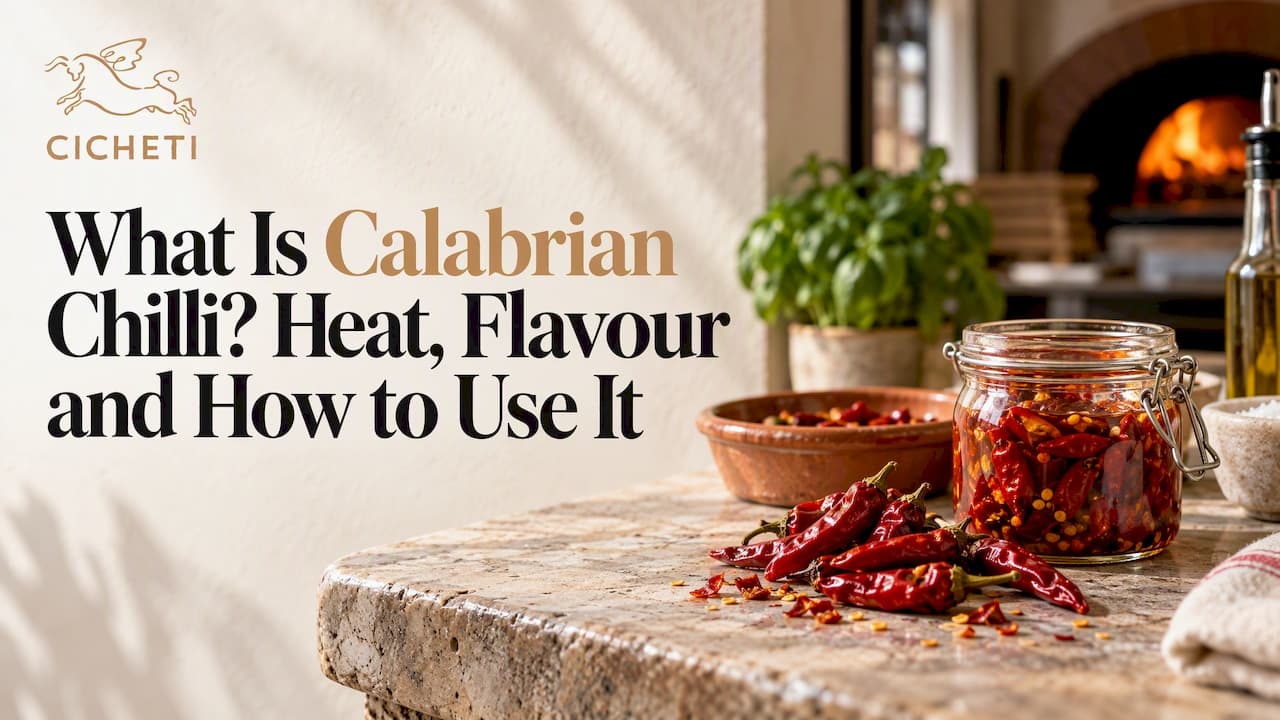
Calabrian chilli is a small, red, tapering pepper from Calabria, the toe of Italy's boot, and it is used fresh, dried, crushed, or preserved in olive oil as whole chillies or a paste. It sits at roughly 25,000 to 40,000 Scoville heat units, so it is properly hot, but it tastes fruity and a little smoky before the heat arrives. That is why cooks reach for it rather than for plain chilli flakes.
If you have seen a jar of red paste on a pizzeria counter and wondered what you were looking at, this is the guide. We'll cover what the chilli is, how hot it gets, what to do with the jar, and how not to ruin a good sauce with it.
TL;DR
- Calabrian chilli is a family of Capsicum annuum peppers grown in Calabria, southern Italy, not one single variety.
- Expect heat in the region of 25,000 to 40,000 SHU, well above a jalapeño, with fruity, tangy and smoky notes.
- The paste is salty and concentrated, so use it as an accent, a teaspoon at a time.
- Buy whole chillies in oil if you cook often: you can blend your own paste and keep the oil as a finishing condiment.
- It's said kuh-LAY-bree-un, and it works on pizza, pasta, eggs, roast vegetables and cheese.
Table of Contents
- What Calabrian chilli actually is
- How hot is it?
- What it tastes like
- Whole, paste, flakes or bomba: what's in the jar
- Calabrian chilli uses in the kitchen
- Make your own paste at home
- Where to find it in Singapore
- Calabria itself, if you're planning a trip
- Our view at Cicheti
- Eat with us at Cicheti
- FAQ
- Sources
What Calabrian chilli actually is
The name is an umbrella. Calabria grows a good many chillies, and the regional tourism board describes a diverse array of Capsicum annuum varieties that differ in look and aroma. The best-known shape is the red, tapered, horn-like fruit, though round and elongated types are grown too, as one Calabrian producer notes. Names you may run into include naso di cane (literally "dog's nose") and corno di capra ("goat's horn").
There is also an official name. Peperoncino di Calabria is a protected designation, and Italy's product specification defines it as fresh and dried fruits, whole, in pieces, as flakes or as powder, from named Capsicum annuum varieties. In other words, "Calabrian chilli" on a label can mean quite different things, from a protected product to a loosely Calabrian-style jar. Read the label if provenance matters to you.

A word on pronunciation, since it's one of the questions people ask: it's kuh-LAY-bree-un, as the Calabrian tourism site gives it. The Italian word for the chilli itself is peperoncino, and in Calabria you'll hear it constantly.
How hot is it?
Hot enough to notice, not hot enough to flatten a dish. Most retail sources put the typical horn-shaped chilli at 25,000 to 40,000 SHU on the Scoville scale. A jalapeño usually sits well below that, so think of Calabrian chilli as several steps up from a jalapeño and a good way below a bird's eye chilli, which Singapore cooks will know well.
Two caveats keep this honest:
- The official specification allows a much wider range than the jar on your shelf. The figures we've seen for the protected product run from roughly 5,000 to 70,000 SHU, so a given batch can taste milder or fiercer than the headline number.
- Paste is not the same as fresh chilli. Salt, oil and vinegar change how the heat lands, and heat in a jar can feel rounder and slower.
The heat itself comes from capsaicinoids, mainly capsaicin and dihydrocapsaicin, which a 2023 study of Capsicum annuum varieties discusses in detail. For the cook, what matters is that heat builds as you eat, so taste before you add more.
What it tastes like
This is where Calabrian chilli earns its place. The Kitchn describes a bright, fruity flavour with a sweet-tart edge, and a trade piece from Nation's Restaurant News points to fruity, tangy and smoky notes that make it behave more like a spice than a pure heat delivery system.
In practice, that means three things on the plate:
- Fruit and acidity. The tang cuts through fat, which is why it suits salami, cheese and olive oil.
- A little smoke. Enough to give a tomato sauce some backbone without tasting of barbecue.
- Heat that leaves room for the rest. Calabrian cooking tends to use chilli as a warming accent so that olive oil, garlic or tomato stay clearly audible. Chilli there is also something of a good-luck charm, a tradition the Italian agriculture ministry's material touches on.
Once you've tasted it next to ordinary dried chilli flakes, the difference is obvious. Flakes give you heat. Calabrian chilli gives you heat with a point of view.
Whole, paste, flakes or bomba: what's in the jar
The forms are easy to muddle, so here is a plain guide.
| Form | What it is | Best for |
|---|---|---|
| Whole chillies in oil | Whole or halved chillies preserved in oil, sometimes with vinegar and salt | Chopping onto pizza, stirring into sauces, blending your own paste |
| Chilli paste | Crushed chillies blended with oil, salt and often vinegar | Spreading on sandwiches, whisking into dressings, quick pasta sauces |
| Flakes or powder | Dried, crushed fruit | Finishing, dry rubs, anywhere you want heat without moisture |
| Bomba calabrese | A spreadable Calabrian condiment, typically chilli with other ingredients | Antipasti, cheese boards, toast |
On that last one, labels vary. One spice retailer's description lists Calabrian chillies, olive oil, vinegar and salt in its bomba di Calabria paste, while other jars add aubergine, mushrooms or tomato. Check the ingredients list and you'll know what you're buying.
Calabrian chilli uses in the kitchen
The short list of what it does well:
- Pizza. A few chopped chillies from the jar, or a drizzle of the oil, over a finished pizza. Pair it with salami, ricotta or a drizzle of honey.
- Pasta. A teaspoon of paste stirred into a simple tomato sauce, or into olive oil and garlic for a quick aglio e olio with some bite.
- Eggs and sandwiches. Scrambled eggs, a fried egg on toast, or a thin layer under cheese in a toastie.
- Roast vegetables. Spoon it over roast cauliflower, aubergine or potatoes while they're still hot.
- Dressings and aiolis. Whisk the paste into mayonnaise, yoghurt or a vinaigrette. Tasting Table's list of ideas runs to fifteen ways in total, if you want more.
- Cheese. Soft, creamy or sweet cheeses love it. Burrata, mozzarella, whipped ricotta and a spoonful of honey all work.
The common mistake is to treat paste like flakes. The Kitchn warns that its concentrated, salty character can quickly overwhelm a dish. Start with a quarter teaspoon per portion, taste, then add more. Remember to reduce the salt elsewhere.
Don't throw the oil away
The oil in a jar of whole chillies has picked up their flavour and colour. Tasting Table suggests using it for finishing pizzas, drizzling over roasted vegetables or emulsifying into dressings and aiolis. We agree, and it keeps the jar from going to waste.

Make your own paste at home
If you cook with it more than occasionally, buy whole chillies in oil and make the paste yourself. Food & Wine describes the method as simple: no mortar and pestle required, a blender or food processor will do.
- Drain the chillies, keeping the oil.
- Blitz them with a little of the oil.
- Stop when the texture suits you: coarse for a rustic spread, smooth for a sauce base.
- Taste, then add more oil, a pinch of salt or a splash of vinegar if you need them.
A small warning for a first batch: wear gloves if you're handling many chillies, and keep your hands away from your eyes afterwards.
Where to find it in Singapore
You don't need to order from overseas. At the time of writing, Marks & Spencer Singapore lists a 180 g jar of its hot Calabrian chilli paste at SGD 8.50. Prices and stock change, so check the page before you go. Italian delis and the specialist aisles of larger supermarkets are worth a look for whole chillies in oil and for bomba-style spreads.
A few tips when you shop:
- Short ingredient lists tend to be a good sign: chillies, oil, salt, perhaps vinegar.
- "Hot" on a label usually means hot, so start small.
- Once opened, keep the jar in the fridge and make sure the chillies stay under a layer of oil.
Calabria itself, if you're planning a trip
Calabria is a long way from Singapore, but the chilli is a decent reason to look at a map. If you want ideas on what to eat and see in the region before you travel, this Calabria travel blog is a useful starting point, even though it's written in Slovenian. Look for the pairing and dish ideas, then ask locals which chilli preserves they'd take home.
Our view at Cicheti
We'll be straightforward: Calabria is not where our cooking comes from. At Cicheti, at 52 Kandahar Street, the kitchen is built around wood-fired Neapolitan pizzas and Venetian-style small plates, cooked by an all-local team. Venetian cicheti are small bites meant for sharing alongside a glass of wine, and our story is also told in our piece on the Venetian bacaro ritual.
So why write about a southern chilli? Because the logic behind it is one we recognise. A good chilli works like a good olive oil: it should make the other ingredients taste more like themselves. Olive oil is something we take seriously, and chilli should be treated the same way: a small amount, chosen with care, added at the right moment.
Here is how we'd use it at home:
- On a pizza, add it after the oven, not before. Wood-fired Neapolitan pizzas cook very fast, and a drizzle of chilli oil on top keeps its fruitiness instead of cooking it away.
- In a sauce, add paste at the start, so the oil carries the flavour through, and taste before you season.
- With wine, look for acidity and freshness. Heat and high alcohol don't get along, which is why a crisp white or a lighter, juicy red usually suits spicy food better than something heavy. Our Sommelier Selection of the day is the easiest way to see how that plays out in the glass.
We haven't confirmed which dishes on today's menu use Calabrian chilli, so please check the current food menu or ask your server if you'd like to know.
— Cicheti
Eat with us at Cicheti
If you'd rather taste a well-made wood-fired pizza than make a jar of paste, we'd be glad to have you at 52 Kandahar Street. You'll find our wood-fired Neapolitan pizzas and Italian wines on the main site, and our family-style menu and Feast of the Seven Fishes for groups at 85 $ and 95 $ per person respectively. For a table of friends or colleagues, private events, handmade pasta and pizza-making workshops are set out on one page. BOOK A TABLE through the site and bring someone who likes a bit of heat.
FAQ
How spicy is Calabrian chilli?
Typically 25,000 to 40,000 Scoville heat units, according to retail and culinary sources, which is noticeably hotter than a jalapeño. The protected designation allows a much wider spread, so batches vary. Taste a small amount first.
Is Calabrian chilli paste the same as chilli flakes?
No. Flakes are dried, crushed chilli and deliver mostly heat. Paste is crushed chilli with oil, salt and often vinegar, so it is salty and moist and has more depth. The Kitchn cautions against using it as though it were flakes.
Do Calabrian chillies have health benefits?
The capsaicinoids that make them hot are studied for antioxidant, anti-inflammatory and antimicrobial activity, as a 2023 paper discusses, but that is laboratory-level research rather than a promise about what a spoonful on pizza will do. If you have reflux, ulcers or another digestive condition, ask your doctor before eating hot chilli regularly.
Can I make Calabrian chilli paste myself?
Yes. Blend whole chillies in oil with a little of their oil until it is as coarse or smooth as you like, as Food & Wine explains. It is often more economical than buying paste if you use it often.
How do you say "Calabrian"?
It's kuh-LAY-bree-un. The region is Calabria, in southern Italy, and the chilli is peperoncino calabrese in Italian.
Sources
- Calabrian Chilli Pepper tour: Scoville, cultivation and uses, Calabria tourism
- Disciplinare Peperoncino di Calabria, Italian ministry of agriculture
- Italian ministry of agriculture (MASAF)
- What Are Calabrian Chiles, The Kitchn
- How to Cook with Calabrian Chiles, Food & Wine
- 15 Delicious Ways To Use Calabrian Chiles, Tasting Table
- Calabrian Chili Paste Recipe, Chili Pepper Madness
- Calabrian: a fruity, smoky flavor from Southern Italy, Nation's Restaurant News
- Phenolic Compounds and Capsaicinoids in Three Capsicum annuum Varieties, MDPI Molecules
- Calabrian Chili Peppers: Scoville Ratings and Uses, A. Conforti
- Calabrian Hot Pepper Paste (Bomba di Calabria), Savory Spice
- Collection Hot Calabrian Chilli Paste, Marks & Spencer Singapore