
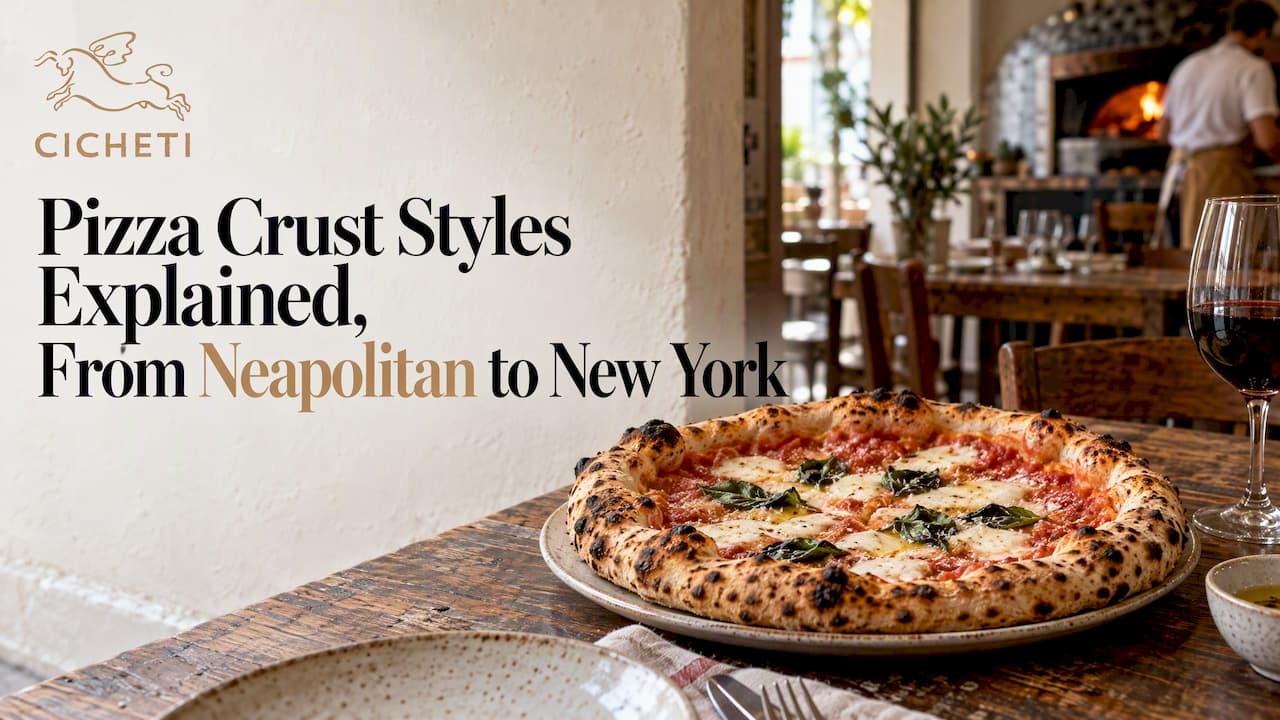
The crust is where a pizza's style is decided, and it comes down to three things: how hot the oven is, how long the pizza stays in it, and how the dough is built. Neapolitan is soft, puffed and blistered, and eaten with a knife and fork. New York is wider, sturdier and crisper, made to be folded. Roman, Detroit and deep-dish are different animals again. Below we explain each one, then say what to order when you sit down.
We cook wood-fired Neapolitan pizzas at Cicheti, 52 Kandahar Street, so that's the style we know best from the inside. We've tried to be fair to the others.
TL;DR
- Neapolitan is a soft, thin-centred pizza with a puffed rim, baked in a wood-fired oven for 60 to 90 seconds. You eat it with a knife and fork.
- New York uses higher-gluten flour and a longer, cooler bake in a gas or coal oven. The result is a crisper, sturdier base that folds.
- Deep-dish, Detroit and Roman crusts are thicker or crunchier, and built around the pan or tray rather than the oven's fire.
- A "regular" crust usually means hand-tossed New York style. A "screen" crust is baked on a perforated metal disc for a crisper base.
- Prefer a lighter, more delicate pizza? Neapolitan is the one to try. Want a slice you can hold in one hand? Look to New York.
Table of Contents
- What a pizza crust actually is
- Neapolitan: soft, quick and a little charred
- New York: wide, foldable and built for a slice
- Why the oven shapes the crust and the toppings
- Other crust styles you'll meet
- Two crust terms worth decoding
- Our view from the oven at Cicheti
- Choosing a crust for how you eat
- A note on pizza and acid reflux
- Try Neapolitan at Cicheti
- FAQ
- Sources
What a pizza crust actually is
A crust is three parts: the base (the thin floor under the toppings), the rim (the edge, which the Italians call the cornicione), and the crumb, which is the airy inside you see when you tear the rim open. Every style plays with the balance between those three.
Flour strength sets the chew. Water content sets how open and tender the crumb is. Fermentation time builds flavour. Then the oven has the final say, because heat is what turns a wet dough into something crisp outside and soft within. Change the oven and you change the pizza, even with identical dough.
The Kitchn's list of pizza types runs to a dozen, from Detroit to New Haven apizza, Sicilian, Grandma and Roman. You don't need all twelve. Most of them are variations on the handful we cover below.
Neapolitan: soft, quick and a little charred
Neapolitan is the most tightly defined style. The Associazione Verace Pizza Napoletana (AVPN), the body that certifies it, sets out its international regulations in unusually exact terms. A pizza that carries the name must not exceed 35 cm across. After baking, the centre should be 0.25 to 0.30 cm thick (with a 10% tolerance), and the raised rim 1 to 2 cm high.
The dough is deliberately plain: flour, water, salt and yeast, with no added fat or sugar. The AVPN also asks for a wood-fired oven and a bake of around 60 to 90 seconds. Its recipe page describes a base temperature of roughly 380 to 430°C. One guide to the style puts the oven at 700 to 1,000°F, with a 60 to 90 second bake, leaving dark charred spots across a pillowy, chewy crust.
What does that mean on the plate? The centre stays soft and slightly wet, so it doesn't stay stiff when you lift it. The rim is airy with a thin, blistered skin. The char gives a faint bitterness that balances the sweetness of tomato. It's the pizza you cut and eat with cutlery, and nobody at the table will think you're being fussy.
The AVPN's name is limited to two types, the Marinara (tomato, oil, oregano and garlic) and the Margherita. That is a narrow definition, and it's worth knowing that many excellent Neapolitan-style pizzas, including with other toppings, sit outside it. Whether a pizza is certified and whether it is good are two different questions.

New York: wide, foldable and built for a slice
New York pizza grew out of the Neapolitan tradition but changed with the ovens. Eater's guide to New York pizza styles notes that the earliest versions, sometimes called Neapolitan-American, shared a lot with the original: a thin crust, a light layer of tomato and a scattering of fresh mozzarella.
The modern version is different in practice. It typically uses higher-gluten flour and a gas or coal oven, with a longer bake of around 12 to 15 minutes at a lower temperature. Gluten is the protein network that gives dough its stretch, and more of it means a base that can hold its own when you fold the slice in half. Patsy Grimaldi, a veteran New York pizza maker, describes the New York slice as completely covered in cheese with a slightly crunchy crust.

So the difference between the two is roughly this: Neapolitan is soft, fast and fresh, while New York is crisp, sturdy and portable. Neither is the "real" pizza. They answer different questions, one about how to cook a dough in seconds, the other about how to sell a big slice from a counter.
Neapolitan and New York side by side
| Neapolitan | New York | |
|---|---|---|
| Oven | Wood-fired | Gas or coal |
| Bake time | About 60 to 90 seconds | About 12 to 15 minutes |
| Flour | Type 0 or 00 under AVPN rules | Higher-gluten |
| Centre | Thin, soft, a little wet | Thin but firm and crisp |
| Rim | Puffed, airy, charred in spots | Smaller, chewier, crunchy |
| Size | Up to 35 cm (AVPN) | Large, often sold by the slice |
| How you eat it | Knife and fork | Folded, in your hand |
Why the oven shapes the crust and the toppings
Oven heat doesn't only change the crust. It changes what you can put on top. A very hot wood-fired oven cooks a pizza before moisture has time to pool, which is why delicate, fresh ingredients such as fresh mozzarella work. A cooler gas oven needs a longer bake, so New York places generally reach for aged, low-moisture mozzarella to stop the pizza turning soggy or rubbery. That point is made by Grimaldi in the same interview.
The principle is the same one bakers use with bread. Intense heat and the right moisture at the start of a bake decide how crisp the outside gets while the inside stays tender. If you're curious about that side of it, a French bakery has written a useful piece on getting a crisp crust on sourdough bread (in French), and many of the ideas carry over to pizza dough.
For a diner this has a practical upshot. If a menu lists fresh mozzarella and a very short bake time, expect a soft, wet-centred pizza. If the pizza arrives in a big flat box with a stiff base, it was probably built for a longer bake and a firmer crumb.
Other crust styles you'll meet
Outside those two, these are the ones that come up most often.
- Roman (pizza al taglio and tonda). Roman pizza comes in two main forms: thin and crisp in a round, or baked in a rectangular tray and cut with scissors. The tray version is airy inside with a crunchy base.
- Sicilian and Grandma. Both are baked in a tray, giving a thicker, bready base with a crisp, oily underside. Grandma is generally thinner and more casual than Sicilian.
- Detroit. Rectangular and baked in a deep pan, with a thick, airy crumb and crisp edges. It's often topped with sauce in stripes over the cheese.
- Chicago deep-dish. A tall, buttery crust that works more like a pie, with the toppings and sauce layered inside.
- New Haven apizza. Thin, charred and coal-fired, closer to a Neapolitan in spirit but chewier.
- Thin cracker-style. Regional American versions such as St. Louis are cracker-thin, a world away from the soft Neapolitan centre.
All of these are legitimate. They simply suit different appetites. A deep-dish is a knife-and-fork meal you plan for. A Roman tray slice is a quick lunch. A Neapolitan is something you share across a table with a glass of wine.
Two crust terms worth decoding
The questions we hear most are about the labels on delivery menus.
"Regular" crust. This generally means a hand-tossed, New York-like base that balances chew and crispness, according to Slice's explainer.
"Screen" crust. A screen is a perforated metal disc the pizza bakes on, which spreads the heat evenly and gives a crisper base. The same source says it is common in high-volume delivery kitchens.
"Italian style" crust. This one is slippery. The label usually signals a thinner, lighter base closer to Neapolitan than to the thicker, cheese-heavy Americanised pizzas, but it's applied to many regional variations. If a menu says only "Italian style", ask what the oven is.
Our view from the oven at Cicheti
We run a three-storey shophouse trattoria in Kampong Glam, and wood-fired Neapolitan pizza is the centre of the menu. We say "Neapolitan" because that's the tradition our pizzas come from: a wood-fired oven, a short bake and a soft, blistered crust. We don't claim AVPN certification, and we'd rather you judged the pizza than a badge.
Our kitchen is run by an all-local team, and the pizzas sit beside regionally inspired Italian dishes and Venetian-style small plates. That's where our name comes from. Cicheti (pronounced chee-keh-tee) are the small plates served in Venetian bàcari, the traditional wine bars of Venice. In practice, that means the pizza is rarely eaten alone at our tables. People pass a plate of small dishes around first, then a pizza arrives, and it's usually gone before the conversation has finished.
Here's what we'd tell a curious guest about ordering a Neapolitan-style pizza:
- Eat it fresh. A soft centre is at its best in the first few minutes. That's the main trade-off of the style, and the reason it's best enjoyed at the table.
- Share, and order a second. A pizza of this size isn't built for sharing one between four. Two pizzas among four people, with a few small plates, works well.
- Pair it with something with acidity. Tomato and fresh cheese like a wine with some freshness. Our selection leans towards Italy's lesser-known grape varieties, and the team can steer you.
- Don't ask it to behave like New York. It won't stay stiff when you fold it, and that's by design.
— Cicheti
Choosing a crust for how you eat
Working backwards from the occasion usually helps.
- A sit-down dinner with wine: Neapolitan. The soft centre, the char and the short bake suit a slow meal.
- A fast lunch or a walk-and-eat slice: New York or Roman tray pizza. Both hold up on the move.
- A hungry group that wants one big shared dish: a tray style, such as Sicilian or Detroit.
- Delivery: a firmer, crisper base survives the journey better than a soft Neapolitan centre. If you're ordering in, a thin and crisp style is the safer pick, and it's worth asking the kitchen how a pizza travels.
If you do take a pizza home, our reheating instructions explain how to bring it back to life.
A note on pizza and acid reflux
People with reflux often ask which style is kindest. Tomatoes are acidic, with a pH of roughly 4.3 to 4.9, and combined with high-fat cheese or toppings they can relax the valve between the oesophagus and the stomach. Guidance for people dining out with GERD suggests choosing white-base pizzas (olive oil or pesto), lighter cheese and avoiding very spicy or garlic-heavy dishes, and staying upright for an hour or two after eating.
That is general information, not medical advice. If reflux is a regular problem for you, speak to your GP or a dietitian, and tell the staff about it when you order so they can talk you through the menu. Check our current food menu for what's on offer rather than relying on a general rule.
Try Neapolitan at Cicheti
If this made you curious about a wood-fired crust, come and compare it for yourself. You'll find our wood-fired Neapolitan pizzas at 52 Kandahar Street, and our website lists opening hours of 11:30 to 21:30 daily. Browse the food menu first, or see the dine-in menus.
If you're planning something bigger, our Cicheti Family-Style Menu is $85 per person and the Feast of the Seven Fishes is $95 per person, both on our festive feasts page. Our Sommelier Selection of the day, which ranges from $19 to $90, is on the drinks menu. For groups, our private events page covers pizza-making workshops, wine tasting classes and family-style sharing menus. BOOK A TABLE through cicheti.com, or ENQUIRE TODAY about an event.
If wine is what drew you in, our piece on tasting Italian natural wine before you buy is a good next read.
FAQ
What is the difference between Neapolitan and New York pizza?
Neapolitan is baked in a wood-fired oven for around 60 to 90 seconds, leaving a soft centre and a puffed, charred rim. New York is typically baked in a gas or coal oven for 12 to 15 minutes using higher-gluten flour, which gives a sturdier, crisper base that can be folded. One is eaten with a knife and fork, the other in your hand.
What is a regular pizza crust called?
It usually refers to a hand-tossed, New York-like crust that balances chew and crispness. There's no official standard, so a menu using "regular" or "classic" is describing a middle-of-the-road base, not a specific regional style.
What is screen-style pizza crust?
A screen-style crust is baked on a perforated metal disc, which spreads the heat evenly and crisps the bottom. It's common in high-volume delivery kitchens. It differs from a pizza baked directly on the floor of a hot oven.
What does Italian-style crust mean?
In most cases it points to a thinner, lighter base closer to Neapolitan than to a thick, cheese-heavy Americanised pizza. The term is loose and covers several regional variations, so it's worth asking what oven and dough the kitchen uses.
Which pizza is best for people with GERD?
Guidance for people with reflux suggests white-base pizzas, such as olive oil or pesto, with lighter cheese and no heavy spice or garlic. Individual triggers vary, so see your GP or a dietitian for advice that fits you.
Sources
- AVPN International Regulations 2024
- AVPN: Neapolitan pizza recipe
- The Kitchn: 12 Best Types of Pizza
- Eater NY: A Complete Guide to New York City Pizza Styles
- Slice: The Difference Between New York and Neapolitan-Style Pizza
- The Daily Meal: Patsy Grimaldi on New York and Neapolitan Pizza
- Food & Wine: The Essential Regional American Pizza Styles
- CookingIsCool: Why Does Pepperoni Pizza Upset My Stomach?
- Food Guides: Dining Out Options with GERD