
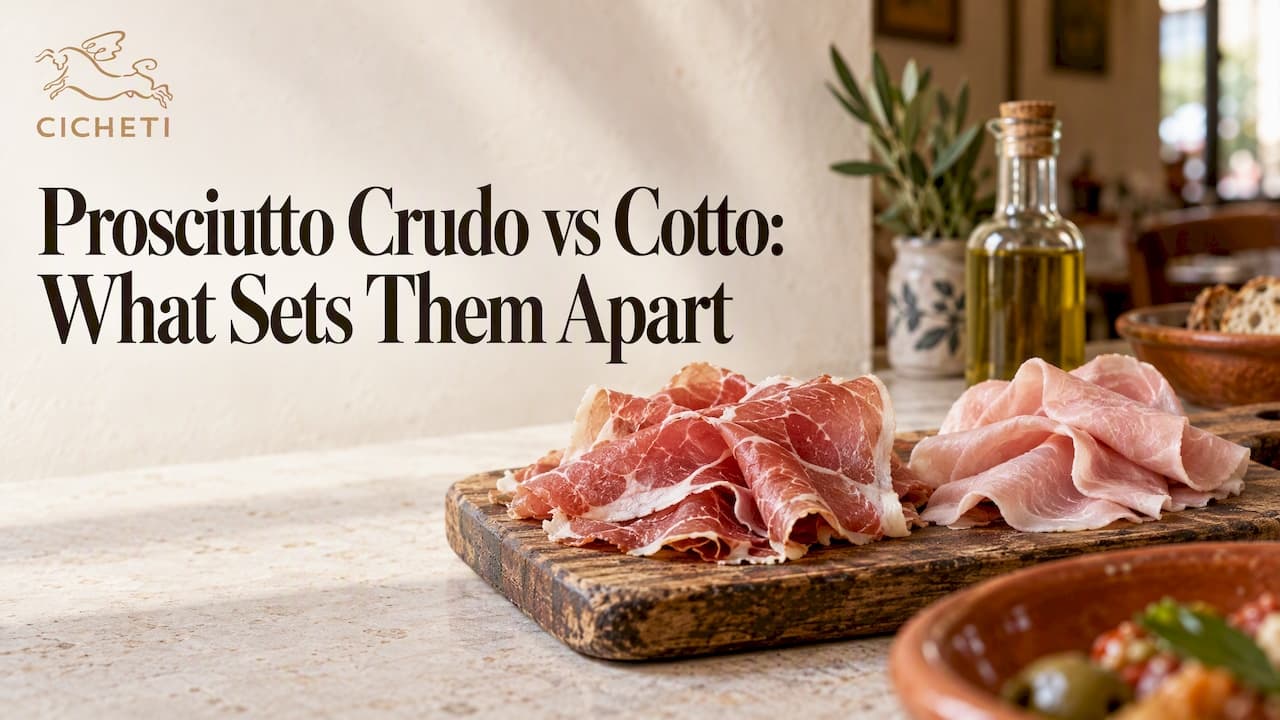
Prosciutto crudo is a pork leg cured with salt and time, then sliced thin and eaten as it is. Prosciutto cotto is a pork leg that has been brined and cooked, so it tastes like a softer, sweeter and far less salty ham. They share a name and a pig, and not much else. If you're choosing between them for a board, a sandwich or a pizza, the short answer is that crudo suits anything where you want a savoury, silky note, and cotto suits anything where you want gentle, juicy ham.
TL;DR
- Crudo means "raw", but it is salt-cured for months and eaten without cooking. Cotto means "cooked", and it is.
- Crudo is saltier, firmer and more intense. Cotto is tender, milder and slightly sweet.
- Per 100g, crudo has roughly four times the sodium of cotto, according to figures reported by Gazzetta dello Sport.
- On pizza, crudo goes on at the end or very late, so it stays silky. Cotto copes with the oven far better.
- Parma ham is one protected kind of prosciutto crudo, not a synonym for the whole category.
Table of Contents
- The difference in one table
- How prosciutto crudo is made
- How prosciutto cotto is made
- Flavour and texture, side by side
- Nutrition and salt: what the numbers say
- Is prosciutto crudo safe to eat uncooked?
- Crudo and Parma ham: are they the same?
- How to pair each one
- Prosciutto on pizza: before or after the oven?
- Prosciutto at Cicheti
- Our view on choosing between them
- Eat it at the table
- Buying and storing prosciutto at home
- Quick picks by occasion
- FAQ
- Sources
The difference in one table
Before the detail, here is the comparison most people are really after.
| Prosciutto crudo | Prosciutto cotto | |
|---|---|---|
| Literal meaning | Raw (but cured) | Cooked |
| Made with | Pork leg, salt, time | Deboned pork leg, brine, oven cooking |
| Time to make | Cured for 8 to 16 months | Cooked in a day or so once brined |
| Texture | Silky, supple, a little chewy at the edges | Soft, moist, easy to slice thickly |
| Flavour | Savoury, salty, sweet-nutty | Mild, gently sweet, "hammy" |
| Colour | Deep rose to red | Pale pink |
| Typical use | Melon, bread, rocket, cheese, finishing a pizza | Sandwiches, toasties, baked dishes, pasta fillings |
| Sodium per 100g (reported) | About 2600 mg | About 650 mg |
The sections below explain each row, starting with how the two are made, because that explains almost everything else.
How prosciutto crudo is made
Crudo is a patient product. The Istituto Valorizzazione Salumi Italiani, the Italian cured-meat institute, describes it as pork thighs and salt, cured for 8 to 16 months in suitable, controlled environments. There is no cooking step. Salt draws out moisture, the leg dries slowly, and the flavour concentrates.
The institute also describes crudo as a seasoned product made from selected pork thighs using, in its words, hog leg, salt and time, and notes that the traditional examples carry European DOP or IGP protection. Those letters mean the name is tied to a place and a method, which matters when you see "Prosciutto di Parma" or "Prosciutto di San Daniele" on a label.
So is crudo actually raw? Not in the way raw chicken is. The salt and the long drying make it safe and ready to eat for most people, which is why you can drape it over a salad without a second thought. The word "crudo" simply tells you it never met an oven. We come back to who should be a little careful further down.

What the texture tells you
Good crudo is sliced paper-thin for a reason. Cured meat is dense and salty, and a thick slice would be chewy and overpowering. Thin, it almost melts against the tongue, and the fat that rims the slice softens at room temperature. That is why you'll often see it taken out of the fridge a few minutes before serving.
How prosciutto cotto is made
Cotto is closer to what many of us in Singapore grew up calling ham. The Istituto Valorizzazione Salumi Italiani says it starts with hog thighs that are deboned and injected with brine. The meat is then churned so the brine is evenly distributed, placed in moulds and cooked in ovens at 75°C.
That process is quicker and more controlled than curing, and it shows in the result: a pale pink, moist, tender slice that tastes mildly sweet and savoury rather than sharply salty. It is also worth knowing that cotto is not an ancient fixture of the Italian table. The Italian encyclopaedia Treccani says cooked ham is not part of Italy's tradition and arrived there relatively recently. In other words, if someone tells you crudo is the "real" prosciutto and cotto is a pretender, they have some history on their side, though cotto is certainly a well-loved everyday ham in Italy now.
Flavour and texture, side by side
Take a slice of each and put them on a plate. You will notice four things.
- Salt. Crudo arrives first as salt, then sweetness, then a faintly nutty, almost buttery finish from the fat. Cotto leads with sweetness and a soft, roasted-pork note.
- Bite. Crudo has a slight resistance, then yields. Cotto has no resistance at all and falls apart in thick slices.
- Intensity. A single slice of crudo can season a mouthful of bread or melon. Cotto needs company, such as mustard, a sharp cheese or something pickled.
- Persistence. Crudo lingers. Cotto is gone quickly, which is exactly what you want in a sandwich where the ham should not shout.
Neither is better. They simply do different jobs, a bit like the difference between a cured anchovy and a poached fish.
Nutrition and salt: what the numbers say
The figures below come from a 2023 Italian report, and they are worth reading as a rough guide rather than a label. Per 100g, prosciutto crudo is reported to contain about 2600 mg of sodium, against 650 mg for cotto. The same article gives 26g of protein and 18g of lipids for crudo, and 19.8g of protein and 14.7g of fat for cotto.

What does that mean at the table? Crudo is more concentrated, because curing removes water. It carries more protein and more salt for the same weight. But nobody eats 100g of crudo in one go. A typical serving on a board or a pizza is a few slices, so the salt you actually take in is smaller than the headline number suggests. Still, if you're watching your sodium, cotto is the milder choice, and crudo is something to enjoy in small, deliberate amounts.
Is prosciutto crudo safe to eat uncooked?
For most healthy adults, yes: that is how it is meant to be eaten. Curing, not cooking, is what makes it ready to eat. The honest caveat is for people with a higher risk from foodborne illness.
In Singapore, the Singapore Food Agency says people with weakened immune systems, especially organ-transplant recipients or those with chronic liver disease, and pregnant women in their second or third trimester, are at increased risk of severe outcomes from hepatitis E. That page is about pork-related risk in general, not prosciutto in particular, so if you fall into one of those groups, ask your doctor or obstetrician whether cured, uncooked pork is suitable for you.
The Italian press is blunter about pregnancy: the Gazzetta piece says cotto is the usual preference for pregnant women, because cooking eliminates bacteria such as Toxoplasma, Salmonella, Listeria and E. coli. If you are pregnant and booking a table, tell your server, who can steer you towards dishes without cured meats.
Crudo and Parma ham: are they the same?
Not quite. Prosciutto crudo is the broad category of dry-cured ham. Parma ham is one specific, protected example. The Consorzio del Prosciutto di Parma says Parma Ham is made by curing a pork leg with pure sea salt, and that controlled salt absorption and moisture loss concentrate the flavour while keeping the meat supple.
So every Parma ham is a prosciutto crudo, but not every prosciutto crudo is Parma ham. San Daniele is another protected name, and plenty of good crudo carries no name at all. When a menu says "prosciutto di Parma", it is telling you exactly which one you're getting.
How to pair each one
Pairing follows the personality of each ham.
Crudo
Crudo likes contrast: something sweet, fresh or creamy to sit against the salt. Melon is the classic. In Singapore, NTUC FairPrice notes that prosciutto is commonly served cold with rock melon, and the same page mentions it on pizza and in a panini. Other friends:
- Ripe figs, pears or peaches when in season
- Fresh mozzarella or burrata
- Peppery rocket with shaved hard cheese and olive oil
- Plain bread or a crisp flatbread
- A dry sparkling or a crisp, mineral white
Cotto
Cotto likes company that holds its own: mustard, pickles, melted cheese, bitter leaves, and bread with some crust. It is the better choice for a hot sandwich, a baked pasta or a béchamel-led dish, where crudo would turn tough and salty.
Prosciutto on pizza: before or after the oven?
This is where the two hams really part ways, and it is the question behind most searches about prosciutto on pizza.
Cotto is happy in the oven. It is already cooked, it holds moisture, and it warms through without much drama. Crudo is a different story. The pizza-oven makers at Forno Bravo put it plainly in a piece by Peter Reinhart: prosciutto can be baked on the pizza, which makes it saltier and more intense, or added after baking, and longer cooking dries it and can crisp it.
That gives you two honest options.
- Add crudo after baking. The heat of the base softens the slices, the fat turns glossy, and the texture stays silky. This is the classic approach, and it works especially well with a peppery topping such as rocket.
- Bake it. You get a saltier, chewier, almost crisp-edged ham. It is a legitimate style, just a different one.
There is no single rule, but the question to ask is what you want: silk or crunch. If you want silk, finish it fresh.
Why wood-firing changes the answer
A Neapolitan pizza bakes fast, in a wood-fired oven that runs very hot. That speed is the reason pizzas from these ovens come out with a soft, blistered rim and a tender middle, and it is also why delicate toppings are best added once the pizza leaves the oven. A slice of crudo laid on a dough straight from the fire warms just enough to release its aroma without drying out. If you're curious about how different doughs behave under heat, our guide to pizza crust styles from Neapolitan to New York goes into the details.
Prosciutto at Cicheti
At Cicheti, 52 Kandahar Street, the food menu lists a Prosciutto e Rucola pizza: fior di latte, prosciutto di Parma, arugula, shaved parmigiano and extra virgin olive oil. Those are the ingredients as listed. The pairing logic is the one described above: salty cured ham, peppery leaves, a little hard cheese for depth and a creamy mozzarella to soften everything.
We do not list a cotto-based dish on that menu, so for this article crudo is the ham to look for with us. If you have dietary needs, the menu asks you to tell your server about allergies or dietary requirements, and it is worth doing that before ordering anything with cured meat.
Our view on choosing between them
We cook with wood fire, and we've learned to respect what heat does to delicate ingredients. Our own rule of thumb is simple. Ask what the ham is there to do. If it is the star, give it a plate where it can be tasted on its own or alongside something fresh. If it is a supporting player in a hot dish, pick the cooked one. A great cured ham deserves not to be hidden under a blanket of melted cheese, and a good cooked ham deserves not to be asked to behave like something it isn't.
It is also why a pizza topped with prosciutto di Parma and rocket is a very different experience from a cooked-ham pizza, even though both would be described as "prosciutto pizza" by anyone in a hurry. When you order, it helps to be precise, and we are always glad to talk you through it.
— Cicheti
Eat it at the table
If you'd rather taste than read, come and share a pizza with us. The Prosciutto e Rucola is on the food menu, alongside our wood-fired Neapolitan pizzas and a list of Italian wines. Bring a few friends and order a few things to share: our guide to family-style Italian dining in Singapore explains how to pace it.

If you'd like to see everything we do, visit Cicheti online and book a table, or look at our dine-in menus. For groups, the private events page has the details.
Buying and storing prosciutto at home
A few practical habits make a real difference, whichever one you buy.
- Buy it sliced to order, or in a sealed pack with a recent date. Thin slices dry out and oxidise quickly once exposed to air.
- Keep crudo and cotto separate. Their moisture levels and shelf lives are different, and the strong flavour of crudo travels.
- Serve crudo slightly cool, not fridge-cold. A few minutes at room temperature, in Singapore's warmth, is plenty. The fat softens and the aroma opens up.
- Finish cotto gently. If you heat it, do so briefly, so it stays tender rather than turning rubbery.
- Read the label. "Prosciutto" alone doesn't say which kind you've got. Look for "crudo", "cotto", "cooked" or a protected name such as Parma.
And if a sandwich or a toastie is the plan, remember that crudo toasted in a press tends to go hard and salty. Use cotto there, and save crudo for the cold plate or for the top of a finished pizza.
Quick picks by occasion
- A cheese and charcuterie board: crudo, in thin slices, with fruit and bread.
- A grilled cheese or panini: cotto, with a sharp cheese and mustard.
- A salad with melon or figs: crudo.
- A baked pasta or gratin: cotto.
- A pizza with rocket: crudo, added at the end.
- A child's lunchbox sandwich: cotto, for the milder flavour and lower salt.
FAQ
What's the difference between prosciutto cotto and crudo?
Crudo is a pork leg cured with salt for months and eaten without cooking. Cotto is a deboned, brined pork leg cooked in an oven. Crudo is saltier, firmer and more intense, while cotto is softer, paler and milder.
What is the best type of prosciutto?
There isn't a single best one, because the right choice depends on the dish. For eating cold with melon, cheese or bread, a good crudo such as a protected Parma ham is the usual favourite. For hot dishes and sandwiches, cotto is the better fit.
What is the difference between prosciutto crudo and Parma ham?
Prosciutto crudo is the general term for dry-cured ham. Parma ham is a specific protected crudo, made by curing pork leg with sea salt in a defined area. All Parma ham is crudo, but not all crudo is Parma ham.
Does prosciutto crudo have to be cooked?
No. Curing with salt over 8 to 16 months makes it ready to eat. People who are pregnant or who have weakened immune systems should ask their doctor before eating uncooked cured pork, as Singapore's food agency highlights higher risks for those groups with pork-related illness.
Should prosciutto go on a pizza before or after baking?
Crudo is usually best added after baking, so it stays silky and doesn't dry out. Baking it makes it saltier and crisper, which some people like. Cotto can go on before baking without trouble.
Sources
- Prosciutto, Enciclopedia Treccani
- Prosciutto, meglio cotto o crudo? Gazzetta dello Sport
- Cooked ham, Istituto Valorizzazione Salumi Italiani
- Prosciutto crudo, Istituto Valorizzazione Salumi Italiani
- Parma ham, Istituto Valorizzazione Salumi Italiani
- Hepatitis E virus and food safety, Singapore Food Agency
- Preparation of Parma ham, Consorzio del Prosciutto di Parma
- Pizza Two Ways, Pizza Quest with Peter Reinhart
- Gourmet 101: Know your specialty meats, NTUC FairPrice