
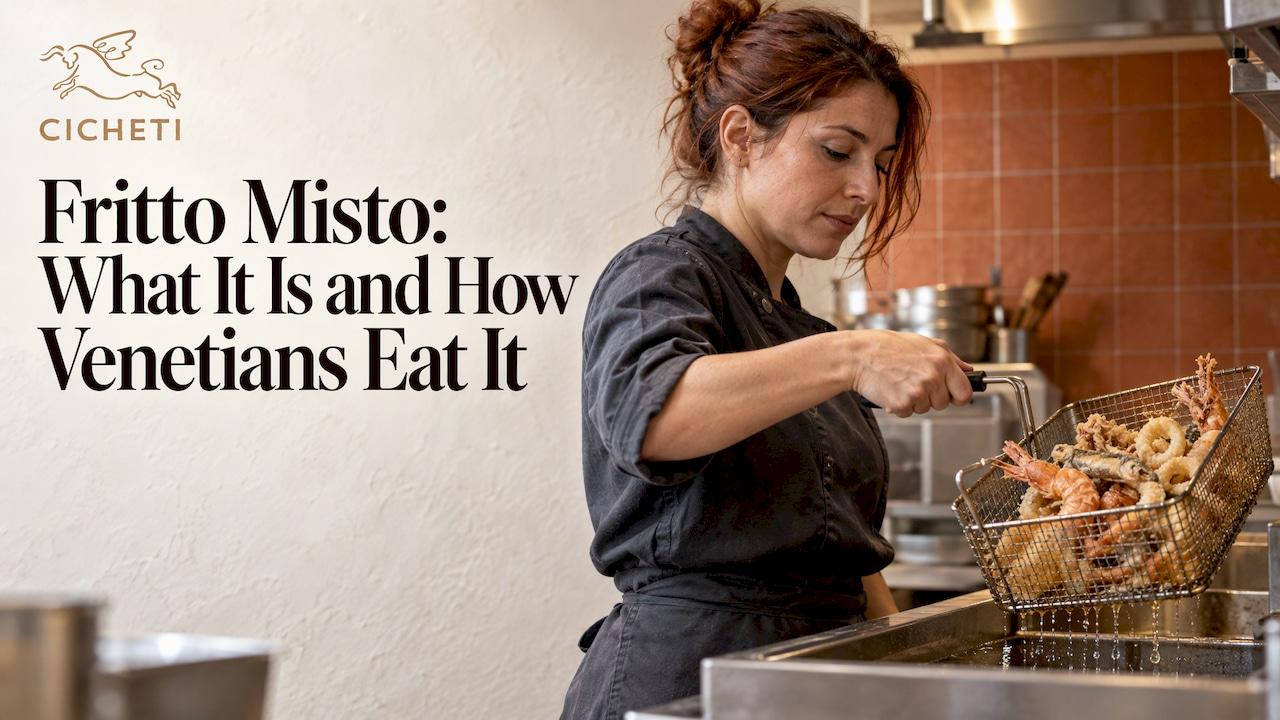
Fritto misto means "mixed fry": small pieces of seafood, vegetables or meat, lightly coated and fried until crisp, then eaten hot with a wedge of lemon. In Venice, the seafood version is the one you will meet most often, and the best ones taste of the sea first and oil barely at all. Below you'll find what goes in, how the regions differ, how to cook it at home and how to order it well.
TL;DR
- Fritto misto is Italian for "mixed fry". It is a plate of bite-size pieces, battered or floured and deep-fried, and it can be seafood, vegetables, meat or all three.
- The coastal version, fritto misto di mare, usually means squid, prawns and small whole fish. Venice leans towards squid, prawns, sardines and sometimes soft-shell crabs, with polenta on the side.
- The coating should be thin. A light dusting of flour or semolina, hot oil and a short cooking time give crispness without heaviness.
- In Italy it is usually a first course or a stand-up antipasto, eaten with fingers and lemon.
- We cook Venetian-inspired small plates at Cicheti, 52 Kandahar Street, and the menu pages below show what's currently served.
Table of Contents
- What fritto misto means
- What goes into a fritto misto
- Venetian fritto misto
- How the regions differ
- Getting the crunch right
- How to serve and eat it
- Is fritto misto healthy?
- Eat Venetian-style at Cicheti
- FAQ
- Sources
What fritto misto means
The name is literal. Fritto is fried and misto is mixed. The Cambridge Dictionary describes an Italian dish of vegetables, meat or small fish covered in flour or batter and fried in deep oil. That's accurate, and also wonderfully vague, which is rather the point. Nobody owns a single recipe.
Katie Caldesi, quoted in Felicity Cloake's Guardian recipe, puts the idea well: everything is bite-size and meant to be eaten with your fingers and a wedge of lemon. If you have eaten tempura, you already understand the format. One recipe page even calls it the Italian equivalent of Japanese tempura, though the Italian coating is usually plainer and drier than a tempura batter.
What goes into a fritto misto
The honest answer is: whatever is good that day. The Guardian's recipe advises being guided by what is freshest at the fishmonger, which it calls the Italian way. That's a sensible rule for a restaurant kitchen too.
Seafood: fritto misto di mare
The coastal classic is known as frittura di paranza in Campania and other parts of the south, and in its Serious Eats version it features shell-on shrimp, squid and small whole fish. Further along the coast, the mix can include baby octopus, calamari rings, cod, sardines, shrimps and whitebait, and it is often named after where it comes from, such as fritto misto ligure or fritto misto della laguna.
Shell-on prawns earn their place for practical reasons. Sasha Marx explains that the shells protect the meat from overcooking and crisp up into a crunchy, edible coating, so you don't need a heavy dredge. The Guardian makes the same point: prawns stand up best to fierce heat, even more so with the shells left on.
Vegetables
Fennel, courgette, green beans and peppers all turn up. Fennel is a favourite because it softens and sweetens in the oil while keeping a little bite. The Guardian's four-serving recipe pairs two fennel bulbs with squid, prawns, whitebait, sage leaves and anchovy fillets, so vegetables and herbs are not an afterthought.
Meat, offal and the odd sweet
This surprises people. The Roman street version was frugal and often made of offal and vegetables, while a more upmarket Bologna version used prime cuts such as strips of lamb and chicken. Some variants even add sweet elements, such as fried apples or amaretti di Saronno biscuits.
Venetian fritto misto
Venice is the angle most readers are curious about, and the answer is mostly in the lagoon. Alan Davidson's 1972 Mediterranean Seafood, quoted by the Guardian, says a typical Venetian mix is drawn from inkfish or squid, soft-shell crabs, prawns or shrimp, eel and sardines, whereas in Naples the list would be shorter.
A Venetian recipe from Al Covo, published by Saveur, adds small shrimp, sole, squid and bay scallops alongside green beans, red pepper and courgette, in a batter of flours and sparkling mineral water. Another Veneto recipe lists cod, sardine fillets, giant prawns, scallops and squid rings, and notes that the traditional side in the Veneto is a piece of polenta. Polenta is a sensible partner: soft or grilled, it soaks up the lemon and the last of the salt.
If Venetian small plates are what draw you in, our guide to Venetian food specialties walks through the classics and how to eat them. At Cicheti we cook Venetian-style small plates alongside our wood-fired Neapolitan pizzas, and fritto misto sits naturally in that world of shared, bite-size food.
How the regions differ
One dish, many families. La Cucina Italiana notes that in Liguria you might find a fritto misto of only anchovies, in Le Marche olive all'Ascolana (meat-stuffed fried olives) may join in, and the Piedmontese version is built on meat and vegetables, with offal such as veal liver.

Piedmont takes it furthest. Fritto misto alla piemontese traditionally runs to no fewer than eighteen items, savoury and sweet, from veal and pork sausages to semolina, macaroons, apples, artichokes and courgettes. In Rome, the Los Angeles Times notes that the deep-frying method comes originally from the Roman Jewish kitchen, where the dish is called pezzetti fritti, or "fried pieces".
Even the frying fat has regional opinions. According to the Accademia Italiana della Cucina, Pellegrino Artusi observed that Tuscans fry with oil, Emilians with lard and Lombards with butter. The same publication traces the dish back to a 1148 document and to Bartolomeo Scappi's 1570 cookbook, which already gave recipes for fried vegetables, fish and shrimp. So this is not a trend. It is very old cooking.
Getting the crunch right
If you are cooking fritto misto at home, a few principles matter more than the recipe.
- Keep the coating thin. Serious Eats describes the traditional frittura di paranza dredge as semola rimacinata (finely ground semolina) or plain flour, tossed until just coated. It is much lighter than the dredge used for Italian-American fried calamari.
- Use very cold liquid if you batter. The Guardian's batter uses 125g plain flour, 25g cornflour and 250ml very cold sparkling water. The bubbles and the cold keep the coating light.
- Fry in batches, hardest ingredients first. America's Test Kitchen suggests fennel and similar vegetables first, then shrimp and fish, and calamari last, holding finished batches on a wire rack in a 200-degree oven so they stay crisp.
- Fry briefly. La Cucina Italiana's recipe dredges the fish, shakes off the excess and fries it straight away in plenty of hot oil for a couple of minutes until golden.
- Salt and lemon at the end. Andrew Zimmern's rule is simply sea salt and lemon, so the fish, squid and shrimp can speak for themselves.
The pattern here is restraint. A fritto misto that arrives pale gold, rustling and not at all greasy has usually been fried hot, fast and in small amounts.
How to serve and eat it
In Italy, fritto misto is nearly always a first course, and it works especially well as a bite-size stand-up antipasto. Wikipedia adds that it can also be a one-plate buffet dish or street food, and it records an 1816 engraving of a fryer cooking over an outdoor wood-burning stove while an assistant wraps portions in a paper cone. Paper cones are still the right idea: eat it while it's hot.
A few practical pointers:
- Eat it within minutes. Fried food has a short window, and a table that waits to finish a conversation first will get a softer dish.
- Squeeze lemon over it only when you are ready to eat, not before.
- Pair it with something crisp and sharp. A lively white or a sparkling wine suits fried seafood, and the hour before dinner is its natural home, which is where our piece on aperitivo culture comes in.
- Plan it as a shared starter. It is built for the middle of the table, which makes it a good fit with family-style Italian dining.
- If someone at the table avoids seafood, vegetable-only versions exist, and our guide to vegetarian Italian dishes covers what to order instead.
If you are building a seafood spread at home, these seafood platter ideas are a useful starting point for what to put alongside the fried pieces.
Is fritto misto healthy?

It is a fried dish, so treat it as a treat to share rather than a daily plate. The protein is real, but frying adds fat and calories. The USDA's entry for breaded and fried shrimp shows 242 kcal and 12.28g of fat per 100g, and one New York Times recipe's automated estimate, for four to six servings, was 1781 calories per serving, with 155g of fat. That figure is an estimate and depends heavily on how much oil clings to the food and how big the portion is.
A thin coating, hot oil and a good drain on paper or a rack all help keep a portion lighter. If you have a medical condition that affects what you can eat, such as high cholesterol or a seafood allergy, ask your doctor or dietitian before ordering fried dishes, and tell the restaurant about allergies when you book.
What we think about fritto misto
We cook for people who want to share, so fritto misto makes sense to us: small pieces, one plate, everyone reaching in. At Cicheti, our all-local kitchen team cooks regionally inspired Italian dishes and Venetian-style small plates, and wood-fired Neapolitan pizzas sit alongside them.
Our view is simple. Good fried food is about timing and restraint, a thin coating, hot oil and a plate that reaches the table straight away. We'd rather the sea, the vegetable or the lemon be the loudest thing on the plate.
Pair it with one of our curated Italian wines, many from lesser-known varietals, and you have the beginning of a very good evening.
Cicheti
Eat Venetian-style at Cicheti
We're at 52 Kandahar Street, in Singapore's Arab quarter, serving Venetian-inspired small plates, wood-fired Neapolitan pizzas and Italian wines in a rustic, modern trattoria. Our menus change, so please look at the food menu and the dine-in menus for what is being served now, rather than assuming a dish is on.

For a bigger table, our Cicheti Family-Style Menu is $85 per person, and the Feast of the Seven Fishes is $95 per person; both are listed on the same page, so check there for current availability. Our Sommelier Selection of the day runs from $19 to $90 on the drinks menu. Ready to go? BOOK A TABLE through cicheti.com, or ENQUIRE TODAY about private events.
FAQ
What is fritto misto?
It is an Italian dish of mixed pieces of fish, vegetables or meat, coated in flour or batter and deep-fried. The name means "mixed fry". Wikipedia describes it as popular in various Italian regions, so there is no single standard recipe.
What is fritto misto di mare?
This is the seafood version. It typically features shell-on prawns, squid and small whole fish, and in southern Italy it is also called frittura di paranza. The exact mix follows what is freshest from the fishmonger that day.
What makes Venetian fritto misto different?
Venice draws on lagoon and Adriatic seafood, such as squid, soft-shell crabs, prawns, eel and sardines. Polenta is the traditional side in the Veneto. Naples, by comparison, typically uses a shorter list of seafood.
How do you keep fritto misto crisp?
Use a thin coating, hot oil and small batches, and fry the firmer items before the delicate ones. Keep finished pieces on a wire rack rather than a plate, and serve straight away with lemon and salt.
Is fritto misto the same as tempura?
The idea is similar: small pieces, quickly fried. The Italian version generally uses a plainer flour, semolina or light batter, and is served with lemon rather than a dipping sauce. Many cooks also treat it as a starter rather than a main.
Sources
- FRITTO MISTO definition, Cambridge English Dictionary
- How to make the perfect fritto misto, The Guardian
- Fritto Misto di Mare (Fried Mixed Seafood), Serious Eats
- Fritto misto, Wikipedia
- Fritto Misto (Mixed Fried Seafood and Vegetables), Saveur
- Fritto Misto, zainoo.com
- Fritto Misto di Pesce, La Cucina Italiana
- The Piedmontese mixed fried food, La Cucina Italiana
- Pezzetti Fritti Recipe, Los Angeles Times
- Civiltà della Tavola, Accademia Italiana della Cucina
- How to make fritto misto, America's Test Kitchen
- Fritto Misto di Mare Recipe, The New York Times
- Seafood platter ideas