
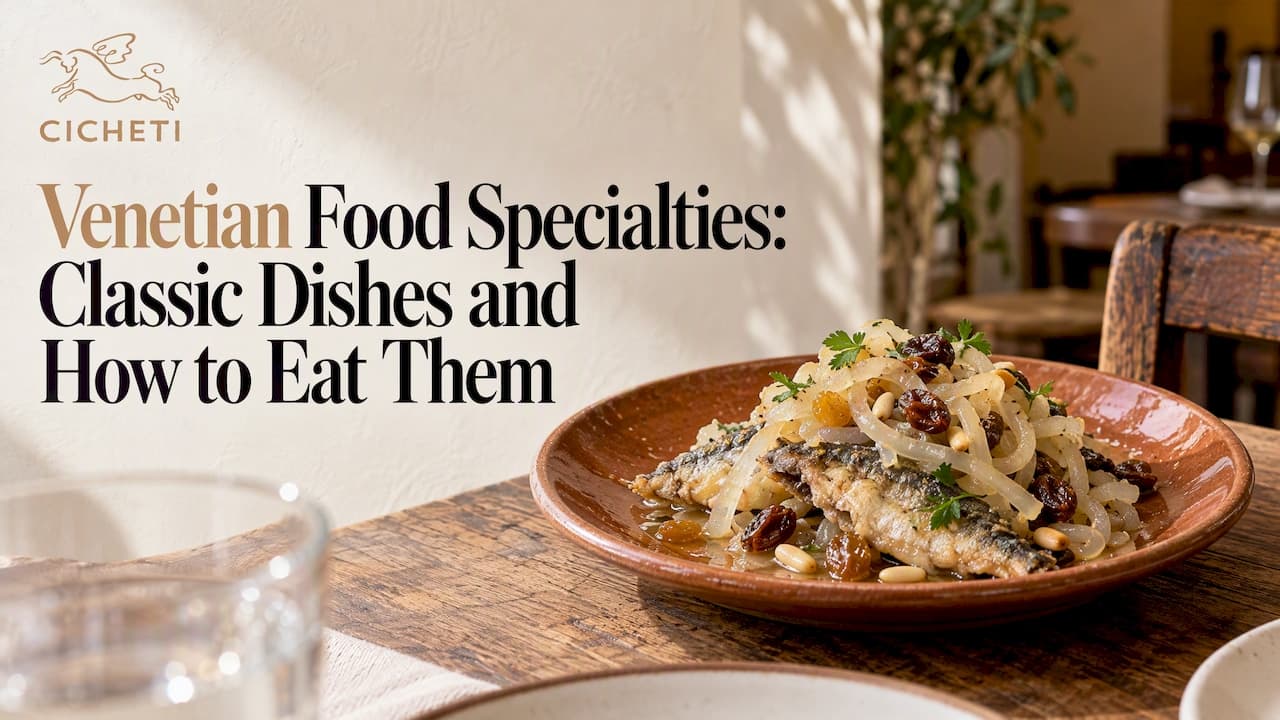
Venetian cooking starts with the lagoon, not the pizza oven: think salt cod whipped into a cloud, sweet-sour sardines, black pasta and small plates eaten standing up with a glass of wine. If you want the short list, it is cicchetti, bigoli in salsa, sarde in saor, baccalà mantecato, risi e bisi, fegato alla veneziana and a few biscuits and a tiramisù to finish. Below, we explain what each one is, how it tastes and how to order it, and how this style of eating translates to a table at Cicheti, 52 Kandahar Street.
TL;DR
- Venetian food is built on fish, rice, polenta and onions, shaped by the lagoon and centuries of trade.
- The defining format is cicchetti: small bites eaten with an ombra, a small glass of wine, at a bacaro.
- Dishes to know: bigoli in salsa, baccalà mantecato, sarde in saor, risi e bisi, spaghetti al nero di seppia and fegato alla veneziana.
- Order several plates to share and let the table build the meal, which is how Cicheti's Venetian-style small plates are meant to be eaten.
- Menus change, so check the current Cicheti food menu before you book.
Table of Contents
- What makes a dish Venetian
- Cicchetti: the small plates that define Venetian eating
- First courses: bigoli, risi e bisi and black pasta
- Fish from the lagoon: baccalà, sardines and fritto misto
- Meat and offal: fegato alla veneziana
- Sweets: bussolai, tiramisù and what to drink with them
- What to drink with Venetian food
- Our view: why Venetian eating suits a Singapore table
- Eating Venetian-style at Cicheti
- Book a table at Cicheti
- FAQ
- Sources
What makes a dish Venetian
Venetian cuisine reflects a long history in which talents, traditions, products, flavours and raw materials have met, as Italia.it, Italy's official tourism portal, describes it. That sounds abstract until you look at a plate. Sardines and anchovies sit beside spices and dried fruit that arrived by ship. Rice and polenta take the place of the wheat pasta you might expect further south. Fish arrives from a lagoon on the doorstep, and what could not be eaten fresh was salted, dried or pickled in vinegar.
The result is food with a recognisable personality. It leans on sweet and sour, on soft textures (creamy polenta, soft onions, risotto cooked loose), and on small portions designed to be eaten with a drink. It is also food that suits sharing. Few Venetian dishes are about a single large main course, and most reward ordering a little of everything.
One note on terms. A bacaro is a small Venetian bar, and cicchetti (you will also see it spelled cicheti, which is where our name comes from) are the snacks served there. An ombra is the small glass of wine you drink with them. We will come back to all three.

Cicchetti: the small plates that define Venetian eating
If one thing explains Venetian food, it is the bacaro habit. The giro d’ombre is a crawl between bacari, with a glass of wine and a couple of cicchetti at each stop, according to the city's official tourism information. Nobody sits down for three hours. You stand at a counter, eat two things, drink one thing, and move on to the next.
What counts as cicchetti? The range is wide. Think crostini topped with creamy salt cod, small fried morsels, marinated sardines, little meatballs, cured meats and cheeses, boiled egg with anchovy. Polenta has a role here too: in Venice it is served soft and creamy as a base for braised dishes, or grilled in slabs as the base for cicchetti. Grilling gives the slab a lightly crisp edge while the middle stays tender, which is why it holds up to toppings that would turn a slice of bread soggy.
The habit of moving from one bar to the next with a drink and something to eat is not unique to Venice, and other cities have their own versions, from signature drinks in Bruges to a Singapore evening that wanders between shophouse bars. What is distinctly Venetian is the scale: small, cheap, quick, social.
If you would like the full story of the ritual, we have written it up in our guide to cicchetti and the bacaro ritual, no flight required.
First courses: bigoli, risi e bisi and black pasta
Venetian first courses are where the lagoon and the farmland meet. Four dishes come up again and again: bigoli in salsa, fegato alla veneziana, risi e bisi and spaghetti al nero di seppia.
Bigoli in salsa
Bigoli are thick, rough-textured strands of pasta, closer to a fat spaghetti with some bite to it. The salsa is anchovy and onion: the onions are cooked slowly until soft and sweet, the anchovies dissolve into them, and the pasta carries the whole thing. It is salty, savoury and gently sweet at once, and far less fishy than the ingredients suggest, because the anchovies melt into the sauce rather than sitting in it. If you like anchovies on a pizza, this is the same instinct in pasta form. (We have a separate note on why anchovies belong on pizza if you need convincing.)
Risi e bisi
Rice and peas. It sits somewhere between a risotto and a soup, wetter than the former and thicker than the latter, and it is traditionally a spring dish when peas are at their sweetest. Its appeal is its simplicity: the sweetness of the peas against the starch of the rice.
Spaghetti al nero di seppia
Spaghetti coloured with cuttlefish ink. The ink gives a dark, glossy sauce with a deep, briny flavour, rounder and less sharp than you would expect from the colour. Expect black teeth afterwards, and no apologies are required. Order it, enjoy it, then take a discreet look in a mirror before the photographs.
Fish from the lagoon: baccalà, sardines and fritto misto
Fish and seafood are the backbone of the cuisine, and three preparations show why.
Baccalà mantecato
Baccalà is salt cod. Mantecato means whipped or creamed. The dried fish is soaked to remove the salt, gently cooked, flaked, and then beaten with olive oil until it turns pale, fluffy and spreadable, usually with garlic. The texture is the point: it is closer to a mousse than to fish. It is typically spread on toasted bread or grilled polenta and eaten as cicchetti, and it is a good first order for anyone wary of strong fish flavours because it tastes mild and savoury.

Sarde in saor
Sardines fried, then layered with slowly cooked onions in a sweet-sour marinade. The classic version cooks sliced white onions with pine nuts, raisins and bay in oil and white wine vinegar until soft and translucent. The onions are cooled before they meet the sardines, so the fish stays firm rather than overcooking, and the dish is assembled in layers with onions at both the bottom and the top. The word saor means flavour in Venetian dialect, and the same source describes the dish as one that began as food for sailors. The vinegar preserved the fish on long voyages, and today it keeps the dish bright against the richness of fried sardines. It is best made ahead, because it improves after a day of marinating.
Fritto misto
A mixed fry of small fish and seafood, usually squid, prawns and whatever the market offered. Done well, the coating is thin and crisp and the seafood tender inside. It is the dish that arrives at the table in a paper cone in many a seaside restaurant, and it shares well, which is another reason Venetian eating suits a group.
Meat and offal: fegato alla veneziana
Fegato alla veneziana, Venetian-style liver, is one of the city's famous dishes. Thinly sliced liver is cooked quickly with a large amount of soft onions, which turn sweet and almost jammy. Liver cooked briefly stays tender, and the onions soften its mineral edge. It is often served with polenta. If you have bad memories of school liver, this is a different animal: gentler, sweeter, and worth a second chance.
Sweets: bussolai, tiramisù and what to drink with them
Venetian desserts tend to be modest. Bussolai di Burano are light, buttery biscuits from the island of Burano, enjoyed with sweet wines such as Recioto di Gambellara or Recioto della Valpolicella. The idea is to dunk them or sip alongside, a gentle end to the meal.
Then there is tiramisù. It is made with savoiardi dipped in espresso, layered with mascarpone cream and raw egg yolks, and its origin within the Veneto is disputed, so we will leave that argument to the people who enjoy having it. If you are making your own at home, a dark roast works well for the soak, and an Italian roast coffee is the sort of bean to look for.
What to drink with Venetian food
Start small. Cicchetti are accompanied by an ombra, a glass of wine such as Merlot, Cabernet or Pinot Grigio, and spritz is a famous Venetian aperitif. Italia.it also lists Prosecco, Soave, Recioto and Amarone among the wines of the Veneto.
A few pairings follow naturally from the flavours:
- Sweet-sour fish such as sarde in saor: something crisp and dry, such as Soave or a dry sparkling wine, to cut through the vinegar.
- Creamy baccalà mantecato: a sparkling wine, whose bubbles refresh the palate between bites.
- Liver and onions: a medium-bodied red.
- Bussolai or other biscuits: a sweet Recioto, as above.
For a deeper look at the region's bottles, read our guide to the wines of Veneto, from Prosecco to Valpolicella. If you like to drink off the beaten track, our notes on Italian natural wine and orange wine from Italy are a good next step.
Our view: why Venetian eating suits a Singapore table
We think Venetian food works well in Singapore for a simple reason: it was never meant to be eaten alone or in a hurry.
Small plates fit the way people here already eat, with many dishes landing in the middle of the table and everyone reaching across. At Cicheti we pair wood-fired Neapolitan pizzas with Venetian-style small plates, and a table can start with a few bites and a glass before deciding how far the evening goes.
Our kitchen team is all local, and they cook regionally inspired Italian dishes with Mediterranean influences and a modern twist. We would rather you came with curiosity than a script. Our wine list leans towards lesser-known Italian varietals, because the best partner for a plate of small, salty, sharp things is often a grape you have not met yet.
Cicheti
Eating Venetian-style at Cicheti
Here is a practical way to approach it at 52 Kandahar Street, in Singapore's Arab quarter. Do not order one dish each. Begin with the Venetian-style small plates, share two or three between you, and add something from the wood-fired oven, which gives pizza a blistered, lightly charred crust that a conventional oven cannot quite match. Then decide whether you want a pasta to follow.
Plan the order around contrast. Pair something creamy with something sharp, something fried with something soft, and keep a glass of something light alongside. For a larger group, our guide to how to order family-style Italian dining in Singapore walks through quantities, and our Cicheti Family-Style Menu is priced at $85 per person. If you prefer to leave the pairing to us, the Sommelier Selection of the day on the drinks menu is priced from $19 to $90. For vegetarians in the group, our notes on vegetarian Italian dishes are a good place to begin.
Our menu changes, and we only describe dishes we can confirm, so please check the food menu and the dine-in menus for what is on offer when you book. The traditional Venetian dishes above are a guide to the style, not a list of what is on our table tonight.
Book a table at Cicheti
If this made you hungry, the easiest next step is to reserve at Cicheti, where wood-fired Neapolitan pizzas, Venetian-style small plates and a list of lesser-known Italian wines share one rustic, candlelit room. You can also order for delivery or takeaway from the same site.

For larger gatherings, private events at Cicheti can include family-style sharing menus, handmade pasta, pizza-making workshops and wine tasting classes. BOOK A TABLE at cicheti.com, or ENQUIRE TODAY about an event.
FAQ
What are the most famous Venetian food specialties?
Cicchetti are the best known, followed by baccalà mantecato, sarde in saor, bigoli in salsa, risi e bisi, spaghetti al nero di seppia and fegato alla veneziana. Tiramisù and bussolai di Burano cover dessert. Between them they show the cuisine's fondness for fish, rice, polenta and onions.
What are traditional Venetian dishes made of?
The core ingredients are fish and seafood, onions, rice, peas, polenta, anchovies and olive oil. Bigoli in salsa uses anchovy and onion, risi e bisi uses rice and peas, and spaghetti al nero di seppia uses cuttlefish ink. Liver with onions is the best-known meat dish.
What is the difference between cicchetti and tapas?
Both are small bites eaten with a drink, so the idea is similar. Cicchetti are Venetian, traditionally eaten standing at a bacaro with an ombra, a small glass of wine, and often moving to the next bar. The flavours lean on lagoon fish, polenta and cured meats.
What should I drink with Venetian food?
Start with an ombra, a small glass of local wine, or a spritz as an aperitif. For fish dishes choose something crisp and dry, such as Soave or a sparkling wine. With biscuits, a sweet Recioto is the classic partner.
Does Cicheti serve Venetian food?
Cicheti serves wood-fired Neapolitan pizzas and Venetian-style small plates, alongside regionally inspired Italian dishes. Menus change, so check the food menu for the dishes available when you visit.
Sources
- Typical food products in Veneto, Italy (Italia.it)
- Venice and the lagoon: from Giudecca to the islands (Italia.it)
- Crossroads of the world: Jews, Moors and Christians (VeneziaUnica)
- Venetian cuisine: must-try dishes in Venice and Veneto
- Sardines in saor (Cantina Do Spade)