
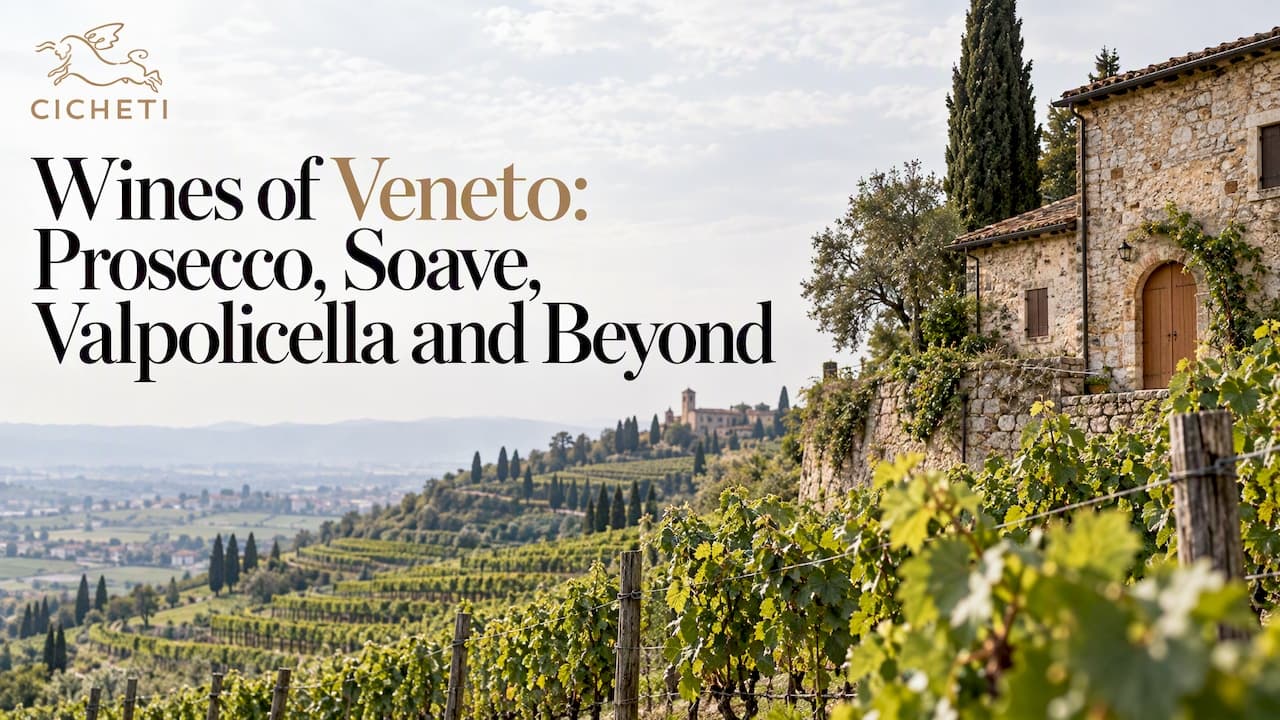
Veneto makes sparkling wine, crisp whites, light summer reds and some of Italy's densest dried-grape reds, so there is no single Veneto taste. The simplest way in is to learn six names: Prosecco, Soave, Bardolino, Valpolicella, Ripasso and Amarone. Once you know what each one does at the table, the rest of the label starts to make sense. We pour a curated list of Italian wines at Cicheti, 52 Kandahar Street, and these are the questions guests ask us most.
TL;DR
- Veneto is a region in north-eastern Italy, not a wine style. Its white grapes outnumber its black grapes by a clear margin, at over 70% of plantings.
- The six names to know are Prosecco, Soave, Bardolino, Valpolicella, Ripasso and Amarone, which are the ones enthusiasts most often cite.
- Valpolicella is one grape blend made four ways: fresh, Ripasso, Amarone and the sweet Recioto.
- On a label, "Classico" and "Rive" point to hillside sites and usually to more character than the broad zones.
- Our drinks menu changes, so ask the team what is open from Veneto on the night you visit.
Table of Contents
- What "Veneto" means on a wine list
- The grapes behind the names
- Prosecco is a pyramid, not a single wine
- Soave: the white that deserves a second look
- Valpolicella: one blend, four wines
- Bardolino: the light red from Lake Garda
- How to read a Veneto label without a dictionary
- Our view from Kandahar Street
- Drinking Veneto wines in Singapore
- Pairing Veneto wines with a Cicheti table
- Book a table or plan a wine evening
- FAQ
- Sources
What "Veneto" means on a wine list
Veneto is the administrative region around Venice and Verona. It is often called a wine factory because of the sheer volume it makes, and part of its weight comes from Pinot Grigio and from the surge in demand for Prosecco. Yet inside that volume sit small pockets of properly site-driven winemaking.
The diversity is physical. Soave grows on volcanic and limestone soils east of Verona, while Bardolino sits on the glacial soils around Lake Garda. Change the soil and the grape, and you change the glass. That is why one guest orders a pale, snappy white and another asks for something that tastes of raisins and cocoa, and both are drinking Veneto.

The grapes behind the names
Most Veneto wines are named after a place, not a grape, which is where the confusion starts. Four varieties carry much of the region's reputation, and three of them, Glera, Corvina and Garganega, are unfamiliar to most people even though the wines are not.
| Wine | Main grape | Style in the glass |
|---|---|---|
| Prosecco | Glera | Sparkling, from Extra Brut to Dry |
| Soave | Garganega | Dry white, usually crisp and mineral |
| Valpolicella, Ripasso, Amarone, Recioto | Corvina and Rondinella, mainly | Light red through to powerful and sweet |
| Bardolino | Similar grapes to Valpolicella | Lighter red, plus the rosato called Chiaretto |
The red grapes are the same family across Valpolicella and Bardolino. That is why a Bardolino and a basic Valpolicella can feel like cousins, and why Amarone is best understood as a technique applied to the same fruit.
Prosecco is a pyramid, not a single wine
Most people meet Prosecco as the easy glass at the start of an evening. Producers see it as a pyramid. At the base is Prosecco DOC, which covers nine provinces across Veneto and Friuli-Venezia Giulia. Above it sit Asolo Prosecco DOCG and, at the top, Conegliano Valdobbiadene Prosecco Superiore DOCG.
The top tier is the historic heartland. The denomination was recognised in 1969 and raised to DOCG in 2009, and it is made across 15 communes on hillsides. In 2024 it produced more than 90.6 million bottles, with Germany, the UK, Austria, Switzerland and the US as the top five export markets, according to the Consorzio's own booklet.
Two label habits help:
- Glera content. In the Conegliano Valdobbiadene DOCG, Glera must make up at least 85% of the blend.
- Sweetness words. Prosecco can be Extra Brut, Brut, Extra Dry or Dry. Counter-intuitively, Extra Dry is sweeter than Brut. If you like your fizz bone dry, Brut or Extra Brut is the safer pick.
If you see "Rive" on a bottle, it denotes wine from a single steep hillside, a step up in site expression from standard Prosecco.
Soave: the white that deserves a second look
Soave is built on Garganega, with other grapes permitted depending on the style. Soave DOC covers the area east of Verona, and the volcanic and limestone soils and the historic Classico zone are what set the better bottles apart from the generic ones.
This is where the "Classico" rule becomes useful. Many Soave and Valpolicella wines are made in both hilly and flat areas, and the Classico zones are the original, higher-quality sites. For everyday value, the broader DOC wines are perfectly sound. For complexity, look for Classico or a named hillside. That is the sort of trade-off worth knowing before you spend.
At the table, a dry Garganega-based white suits the lighter end of a Venetian-style small plate menu: seafood, vegetables, anything where acidity does the work that lemon would otherwise do.

Valpolicella: one blend, four wines
This is the part of Veneto wine that most rewards a little attention. According to the Consorzio Tutela Vini Valpolicella, the area produces four distinct styles from the same blend of grapes, built mainly on Corvina and Rondinella.
Valpolicella
The fresh, light-bodied everyday red. Bright cherry fruit, low weight, and an easy match for pasta, charcuterie and, yes, pizza.
Valpolicella Ripasso
Ripasso is basic Valpolicella refermented on the pomace, the leftover skins, of Amarone or Recioto. The Consorzio describes it as medium-bodied with good alcohol. Think of it as the bridge: more depth than Valpolicella, less heft and expense than Amarone. It is recommended at 15° to 18°C.
Amarone della Valpolicella
Amarone is made from dried grapes. They rest in drying rooms called fruttaio for typically three to four months, which concentrates sugars and flavour before fermentation. The result is powerful and dense, a wine for slow dishes and slow evenings, not a casual first glass.
Recioto della Valpolicella
Recioto is the historical ancestor of Amarone, fermented only partially so that some sweetness remains. It carries higher residual sugar, but its good acidity keeps it balanced rather than syrupy. The Consorzio suggests serving it at 14° to 16°C, which is a little cooler than most people expect for a red.
Bardolino: the light red from Lake Garda
If a guest asks for a light red from the Verona area, Bardolino is usually the answer. It comes from the shores of Lake Garda and uses similar grapes to Valpolicella, but the result is lighter and fresher. Its rosato, Chiaretto, is an easy companion to starters and small plates, which makes it a sensible pick when the table is ordering many things at once.
How to read a Veneto label without a dictionary
- Start with the place name. Prosecco, Soave, Bardolino and Valpolicella are places first and styles second.
- Check the tier. DOC is the broad designation, DOCG the stricter one. Conegliano Valdobbiadene, Amarone and Recioto della Valpolicella are all DOCG.
- Look for Classico or Rive. Both point towards older or steeper sites.
- Match the weight to the meal. Fresh Valpolicella and Bardolino for pizza and pasta, Ripasso for richer sauces, Amarone for the end of a long meal.
A quick word on health, since "which wine is the unhealthiest?" is a common question. There is no single answer. The sensible advice is moderation, and it applies to Prosecco and Amarone alike. The only structural difference is sweetness: Recioto, being sweet, carries more residual sugar than a dry Valpolicella. If you have a medical condition or are on medication, ask your doctor about alcohol before you order.
Our view from Kandahar Street
We built our wine list around Italian wines, with a leaning towards lesser-known varietals, because they tend to show a place more clearly than the big commercial styles do. Veneto is a good example. The region gives you Glera, Garganega and Corvina, grapes that few people could name a decade ago and that reward curiosity.
Our kitchen is run by an all-local team, and the food is Neapolitan pizza from a wood-fired oven alongside Venetian-style small plates. That pairing matters. The wood fire gives pizza a blistered, slightly smoky crust and a fast, hot bake, so a fresh Valpolicella or a crisp white cuts through it neatly. Small plates in the cicchetti tradition are meant to be shared and sampled, so a lighter wine lets you move between dishes without fatigue. If you are curious about the Venetian side of our menu, our piece on Venice's bacaro ritual explains where it comes from.
We would rather tell you what suits your plate than sell you the most expensive bottle. Tell us what you are eating and how adventurous you feel, and we will take it from there.
— Cicheti
Drinking Veneto wines in Singapore
Singapore's heat changes how you pick. Chilled Prosecco, Soave and Chiaretto are natural fits for the climate. A Valpolicella or Bardolino served slightly cool is far more pleasant than a warm, heavy red. Amarone is a cool-room, late-evening wine.
If you want to taste before you commit to a bottle, the Sommelier Selection of the day is priced from $19 to $90. You can also browse the full drinks menu before you book. For wines made with less intervention, our guides to Italian natural wine and orange wine from Italy cover the neighbouring styles.
Pairing Veneto wines with a Cicheti table
We do not publish a pairing chart by dish, and the list changes, so treat these as principles rather than promises of what is on the menu tonight.
- Pizza: a fresh Valpolicella or Bardolino, or a dry Soave if the topping is lighter.
- Small plates and vegetables: Prosecco Brut or Chiaretto. Our vegetarian Italian dishes guide shows what works.
- Richer pasta and sharing mains: Ripasso, which has the body to stand up to a sauce.
- Dessert or a cheese course: Recioto, if it is available.
Sharing a table makes this easier, because everyone can try a different glass. Our piece on ordering family-style Italian dining in Singapore shows how to pace it.
Book a table or plan a wine evening
If you want to taste your way through the region, the simplest route is to come in, sit down and ask. The Cicheti Family-Style Menu is $85 per person and the Feast of the Seven Fishes is $95 per person, both on our festive feasts page. For a group, a wine tasting class or a pizza-making workshop, see our private events page. Prices and availability for the classes and workshops are not published, so please enquire directly. BOOK A TABLE at Cicheti, or ENQUIRE TODAY about an event.
FAQ
What are the main wine regions and appellations in Veneto?
The names you will meet most often are Prosecco (including Conegliano Valdobbiadene and Asolo), Soave, Bardolino and Valpolicella with its Ripasso, Amarone and Recioto wines. Prosecco DOC covers a wide area across Veneto and Friuli-Venezia Giulia. Valpolicella, Soave and Bardolino are tighter zones around Verona and Lake Garda.
What are the main grape varieties in Veneto?
Glera makes Prosecco, Garganega makes Soave, and Corvina with Rondinella forms the base of Valpolicella and its relatives. Pinot Grigio is also grown in large volumes. White varieties make up over 70% of the region's vineyards.
What is a light red wine from Verona?
Bardolino is the classic answer, made on the shores of Lake Garda. A basic Valpolicella is similarly fresh and light. Both are good choices if you find bigger reds too heavy for warm evenings.
What does Ripasso mean, and how is it different from Amarone?
Ripasso is Valpolicella refermented on the pomace of Amarone or Recioto, which gives it extra depth and body. Amarone is made from grapes dried for several months before fermentation, so it is more concentrated and powerful. Ripasso is the more flexible food wine, and Amarone is usually the more expensive bottle.
Sources
- A Beginner's Guide to the Wines of Veneto, Wine Enthusiast
- Wine Grapes of Veneto, Quattrocalici
- Regional Roundup: Veneto, Italian Wine Central
- Prosecco booklet, Consorzio Conegliano Valdobbiadene
- Denomination data sheet 2024, Prosecco.it
- Soave, Superiore.de
- Consorzio Tutela Vini Valpolicella
- Valpolicella Ripasso DOC, Consorzio Tutela Vini Valpolicella