
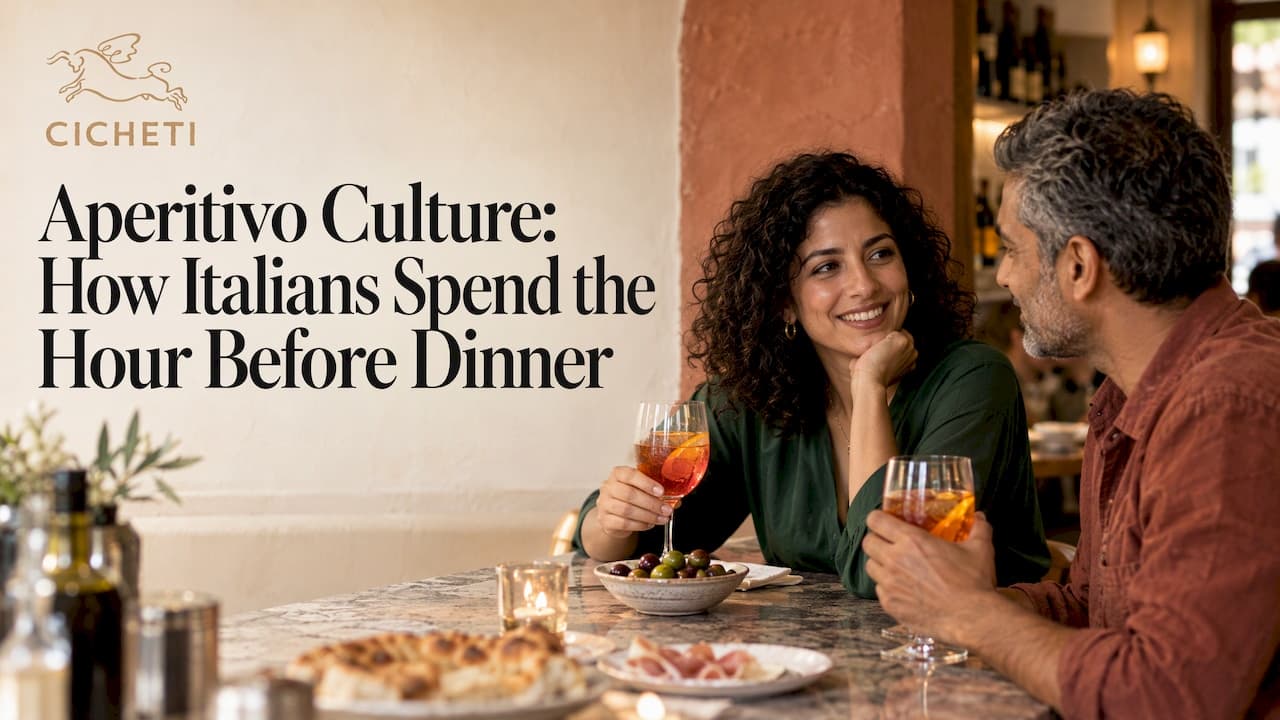
Aperitivo is a small drink, a few things to nibble and an unhurried hour or two between work and dinner, usually between about 6 and 9 p.m. It exists to open the appetite, not to replace the meal, and the conversation matters at least as much as the glass. Below you'll find what's poured, what's served alongside, how the etiquette works, and how to recreate the habit at a table in Singapore.
TL;DR
- Aperitivo is a pre-dinner ritual of a light drink and snacks, meant to start the evening rather than stand in for dinner.
- The hour usually falls between about 6 and 9 p.m., later in the south of Italy, and it is not a discounted-drinks happy hour.
- Typical drinks are spritzes, light cocktails, wine and beer; typical snacks are olives, crisps, bruschette, small pizzas and, in Venice, cicchetti.
- Order one drink, take your time, and take a sensible share from any shared plates.
- At Cicheti, 52 Kandahar Street, the Venetian-style small plates and wood-fired Neapolitan pizzas suit the same unhurried habit.
Table of Contents
- What aperitivo means
- Aperitivo or aperitif?
- What Italians drink at aperitivo
- Italian aperitivo snacks
- When is aperitivo?
- Aperitivo is not happy hour
- Etiquette, without the stiffness
- Venice's version: cicchetti and the bacaro
- Our perspective
- Bringing the ritual to Singapore
- Promo: a table at Cicheti
- FAQ
- Sources
What aperitivo means
The word does a lot of jobs. According to a guide from Italia Mia, it can mean the drink itself, the food that comes with it, the time of day, or the whole social occasion. If a friend in Italy asks whether you'd like to fare un aperitivo, they mean meeting for a drink and something to nibble, not a formal meal.
The name traces back to the Latin aperire, "to open", and AFAR describes it as a daily ritual that bridges daytime and dinner. That opening is meant literally: the drink is there to wake up the appetite. A historian quoted by Appetito magazine links that idea especially to bitterness, and traces related pre-meal drinking habits back to Ancient Roman banquets. It also stresses that aperitivo pairs a drink with food before lunch or dinner and isn't meant to substitute for either.
Researchers at the University of Parma, in a 2025 study of aperitivo as a social ritual, define it as an alcoholic or non-alcoholic drink with light food or tasting portions before a main meal. They add that it has grown into a social and emotional occasion rather than remaining merely a beverage. InsideHook's guide puts it more simply: it's mostly about meeting friends and family, talking and relaxing, with the drinks and snacks in supporting roles.
So if you're wondering whether aperitivo is a drink or an event, the honest answer is both, and the event is the point.
Aperitivo or aperitif?
The two words are close relatives. Difford's Guide treats apéritif and aperitivo as a light, dry or bittersweet pre-meal drink, and describes Italian aperitivi as early-evening drinks served with snacks. In everyday use, the French-flavoured apéritif tends to name the drink, while the Italian aperitivo also covers the snacks and the social hour around it. If you'd like to see where the pre-dinner pour sits against its after-dinner counterpart, our piece on aperitivo and digestivo covers both.
What Italians drink at aperitivo
There's no single official drink. The Splendid Table lists light cocktails, wine and beer as the usual choices, and notes that drinks and foods change from city to city, even within the same region.
The Veneto is the home of the spritz: white wine or Prosecco, soda, and usually Campari or Aperol. The same source reports some local twists:
- Venice commonly uses Select in its spritz.
- Trieste serves a bianco version made with wine and soda.
- The Dolomites pour a Hugo, with elderflower and mint.
The two bright-red bitters are worth knowing apart, because one is gentler and sweeter and the other is sharper and more herbal. We've set out when to reach for each in Aperol vs Campari. If you prefer the wine route, the region's bottles are covered in Wines of Veneto, from Prosecco to Soave and Valpolicella.
Aperitivo doesn't have to involve alcohol. Both the Parma researchers and Difford's Guide note that the drink can be non-alcoholic, and the bitter, dry profile is the point rather than the proof.
Italian aperitivo snacks
The food is deliberately modest, because dinner is still to come. InsideHook lists green olives, potato crisps and sometimes nuts as the usual baseline, with savoury pastries, canapés, mini sandwiches and pizzetta in more generous places. In Liguria, it adds, you may be handed focaccia with local basil pesto and olive oil.

Difford's Guide describes a wider range, from olives and crisps to bruschetta, small pizza squares and elaborate canapé-style food. Some venues charge a supplement or lay out a buffet. A third pattern is described by The Local: the snacks are included with the drink, charged separately as a bigger plate (sometimes called a tris), or offered as an apericena, a more substantial spread that can stand in for dinner.
That last one is the exception that proves the rule. Aperitivo itself comes before the meal; apericena is what it becomes when the spread is generous enough to cover it.
A quick snack map
| Snack | What it is | Where you'll meet it |
|---|---|---|
| Olives | Usually green, served in a small bowl | Almost everywhere |
| Potato crisps | Plain, salty, good with bitter drinks | Almost everywhere |
| Bruschette | Toasted bread with simple toppings | Bars across Italy |
| Pizzetta | Small pizzas or pizza squares | Many bars and buffets |
| Focaccia | Served with pesto and olive oil | Liguria |
| Cicchetti | Small bites on bread or polenta | Venice's bacari |
When is aperitivo?
The common window is early evening. Difford's Guide puts Italian aperitivo hours at roughly 6 to 9 p.m., depending on the bar. The Splendid Table's interview describes meeting at a local bar or café around 6 or 7 p.m., staying until perhaps 8 or 9 p.m. to unwind and talk. The Italian Language School Singapore gives a typical 6 to 8 p.m. window and notes later schedules farther south, especially in Naples and Sicily, which fits Italy's later dinner times in the south.

Season and city shift the rhythm too. A warm evening on a Venetian campo stretches further than a damp Tuesday in a northern city. The sensible reading is a loose window, not a clock: it begins when the working day ends and finishes when the table for dinner is ready.
Aperitivo is not happy hour
This is the most common confusion, and Difford's Guide draws the line clearly: happy hour is built around discounts, while aperitivo is built around a pre-meal ritual in which snacks accompany the drink. Nobody is racing to finish a second round before the prices change.
That difference shapes how you behave. At happy hour, the aim is volume for the money. At aperitivo, the aim is to slow down. If you enjoy seeing how different cities shape a night out across several venues, a Melbourne nightlife guide makes a useful contrast with Italy's single, settled early-evening drink.
Etiquette, without the stiffness
Italia Mia's guide offers a short set of customs that visitors can follow without fuss:
- Ask whether the venue is doing aperitivo, and whether a table is free.
- Check whether the snacks come with the drink or are charged separately.
- Order a drink, then accept the snacks that arrive or choose from the counter.
- At a shared buffet, take a reasonable portion. One drink per person is the norm when food is provided with paying customers' drinks.
- Stay a while. It isn't a quick drink on the way somewhere.
None of this is rigid. It comes down to treating the hour as company first and consumption second, which any good host would recognise.
Venice's version: cicchetti and the bacaro
Venice has its own take. The Splendid Table's Venice example describes cicchetti such as baccalà mantecato (salt cod whipped into a creamy spread) on polenta, plus crostini, usually enjoyed while moving between bacari, the city's small wine bars. A glass of wine or a spritz in one hand, a small bite in the other, and then on to the next bar.
This is the tradition our kitchen draws on for its Venetian-style small plates. If you'd like the full picture of the habit, read what cicchetti are and our guide to Venetian food specialties. Small plates work on the table the way they do in a bacaro: you order a few, share them, and let the evening set its own pace.
Our perspective
We think aperitivo travels well because it isn't really a recipe. It's a decision to let the evening start slowly.
At Cicheti, at 52 Kandahar Street in Singapore's Arab quarter, our kitchen team cooks wood-fired Neapolitan pizzas and Venetian-style small plates, and that pairing sits naturally alongside the aperitivo idea: something small and shareable, something to sip, and no rush to the main event. Our wine list leans towards Italy's lesser-known varietals, which is a good reason to ask questions and try something you haven't poured before.
If you like to let someone else choose, our Sommelier Selection of the day is there for exactly that. You tell us what you enjoy, and we suggest a glass.
Our advice is simple. Order a few small plates for the middle of the table, add a pizza to share if you're hungry, choose a glass you're curious about, and stay for as long as the conversation holds.
Cicheti
Bringing the ritual to Singapore
The habit has already found a home here: the Italian Language School Singapore hosts regular evenings of Italian food, wine, cocktails and conversation. You don't need a special event to borrow the spirit, though. A few ideas that stay true to what aperitivo is:
- Start light. Choose a spritz, a glass of Italian white or a bitter-leaning drink rather than something heavy. The aim is to open the appetite.
- Share small things. Several small plates in the middle of the table recreate the nibbling pace far better than individual starters.
- Decide on dinner afterwards. Aperitivo sits before the meal, so let the table decide whether it ends there or carries on to pizza or pasta.
- Leave the clock alone. Keep the phone face down and give the hour its time.
Singapore's early evenings are warm and humid year-round, which makes the case for something cold, bitter and bubbly rather unarguable.
Planning a visit to Cicheti
We serve Venetian-style small plates, wood-fired Neapolitan pizzas and a curated list of Italian wines. The Sommelier Selection of the day is listed on our drinks menu at $19 to $90, and you can browse the food menu before you arrive. For a bigger table, our family-style sharing menus work in the same spirit, and our seasonal feast menus are listed at $85 per person for the Cicheti Family-Style Menu and $95 per person for the Feast of the Seven Fishes. Check the page for current availability.
If you're planning a gathering, our team also hosts private events, pizza-making workshops and wine tasting classes; details are on the private events page.
Promo: a table at Cicheti
Want to try the habit without the flight? Come to Cicheti, at 52 Kandahar Street, and build your own aperitivo around small plates, a wood-fired pizza and a glass chosen with our team's help. Wood-firing gives a Neapolitan pizza its blistered, lightly charred crust, which goes particularly well with something cold and bitter in the glass.

BOOK A TABLE through cicheti.com, or look through the dine-in menus first. If you'd rather have it at home, delivery and takeaway orders are also available through the site.
FAQ
What is an aperitivo drink?
It's a light, often dry or bittersweet drink served before a meal to open the appetite. Spritzes, light cocktails, wine and beer are the usual choices, and non-alcoholic versions are common. The snacks that come with it are part of the occasion.
Is aperitivo the same as happy hour?
No. Happy hour is built on discounts, while aperitivo is a pre-dinner ritual where food accompanies the drink. Hours often overlap, but the attitude is different: aperitivo is about slowing down, not getting the most drinks for the price.
What time do Italians have aperitivo?
Usually between about 6 and 9 p.m., depending on the city and the bar. It tends to start later in the south, particularly in Naples and Sicily. Treat it as a loose window before dinner rather than a fixed hour.
Does aperitivo replace dinner?
Not in principle. Aperitivo is meant to come before lunch or dinner, not to substitute for either. Some venues serve a bigger spread called an apericena, which can stand in for dinner, but that's a distinct thing.
What snacks come with an Italian aperitivo?
Olives, crisps and nuts are the baseline. Bruschette, small pizzas, canapés and mini sandwiches follow in more generous venues, and in Venice you'll find cicchetti such as baccalà mantecato on polenta or crostini.
Sources
- Aperitivo Time: A Made in Italy social ritual, University of Parma
- A Guide on Where to Find the Best Aperitivos in Italy, AFAR
- How to Enjoy Aperitivo Hour Like an Italian, InsideHook
- What you need to know about aperitivo, The Splendid Table
- Aperitif and Aperitivo Guide, Difford's Guide
- The Italian Aperitivo Explained as Three Things at Once, Appetito
- The unwritten rules of visiting Italian bars and cafés, The Local
- Italian Aperitivo: Drinks, Food, Etiquette and City Guide, Italia Mia
- The Italian Aperitivo: More Than Just a Pre-Dinner Drink, Italian Language School Singapore
- Three Neighborhoods to Cover Melbourne Nightlife in One Night