
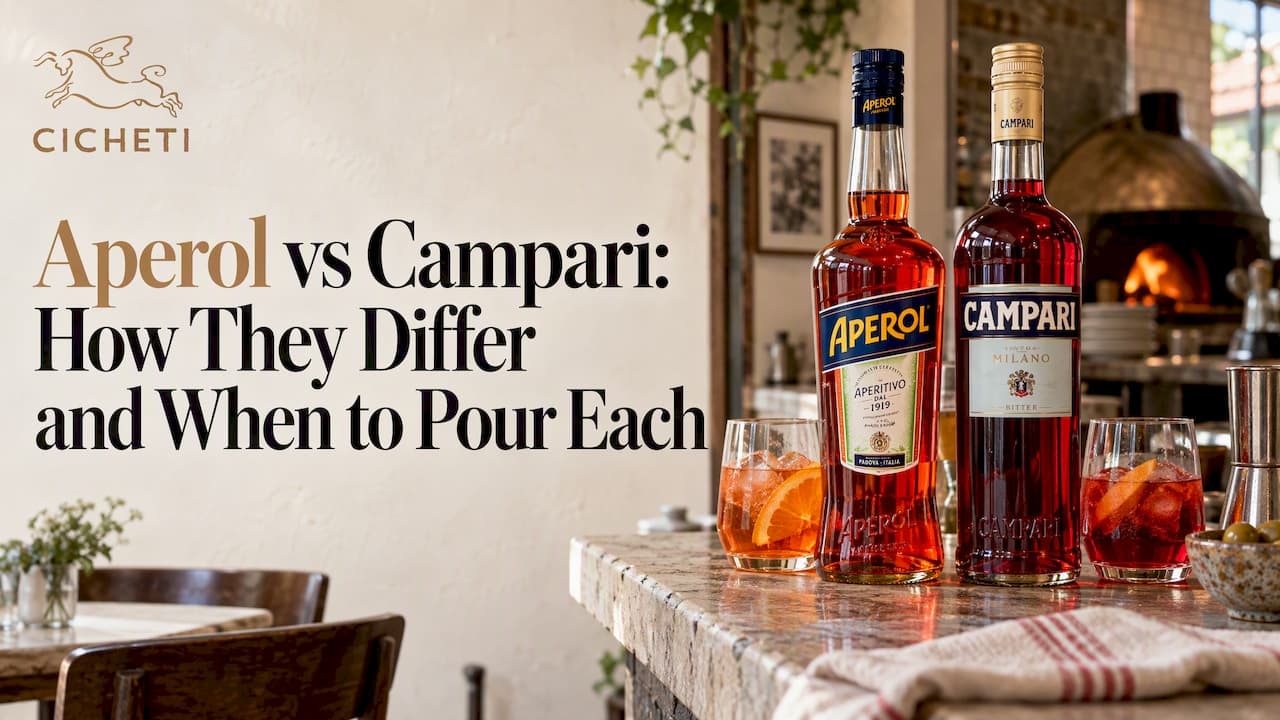
Aperol is sweeter, lighter and gentler, at about 11% ABV. Campari is darker, more bitter and roughly twice as strong. Both are Italian red bitters made for the hour before dinner, so the real question isn't which is better. It's which one suits the drink in your hand and the mood at your table.
We hear this one at Cicheti, 52 Kandahar Street, more often than you'd think, usually while someone studies the drinks list and a pizza menu at the same time. So here is the full answer, with the numbers, the flavours, the classic cocktails and a few practical notes on pairing and storage.
TL;DR
- Strength: Aperol sits at 11% ABV, while Campari runs between 24% and 28%, depending on the market.
- Taste: Aperol is orange-led, sweet and soft. Campari is bitter, herbal and long in the finish.
- Spritz: Aperol makes the easy, sunny spritz. A Campari Spritz is sharper and more grown-up.
- Spirit-forward drinks: Campari anchors the Negroni and the Americano. Aperol would vanish in them.
- Not sure? Start with Aperol, then step up to Campari when you want more edge.
Table of Contents
- The short version: what actually separates them
- Flavour: sweet orange against serious bitterness
- The aperitivo idea behind both bottles
- Aperol Spritz versus Campari Spritz
- Where each one belongs in a cocktail
- Storing your bottle
- Our view from Kandahar Street
- Pairing aperitivo with food
- Planning an evening at Cicheti
- FAQ
- Sources
The short version: what actually separates them
The two share a family tree. Both are Italian bitter aperitifs and both now belong to the Campari Group, which is why they sit side by side on so many back bars. They are made from infusions of herbs, roots and citrus to recipes that remain secret. The differences come down to four things.
| Aperol | Campari | |
|---|---|---|
| Colour | Bright orange | Deep crimson |
| Strength | 11% ABV (15% in Germany) | 20.5% to 28% ABV depending on market |
| Taste | Sweet orange, rhubarb, gentian, a touch of vanilla | Intense, layered bitterness, herbal and peely |
| Best for | Spritzes, light highballs | Negroni, Americano, Boulevardier |
The figures for strength come from the owner and from a trade write-up: the Campari Group gives 11% for Aperol and 24% to 28% for Campari, while VinePair notes Campari ranges from 20.5% to 28% depending on where it's sold, which makes it close to double Aperol. Check the label on the bottle you're actually holding, because it varies by country.
Flavour: sweet orange against serious bitterness
Pour a little of each over ice and the gap is obvious before you taste anything. Aperol is the colour of a traffic cone in good light. Campari is closer to a ruby, and it smells less of orange squash and more of peel, bark and spice.
On the palate, Food & Wine describes Aperol as brighter and sweeter, with orange, gentian root, rhubarb and a hint of vanilla. Campari's bitterness is more intense and complex, and it lingers. Aperol's own makers say it's sweeter than Campari, though they point out that both are bittersweet.
The bartender Julie Reiner has called Aperol "Campari with training wheels". It's a fair line, and not an insult. Plenty of people never leave the training-wheel stage, and nobody at a good bar will judge them for it.
A tasting method that settles the argument
If you're deciding at home, don't mix first. Do this instead:
- Pour 25 ml of each into separate glasses over a single large ice cube.
- Add a slice of orange to both and wait a minute so the ice takes the edge off.
- Sip Aperol first, then Campari, with water in between.
- Note where the bitterness lands: at the front, or only at the finish.
If Campari's bitterness makes you wince, add soda and a lot of ice, and try again in a week. Bitterness is a taste people often grow into.
The aperitivo idea behind both bottles
Both drinks belong to the Italian tradition of the aperitivo, a drink taken before a meal to open the appetite. Aperol's makers explain that the word comes from the Latin aperire, to open, and that it suits the relaxed spirit of the Veneto. Wine Spectator describes the red aperitivo as a bitter scarlet liqueur made by infusing spirits or wine with botanicals and fruit such as orange peel, rhubarb and quinine, and notes they're drunk neat or in a cocktail.
That matters at the table. Bitterness makes you salivate, which is exactly what you want before a plate of salty, rich food. It's the same reason a bitter drink works so well before cured meats, fried small plates or a blistered pizza crust.

Aperol Spritz versus Campari Spritz
The Aperol Spritz is the one that most people mean when they type "Aperol or Campari". The recipe approved by the International Bartenders Association follows a 3-2-1 ratio: three parts Prosecco (75 ml), two parts Aperol (50 ml) and one part soda water (25 ml). The same page suggests pouring the Prosecco over ice and chilling everything beforehand so the fizz lasts.
Swap in Campari and you get a Campari Spritz. It's a perfectly respectable drink, but a different one: drier, more bitter, a little more serious. Aperol's own FAQ addresses the difference between the two spritzes directly, and it comes down to the bitterness of the base.
Choose the Aperol Spritz if:
- you want something light and refreshing in Singapore's heat;
- you're pouring for guests with mixed tastes;
- you'd like a drink that won't dominate dinner.
Choose the Campari Spritz if:
- you already like grapefruit peel, tonic or dark chocolate;
- you want the drink to hold its own against salty food;
- you find the Aperol version a touch sweet.
A small practical point: Prosecco brands vary a lot in sweetness. A brut will balance Aperol's sugar nicely, while an extra dry bottle can make the whole drink feel sweeter than you expect.
Where each one belongs in a cocktail
Bartenders do swap the two to adjust bitterness, but VinePair notes that most are reluctant to, because the drinks behave differently.
Campari: the backbone of strong, bitter drinks
Campari's intensity is its job. It is the red bitter in the Negroni (typically equal parts gin, sweet vermouth and Campari) and the Boulevardier, which swaps gin for whiskey. It also anchors the Americano, a longer, lighter relative built on sweet vermouth and soda. Experts quoted by VinePair say Campari is the usual choice for strong, boozy drinks. If you like experimenting, the way bitterness pairs with other strong flavours is worth exploring, for instance in single origin coffee cocktails, where roasted notes and Campari's bitter edge meet.

Aperol: the lighter touch
Aperol's softer profile works best with lighter, floral or fruity spirits that Campari would swamp. Think low-ABV highballs, citrus-led refreshers and, of course, the spritz. Its sweetness also makes it a useful bridge for people who think they dislike bitter drinks. Wine Spectator's round-up of cocktails shows how many drinks can be made with either bottle.
A quick decision guide
| If you want... | Reach for |
|---|---|
| A light drink with brunch or a long afternoon | Aperol |
| A drink to sip slowly before dinner | Campari, with soda or in a Negroni |
| Something to introduce a friend to bitters | Aperol |
| A cocktail built on whiskey or gin | Campari |
| Lower alcohol overall | Aperol |
Storing your bottle
Neither bottle needs refrigeration before opening. Once opened, Aperol recommends keeping it in the fridge to protect its flavour, where it should last about three months, according to the producer. Aperol's team also say the colour is a clue: it should be a deep orange, and if it looks paler than that, or smells off, it may be past its best. In Singapore's humidity, the fridge door is a sensible home for either bottle, though that's our habit rather than a producer rule.
Our view from Kandahar Street
We don't make Aperol or Campari, and we won't pretend one is the correct answer. What we'll say comes from running a trattoria built around wood-fired Neapolitan pizzas and Venetian-style small plates. The aperitivo idea fits that table well. Venetians have a long habit of pairing a small drink with small plates, and the cicchetti ritual is the reason our kitchen cooks the way it does.
With small, salty plates, we lean towards bitterness: it cleans the palate and makes the next bite taste as good as the first. With a rich, blistered pizza, a lighter, sweeter aperitivo can be a pleasant opener, and then it's sensible to move on to wine. Our drinks list leans towards lesser-known Italian varietals, so if you'd like to carry on from an aperitivo to something with more story, the pages on Italian natural wine and orange wine from Italy are a good place to begin.
Our honest advice: have the aperitivo you'll finish. A drink that makes you pull a face doesn't open the appetite.
— Cicheti
Pairing aperitivo with food
The trick is to match intensity rather than colour. These are general pairing principles, not a description of our menu.
- Salty and cured: bitterness cuts through salt and fat, so Campari-led drinks suit them well.
- Fried or crisp bites: a spritz works because of its bubbles and acidity.
- Tomato-based dishes: orange notes echo the tomato's sweetness, so Aperol sits comfortably alongside.
- Rich, creamy dishes: a bitter drink resets the palate between mouthfuls.
If you like to think about flavour more closely, the same attention applies to olive oil, and our piece on olive oil tasting shows how bitterness and pepperiness can be a feature rather than a flaw.
Planning an evening at Cicheti
If you'd like to taste your way through the aperitivo hour with something to eat, Cicheti is at 52 Kandahar Street, in Singapore's Arab quarter. You can browse the food menu and the drinks menu before you come. We can't promise any particular bottle is behind the bar on a given night, so check the drinks menu or ask your host.
For the wine side, our Sommelier Selection of the day is listed from $19 to $90, and the drinks menu shows what's pouring. For groups, our dine-in menus include the Cicheti Family-Style Menu at $85 per person and the Feast of the Seven Fishes at $95 per person, both on our festive feasts page. If you're planning a gathering, including wine tasting classes or pizza-making workshops, take a look at private events at Cicheti. Ready to settle the debate in person? BOOK A TABLE at cicheti.com.
FAQ
Is Aperol stronger than Campari?
No. Aperol is about 11% ABV, while Campari sits between 24% and 28% according to its owner, and some markets list slightly lower. That is why Aperol drinks feel lighter and why a Negroni hits harder than a spritz.
Can I use Aperol instead of Campari in a Negroni?
You can, and some bartenders do, but expect a sweeter, softer drink. VinePair says the two can be swapped, though most bartenders are unlikely to. If you want the classic bite, stay with Campari.
Which is more bitter, Aperol or Campari?
Campari. Aperol is the sweeter of the two, though both are bittersweet. If you're new to bitter drinks, start with Aperol and add Campari once you're curious.
Who owns Aperol and Campari?
Both brands belong to the Campari Group. They are made as separate products with their own recipes, even though they share an owner.
Sources
- Brands | Campari Group
- What's the Difference Between Campari and Aperol? | Food & Wine
- The Difference Between Campari and Aperol, Explained | VinePair
- VinePair
- 16 Great Cocktails to Make with Campari or Aperol | Wine Spectator
- Aperol Spritz FAQ | Aperol
- Frequently Asked Questions | Aperol
- About Aperol FAQ | Aperol
- Conservation FAQ | Aperol
- Aperol