
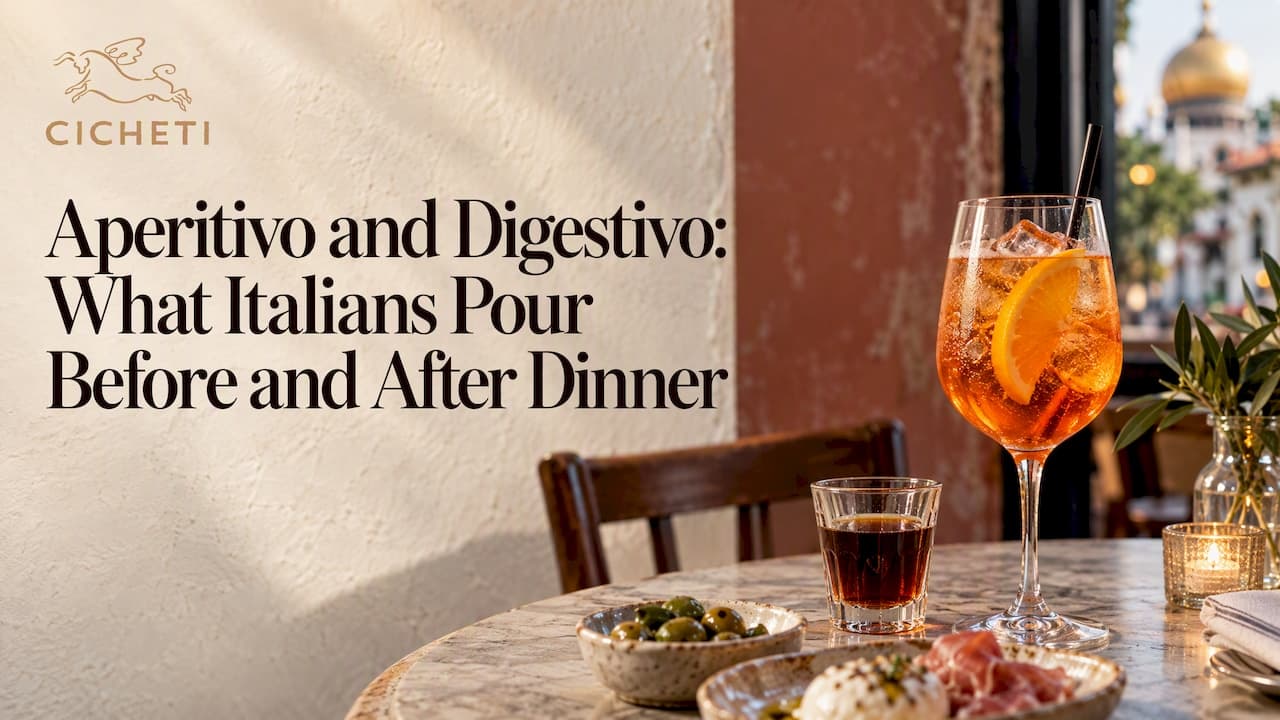
An aperitivo is the drink you have before a meal to wake up your appetite, and a digestivo is the one you have after it to slow the evening down. The first tends to be light, bitter-sweet and low in alcohol. The second is darker, stronger and usually sipped on its own. Nearly everything else people argue about, including where limoncello or grappa belong, comes back to timing, purpose and how the drink is served.
We pour both at Cicheti, our trattoria at 52 Kandahar Street, so this is the guide we would give a guest across the table who asked us which is which.
TL;DR
- Aperitivo comes before the meal, is typically orange or red, bitter-sweet and light, and is meant to be taken with a little food.
- Digestivo comes after dessert and espresso, is typically darker, sweeter and stronger, and is sipped slowly, often neat.
- Amaro is the main digestivo family. Grappa is a grape-pomace spirit that often plays the digestivo role, and limoncello is a lemon liqueur usually served after dinner.
- A digestivo is a custom, not a cure. Singapore's Ministry of Health advises against alcohol when you have indigestion.
- Our drinks menu lists the current wines and the Sommelier Selection of the day, so check it before you book.
Table of Contents
- The short answer: it is about timing and purpose
- What an aperitivo actually is
- Flavour and strength: how the two sides differ
- What a digestivo is, and how it is served
- Grappa and limoncello: where do they fit?
- Does a digestivo help you digest?
- Our view: why we pour both
- Planning your own aperitivo and digestivo at Cicheti
- FAQ
- Sources
The short answer: it is about timing and purpose
The Oxford Companion to Spirits and Cocktails describes aperitif and digestive drinks as taken before or after a meal, and notes that the two categories overlap. That overlap is the part most guides skip. A drink does not belong to one camp by birth. It belongs to whichever moment you pour it in.
So the working rule is simple:
- Aperitivo: the opening. It signals that the working day is over and the table is about to fill.
- Digestivo: the closing. It stretches the meal out so nobody has to leave yet.
A bartender quoted by Wine Enthusiast calls them twinned parts of one culture, one beginning the occasion and one ending it. We like that picture. Think of them as the two bookends, with the food in between doing the real work.
What an aperitivo actually is
In Italy the word covers three things at once: a drink, a time of day and a small ritual, as Appetito magazine puts it. It can happen before lunch as well as dinner, at home or in a bar, and it is meant to sit alongside food rather than replace the meal. Olives, crisps, a few slices of cheese or cured meat are the usual company.
Timing is loose. A Singapore-based Italian language school places the typical aperitivo between about 6pm and 8pm, later in southern Italy, and that fits a Singapore evening neatly: you can have one at a bar, then walk to your table at 8pm without feeling rushed.
What goes in the glass
Food & Wine lists the bitter-sweet classics: Aperol or Campari Spritz, Negroni and Americano, with wine and cocktails more common than beer in many modern settings. Prosecco and vermouth turn up too. The bitterness is deliberate. It nudges the appetite awake, which is why a Spritz tastes better at 6.30pm than it does after tiramisu.
If you want to choose between the two best-known bitter liqueurs, our own guide to Aperol versus Campari explains how they differ and when to pour each.
A note on Veneto
Venice has its own version of the pre-meal habit. In the city's bacari, a glass of wine arrives with small bites called cicchetti, which is where our name comes from. If you want the background, we have written about Venice's bacaro ritual and the wines of Veneto, from Prosecco to Valpolicella.
Flavour and strength: how the two sides differ
Put the glasses side by side and the difference is easy to see. Wine Enthusiast describes aperitivi as typically orange or red, bitter-sweet, citrusy or herbal and relatively low in alcohol, while digestivi are generally darker, stronger, more complex and sweeter, often built on herbs or botanicals. Both can share ingredients such as orange peel, rhubarb, gentian and anise, so a single flavour is not a reliable clue.
| Aperitivo | Digestivo | |
|---|---|---|
| When | Before lunch or dinner | After dessert and espresso |
| Purpose | Stimulate the appetite | Close the meal, extend the conversation |
| Typical colour | Orange, red, pale gold | Dark amber to brown, or clear |
| Typical taste | Bitter-sweet, citrusy, herbal | Richer, sweeter, more complex, often bitter |
| Typical strength | About 10 to 25% ABV | About 25 to 45% ABV |
| Typical service | Over ice, as a spritz or short cocktail, with snacks | Neat, in a small glass, on its own |
| Examples | Aperol Spritz, Campari, Negroni, Americano | Amaro, grappa, limoncello |
The strength ranges come from the Oxford Companion, which is explicit that exceptions exist in both categories. A strong Negroni is not a digestivo because it is strong, and a gentle amaro is not an aperitivo because it is gentle.
If you would like to see the same contrast through the lens of a spritz, this look at differences in taste and strength compares typical timing, flavour and alcohol content in a way that maps neatly onto the before-and-after split.
What a digestivo is, and how it is served
The Italian sequence at the end of a dinner is dessert, then espresso, then the digestivo. The writer at Eating Around Italy mentions that the drink is sometimes called an ammazzacaffè, literally a coffee-killer, which tells you where it sits: right after the cup is empty.
Food & Wine says it is usually served on its own, often neat, and enjoyed slowly as a nightcap while conversation carries on. Tuscany Now & More adds that digestivi are commonly served at room temperature, though customs vary by drink and region. Nobody is in a hurry, and a small glass can last twenty minutes.
Amaro: the main family
Amaro means bitter. It is a herbal liqueur, and Wine Enthusiast names it the principal digestivo category, citing Montenegro, Lucano, Ramazzotti, Averna, Meletti and Fernet-Branca, with many amari sitting around 30% ABV. They range from gently sweet and orange-toned to sharply medicinal, so a first-timer should start at the sweeter end. For a closer look at how these bitter liqueurs are poured after dinner, see these notes on amari served as after-dinner drinks.
Regional habits
What counts as the local digestivo changes with the map. One regional overview from iAperitivo lists limoncello in Campania, mirto in Sardinia, sambuca around Rome and grappa especially in the north. Order what the region is proud of and you will rarely go wrong.
Grappa and limoncello: where do they fit?
This is the question that causes the most friction, because neither is a neat category.
Grappa
Grappa is made from grape pomace, called vinaccia, the skins and pips left after winemaking, and styles run from lightly aromatic to oak-aged riserva, according to Tuscany Now & More. Wine Enthusiast makes a fair distinction: grappa is often drunk after meals, but it is a spirit commonly used as a digestivo, not a digestivo liqueur category in itself. Italia Living agrees that it can be enjoyed after espresso, and stresses that the occasion and manner of service decide the role.
In plain terms: a glass of grappa after coffee is a digestivo. The same grappa at 6pm with nothing to eat is just a strong drink.
Limoncello
Limoncello is a lemon liqueur, and the Eating Around Italy guide includes it among the common digestivi, alongside amari such as Amaro del Capo and Montenegro, Braulio, mirto and grappa. So when someone asks whether limoncello is a digestivo or an aperitivo, the traditional answer is digestivo: served cold and sweet at the end of the meal. Nothing stops a bartender using it in a light drink before dinner, but that is a cocktail decision, not the tradition.
Grappa versus limoncello at a glance
Grappa is a distilled grape spirit: dry, firm and warming, with the character of the grape and, in aged versions, the barrel. Limoncello is a sweet lemon liqueur: bright, syrupy and easy. If you finish dinner with something rich such as chocolate or aged cheese, grappa copes better. After fish or something lemony, limoncello is the gentler close.

How to serve grappa properly
Two customs are worth knowing:
- Aged grappa: one producer's technical sheet advises serving it at room temperature in a wide balloon glass and letting it rest for several minutes, so the oxygen opens up its aromas.
- Resentin: in Veneto, a splash of grappa goes into the emptied espresso cup, sometimes with a little sugar, to rinse it, as Tuscany Now & More describes. It is a small, practical ritual and a fine way to meet grappa gently.
Does a digestivo help you digest?
Historically, yes, that was the idea. Food & Wine reports that digestifs were once used medicinally and have since become alcoholic end-of-meal drinks and social nightcaps. Today the ritual is the point.
If you actually have indigestion, Singapore's Ministry of Health notes that alcohol can contribute to indigestion and advises avoiding it when managing stomach ache or indigestion symptoms. So please do not treat an amaro as a remedy. If stomach pain keeps returning, see a doctor.
It also helps to know what a measure looks like. The Agency for Care Effectiveness defines one standard drink as 330ml of beer, 100ml of wine or 30ml of spirits, which is useful when a 30ml digestivo follows a spritz and a couple of glasses of wine. If you are managing a condition such as pre-diabetes, ask your doctor what limit suits you.

Our view: why we pour both
We think of the evening at Cicheti as a shape with a beginning and an end. Our kitchen team is local, and the food is wood-fired Neapolitan pizza and Venetian-style small plates, so the drinks that open the meal should be bright enough to keep up with them. The drinks that close it should give you a reason to stay at the table once the plates are cleared.
We lean towards lesser-known Italian varietals in our wine selection, and the same curiosity applies here: try the bitter thing you have not heard of, in a small measure, with someone who will tell you what it is. Ask our team and they will gladly steer you. We would rather you left having discovered an amaro you like than having ordered the one you already know.
— Cicheti
Planning your own aperitivo and digestivo at Cicheti
We cannot promise a particular bottle on a particular night, so look at the drinks menu before you come. It carries our Sommelier Selection of the day, published at $19 to $90, and our team can talk you through pairings. Our food menu will help you plan what to eat between the two drinks.
A sensible evening runs like this: arrive a little before your booking for something light and bitter, share small plates and a pizza from the wood-fired oven, then finish with a small, slow glass instead of a second dessert. If you are ordering for a group, our note on family-style Italian dining explains how to pace the table.
For a bigger occasion, the Cicheti Family-Style Menu is $85 per person and the Feast of the Seven Fishes is $95 per person, both on our festive feasts page. We also host private events, including wine tasting classes, which is a good setting to taste an aperitivo and a digestivo side by side.

BOOK A TABLE at 52 Kandahar Street through cicheti.com, or ENQUIRE TODAY about a private evening.
FAQ
Is Aperol good for digestion?
Aperol is an aperitivo, taken before the meal to stimulate the appetite, not to settle the stomach afterwards. It is bitter-sweet and light, but there is no basis here for calling it a digestive aid. Singapore's Ministry of Health advises avoiding alcohol when you have indigestion.
What do Italians drink after dinner?
The traditional order is dessert, espresso, then a digestivo, often served neat. Amaro is the main family, and limoncello, grappa, mirto and sambuca are also common depending on the region. Many Italians simply stop at coffee, so a digestivo is an option, not an obligation.
Is limoncello a digestivo or an aperitivo?
Traditionally it is a digestivo, served cold after the meal. Its sweetness suits the end of dinner better than the start, when a bitter drink does a better job of waking the appetite.
What is the difference between grappa and limoncello?
Grappa is a spirit distilled from grape pomace, dry and warming, with aged versions rested in wood. Limoncello is a sweet lemon liqueur. Both are served after dinner, but grappa suits richer endings and limoncello suits lighter ones.
Sources
- The Oxford Companion to Spirits and Cocktails: aperitif and digestive
- Food & Wine: Aperitif vs. Digestif
- Food & Wine: How to Host an Italian-Inspired Aperitivo
- Wine Enthusiast: Aperitivo or Digestivo?
- Appetito: The Italian Aperitivo Explained
- The Italian Language School in Singapore: Italian aperitivo guide
- Tuscany Now & More: What is Digestivo
- Eating Around Italy: Italian Dinner Courses
- Italia Living: Aperitivo and Digestivo
- iAperitivo: The Digestivo Hour
- Grappa technical sheet
- Singapore Ministry of Health: Abdominal Pain or Indigestion
- Agency for Care Effectiveness: Managing pre-diabetes
- Spritz belge et italien: differences in tasting
- Signature drinks: amari and after-dinner drinks