
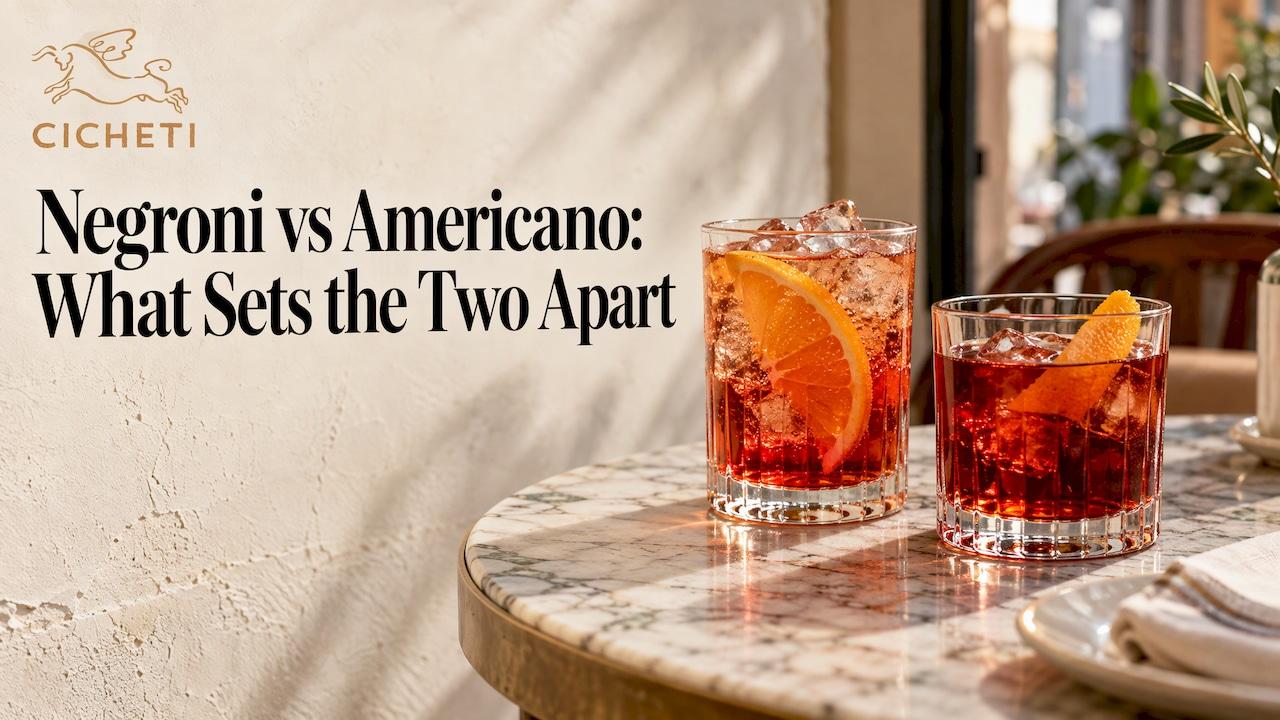
The difference between a Negroni and an Americano is one ingredient. The Negroni takes equal parts gin, Campari and sweet red vermouth. The Americano drops the gin and tops the Campari and vermouth with soda. That single swap turns a short, strong, stirred drink into a long, light, fizzy one, and it decides which of the two suits your evening.
If you're standing at a bar deciding, here's the quick rule: the Americano is the one to order before dinner when you want something bitter and refreshing that leaves your appetite intact. The Negroni is the one for when you want the drink itself to be the event.
TL;DR
- Ingredients: Negroni is gin, Campari and sweet red vermouth. Americano is Campari, sweet red vermouth and soda.
- Strength: per Difford's Guide, a Negroni is about 21.57% alc./vol. and an Americano about 8.8%.
- Taste: the Negroni is bitter, sweet and herbal with a spirit backbone. The Americano is lighter, bubbly and bittersweet.
- Order: the Americano came first, in the mid-1800s. The Negroni followed in 1919 as a stronger variation of it.
- When: Americano for early evenings and long aperitivo hours, Negroni for a slower, more considered first drink.
Table of Contents
- The two drinks side by side
- Which came first
- What goes into each glass
- How they taste
- Which is stronger, and by how much
- When to order which
- Drinking either with food
- Choosing what to drink at Cicheti
- FAQ
- Sources
The two drinks side by side
| Negroni | Americano | |
|---|---|---|
| Base | Gin, Campari, sweet red vermouth | Campari, sweet red vermouth, soda |
| Standard build | 30 ml of each | 30 ml Campari, 30 ml vermouth, soda to top |
| Method | Stirred over ice | Built in the glass |
| Glass | Old-fashioned (rocks) | Old-fashioned or highball |
| Garnish | Half orange slice | Half orange slice |
| Strength (Difford's Guide) | About 21.57% alc./vol. | About 8.8% alc./vol. |
| Character | Bitter, sweet, aromatic, spirit-led | Bittersweet, fizzy, light |
The recipes come from the IBA's official Negroni and from the Singapore Association of Bartenders & Sommeliers, which lists the Americano as a before-dinner drink built directly in an ice-filled old-fashioned glass.
Which came first
The Americano is the older drink. The Manual traces it to the mid-1800s, at Gaspare Campari's bar in Milan. The Negroni arrived in 1919 in Florence, when Count Camillo Negroni asked the bartender Fosco Scarselli to replace the soda water in his usual Americano with gin.
So the Negroni is, quite literally, an Americano with a stronger opinion. That's useful to know when you're choosing, because the two drinks share a bitter-sweet spine. If you like one, you will probably like the other, and the question becomes how much spirit you want in the glass.
If the aperitivo hour itself interests you, our own guides cover what Italians pour before and after dinner and how the hour before dinner is spent.
What goes into each glass
The Americano
The Americano is built, not stirred in a mixing glass. Into an ice-filled old-fashioned glass go 30 ml of Campari and 30 ml of sweet red vermouth, then soda to top, and a half orange slice to finish. That's the method given by the Singapore Association of Bartenders & Sommeliers.
The soda does real work. Liquor.com describes it as cutting through Campari's bitterness and the richness of the vermouth, so the drink stays bittersweet but becomes thirst-quenching. How much soda you add is the only real decision: a short splash keeps more of the Campari's edge, a longer pour turns it closer to a highball.
The Negroni
The IBA's recipe is 30 ml gin, 30 ml Campari and 30 ml sweet red vermouth, poured into a chilled, ice-filled old-fashioned glass, stirred gently and garnished with half an orange slice. WSET describes the equal-parts formula as a balance of bitterness, sweetness and aromatic complexity, and suggests stirring over ice, then straining onto fresh ice with an orange peel.
Two things matter more than any secret. The first is the proportions: equal parts is the classic, and it only works because each ingredient is strong enough to hold its ground. The second is dilution. Stirring with ice chills the drink and softens it slightly, which is why a Negroni made in a hurry tastes harsher than one stirred properly. If you're making them at home, a chilled glass is part of the IBA method, and a double glass drink chiller is one way to get there.
Bartenders do tinker. Local bars often adjust the ratio, so a house Negroni in Singapore may not match the textbook one, and that is part of the pleasure of ordering the same drink in different rooms.

How they taste
Campari is the common thread: bitter orange, herbal, a little medicinal, with a long finish. Everything else is about what surrounds it.
In the Americano, red vermouth supplies sweetness and spice and the soda lifts everything. Bon Appétit calls it lightly alcoholic and lightly bitter, with sparkling water lightening the pairing of bitter liqueur and fruity fortified wine. It's an easy drink to sip slowly, and it tastes the same for the last third as the first, as long as the ice is decent.
In the Negroni, gin adds juniper and botanical dryness that stand up to the Campari instead of diluting it. The result is denser and more aromatic. It's sweet at the start, bitter in the middle and herbal at the end, and it changes as the ice melts. A Negroni asks for a little attention; an Americano doesn't mind if you're talking.

Which is stronger, and by how much
The Negroni, clearly. Its third equal measure is gin, while the Americano's third component is soda.
Here are the figures from Difford's Guide for one serving of each:
| Negroni | Americano | |
|---|---|---|
| Alcohol by volume | 21.57% | 8.8% |
| Pure alcohol | 19.5 g | 14.6 g |
| Calories | 183 | 176 |
Notice what's surprising: per serving, the gap in pure alcohol is smaller than the gap in strength. The Americano is far weaker by volume, but it's also a much bigger drink. Difford's recipe uses 1.5 fl oz each of bitter liqueur and vermouth plus soda, so the Campari and vermouth are doubled compared with the Negroni's 1 fl oz of each. That's why the calories are nearly the same.
In Singapore, a standard drink is defined as containing 10 grams of pure alcohol, according to the Singapore Association for the Responsible Drinking. Using that yardstick, the Difford's servings work out at roughly 1.5 standard drinks for the Americano and roughly 2 for the Negroni. That's my own arithmetic on their figures, and your result will depend on the measures a bar pours. It's worth remembering that a long, light-tasting drink can still count as more than one standard drink, and that a bar's Americano may be poured larger than the classic.
Neither is a drink to hurry. If you're driving or have an early start, the sensible plan is to treat either as a full drink, pace yourself and have water alongside.
When to order which
Order the Americano when:
- It's early evening and dinner is an hour away. Liquor.com recommends it for daytime or pre-meal drinking because it is low-alcohol, easy-drinking, bittersweet and bubbly.
- It's warm and humid, which in Singapore is most days, and you want something long over ice.
- You're new to Campari and want an approachable way in.
Order the Negroni when:
- You want a short, spirit-forward drink that stays interesting from first sip to last.
- You like gin, or you already know you like bitter drinks.
- The evening is unhurried and the drink is the point.
For the occasional person who finds a Negroni too sharp and an Americano too soft, the answer is not a compromise ratio but a different bitter altogether. Our guide to Aperol vs Campari explains how the two bitter aperitivi differ and when each one fits.
Drinking either with food
Both drinks were designed as appetite openers, and bitterness is the reason. It sharpens the palate and makes salty, rich or fried food taste better. A Venetian-style small plate is the natural partner: think cured and salted things, fried morsels, something marinated. The Americano's lightness leaves room for the meal. The Negroni's weight suits a slower start before richer dishes.
If you'd like to understand what usually sits alongside an aperitivo, our guide to the Italian aperitivo covers what it is, when it happens and what to eat with it.
What we'd tell you across the table
We think of the Negroni and the Americano as the same conversation held at two volumes. Both start with Campari and sweet vermouth, and both are meant to wake the appetite before food arrives. The only real question is how long you want the opening to last.
That's also how we think about drinks at Cicheti on Kandahar Street. Our kitchen cooks wood-fired Neapolitan pizzas and Venetian-style small plates, and the drinks are there to suit the food and the pace of the table, not to compete with it. Our wine list leans towards lesser-known Italian varietals, because we'd like you to taste something you haven't had before.
If you're unsure what to order with a plate, ask. Choosing something to go with the food is part of what we're here for.
Cicheti
Choosing what to drink at Cicheti
We're a trattoria in Singapore's Arab quarter, at 52 Kandahar Street, serving wood-fired Neapolitan pizzas, Venetian-style small plates and curated Italian wines. Our drinks menu lists the Sommelier Selection of the day, priced between $19 and $90, so you can see what's pouring before you sit down. If you're planning a meal, the food menu and dine-in menus are the place to start, and you can find everything else, including how to reserve, at cicheti.com.

FAQ
Is an Americano the same as a Negroni?
No, though they're close relatives. Both use Campari and sweet red vermouth, but the Americano adds soda and the Negroni adds gin. The Negroni was invented in 1919 as a stronger take on the older Americano, according to The Manual.
Which is stronger, a Negroni or an Americano?
The Negroni. Difford's Guide gives it about 21.57% alc./vol., against about 8.8% for the Americano. The Americano is a larger, more diluted drink, so the difference in pure alcohol per serving is smaller than the percentages suggest.
Which is better for someone new to Campari?
The Americano is the gentler introduction. The soda softens the bitterness and keeps the drink long and refreshing, which is why Liquor.com recommends it for daytime and pre-dinner drinking. Once you enjoy that, the Negroni is the obvious next step.
Do both drinks use the same garnish?
In the standard recipes, yes. The IBA's Negroni and the Singapore bartenders' Americano both finish with half an orange slice. The citrus oils pick up the orange notes in the Campari.
Sources
- How to make the classic Americano cocktail, The Manual
- Recipes, Association of Bartenders & Sommeliers Singapore
- Negroni, IBA
- Your guide to the most popular cocktails, WSET
- Americano Cocktail Recipe, Liquor.com
- Americano Recipe, Bon Appétit
- Negroni Cocktail Recipe, Difford's Guide
- Americano Cocktail Recipe, Difford's Guide
- Standard drinks calculator, Singapore Association for the Responsible Drinking