
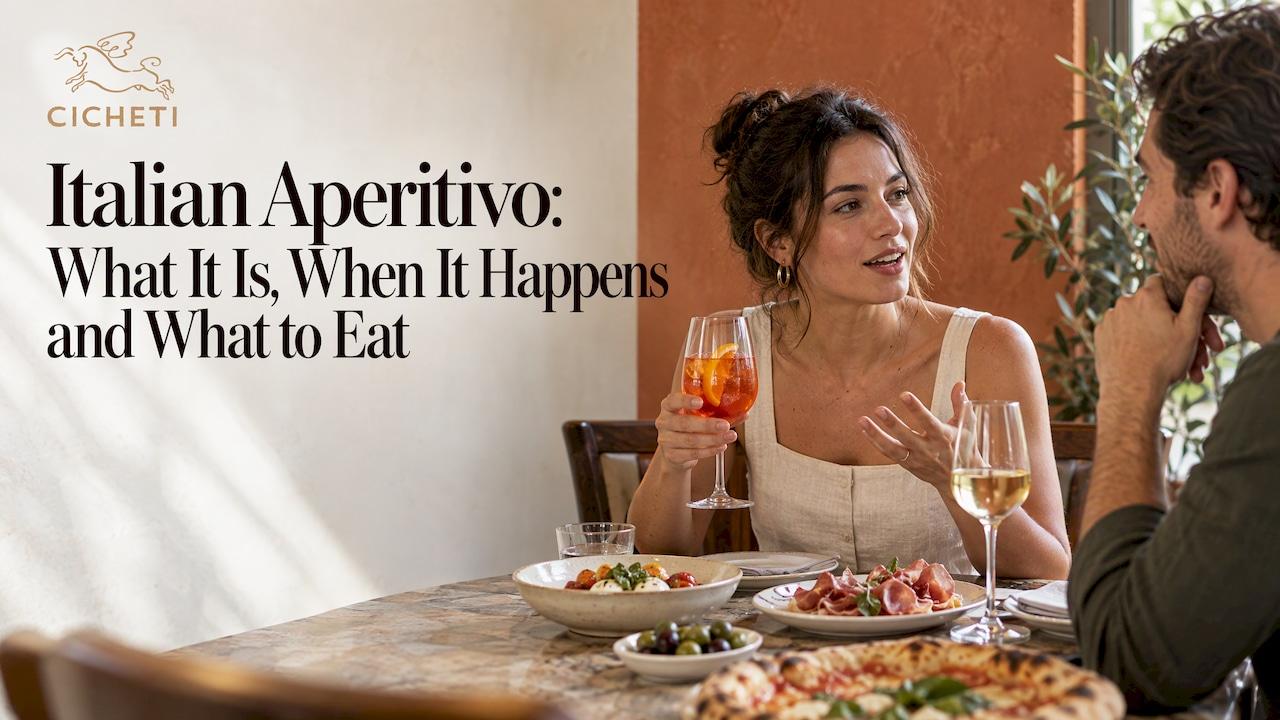
Aperitivo is the early-evening ritual of having a light, usually bittersweet drink with a few small bites before dinner, and it's as much about the pause as the glass. In Italy it typically falls somewhere between 6 and 8 pm, according to the Italian Language School in Singapore. The drink is a Spritz, a Negroni or a glass of wine, and it comes with something to nibble. Then you talk, and dinner can wait.
Below, we explain how aperitivo differs from the French-style apéritif and from Aperol, what people actually eat, how it changes from Turin to Naples, and how to recreate the feeling at home or at the table in Singapore.
TL;DR
- Aperitivo is a social ritual of a light drink plus small food, taken in the early evening. It isn't one drink gulped before dinner.
- The usual window is around 6 to 8 pm, later in Naples and Sicily.
- Classic drinks are the Aperol Spritz, Negroni, Campari Soda and Prosecco. Crodino and chinotto cover the alcohol-free side.
- Typical snacks: olives, crisps, taralli, cheese, cured meats and, in Venice, cicchetti.
- At Cicheti, 52 Kandahar Street, our Venetian-style small plates and curated Italian wines follow the same spirit of eating small and lingering.
Table of Contents
- What aperitivo actually means
- Aperitivo, aperitif, Aperol and happy hour: four different things
- When is aperitivo hour?
- What's in the glass
- What's on the plate: aperitivo snacks
- How aperitivo changes across Italy
- Venice's version: wine, ombra and cicchetti
- Perspective: why small plates and a good glass make sense
- How to enjoy aperitivo in Singapore
- Come and eat small at Cicheti
- FAQ
- Sources
What aperitivo actually means
The word comes from the Latin aperire, "to open". The idea is that a little bitterness and a little food open the appetite for the meal ahead. That's the textbook line, and it's true as far as it goes.
What the textbooks tend to skip is the social half. The Telegraph draws the distinction well: the Italian custom is a stretch of socialising in which food is essential, rather than a single drink before dinner. Campari Academy describes it in three parts: the drink, the time of day and the ritual. Its sensory shorthand is a bitter or bittersweet taste, a red or orange colour, small shared food and a convivial mood.
Think of it as a bridge between the working day and the evening. Marisa Huff, interviewed by The Splendid Table, describes people heading to a local bar or café, ordering something light, eating a small snack and unwinding. The point is conversation and carefully made drinks, not getting drunk quickly.
Aperitivo, aperitif, Aperol and happy hour: four different things
These get tangled, so here's the short version.
| Term | What it is |
|---|---|
| Aperitivo | The Italian ritual: drink, small food, company, early evening |
| Aperitif (apéritif) | The drink itself, a pre-dinner serving in the French tradition |
| Aperol | One brand of bittersweet orange liqueur, used in the Spritz |
| Happy hour | A discounted-drinks window, driven by price rather than ritual |
So no, aperitivo isn't the same as Aperol. Aperol is one ingredient among many. Aperol's own FAQ lists orange, gentian, cinchona, herbs and spices in the recipe, and contrasts it with Campari, which it describes as more bitter and 25% ABV. If you'd like to go deeper on which to pour when, we've written a guide to Aperol versus Campari.
And happy hour? The Telegraph's insight is that treating aperitivo as a discount-driven happy hour misses the purpose. Food and time matter more than price. If you want the wider cultural picture, our piece on how Italians spend the hour before dinner covers it.
There's one more neighbour worth knowing: the digestivo, the bitter, herbal drink that closes the meal instead of opening it. We explain the pair in aperitivo and digestivo.
When is aperitivo hour?
The commonly cited window is roughly 6 to 8 pm. Visit Italy gives a slightly wider 6 to 8.30 pm and notes that weekends and summer seaside settings may start earlier, often around sunset. The Italian Language School says it shifts later in Naples and Sicily.
The clock matters less than the order of events. Aperitivo comes first, dinner follows, and in Italy dinner itself tends to start later than many Singapore diners are used to. That gap is what gives the ritual room to breathe.
If you're planning this in Singapore, an early evening start works the same way: a drink and a few small plates around 6 pm, then a decision about whether to stay for more. Our Italian dining etiquette guide is useful if you're curious about the rhythm of an Italian meal after that first glass.
What's in the glass

The classics are short and easy to remember. The Italian Language School lists the Aperol Spritz, Negroni, Campari Soda, Negroni Sbagliato and Prosecco as common choices, and gives its Aperol Spritz formula as 3 parts Prosecco, 2 parts Aperol and 1 part soda. Visit Italy adds Americano and vermouth to the established list.
A quick tour:
- Aperol Spritz: light, orange, gently bitter and low in alcohol relative to its looks. The easy entry point.
- Negroni: Campari-led and bolder, for people who like their bitterness unapologetic.
- Negroni Sbagliato: the "mistaken" Negroni, made with sparkling wine in place of gin.
- Campari Soda: simple, bracing and very red.
- Vermouth: closely tied to Turin, often served over ice with a slice of citrus.
- Wine or beer: perfectly normal. The Local notes that a beer or a glass of wine are standard evening alternatives.
If you're not drinking alcohol
The ritual survives without it. The Local mentions Crodino, a non-alcoholic bitter served like a spritz, and chinotto, a bittersweet citrus soft drink. Visit Italy also points to a growing interest in aromatic non-alcoholic cocktails. You keep the colour, the bitterness and the pause.
Wine as an aperitivo
A glass of something crisp and a little unusual is an entirely respectable aperitivo. We pour curated Italian wines with a leaning towards lesser-known varietals, and our drinks menu lists a Sommelier Selection of the day, priced from $19 to $90. If you're curious about something with more texture and grip than a standard white, our note on orange wine from Italy is a good place to start. You can see what's currently poured on our drinks menu.
What's on the plate: aperitivo snacks
The search most people make after "what is aperitivo" is "what do you eat with it". The honest answer is: small things that don't compete with dinner.
The Local says the usual companions are crisps, taralli (small, crunchy, ring-shaped savoury biscuits from southern Italy) and olives, while some bars go further with small plates of pizza, focaccia or pasta. Campari Academy describes the food principle as small, shareable finger food, with examples such as tramezzini cubes, pizza, cheese, prosciutto wrapped round a grissino and raw vegetables with pinzimonio, which is olive oil seasoned for dipping.

A practical rule: if you can eat it with one hand while holding a glass in the other, it belongs.
Does the food cost extra?
It depends on the venue, and it's polite to ask. Italia Mia advises checking whether food is included, since some places fold snacks into the drink price while others charge for a set formula or a separate platter. Its suggested phrase is "Il cibo è incluso?", meaning "Is the food included?", or "Come funziona l'aperitivo?" if you'd like them to explain how it works. Formats range from individual plates to shared buffets, as Walks of Italy describes.
The same logic applies anywhere: look at the menu, see how drinks and small plates are priced, and order in rounds rather than all at once.
How aperitivo changes across Italy
There isn't one aperitivo. Each region has its own habits, and they make a good map for deciding what to order.
- Turin: associated with vermouth.
- Milan: the most generous. The Italian Language School describes how the spread can grow into apericena, a word blending aperitivo and cena (dinner), with antipasti, pasta, risotto and even desserts, enough to replace the meal.
- Veneto and Venice: spritzes rule. The Splendid Table notes that Venice also has spritzes made with Select, and that Trieste serves a bianco version with wine, soda and lemon. The Dolomites are linked with the Hugo, made with elderflower and mint.
- Naples and the south: later and more informal. The Splendid Table observes that northern Italy is more used to gathering for aperitivo, while southern Italians have traditionally been more likely to drink wine with the meal itself.
So if someone tells you aperitivo "always means" a particular thing, they've probably only been to one city.
Venice's version: wine, ombra and cicchetti
Venice is where our kitchen takes its cue. In the city's bacari (small wine bars), the aperitivo habit centres on cicchetti, small bites eaten standing up with an ombra, a small glass of wine. The Splendid Table gives whipped salt cod on polenta or crostini as examples. Virtuoso adds baccalà mantecato on toast, marinated anchovies, meatballs, fried courgette flowers and sarde in saor (sardines in a sweet-sour onion marinade), noting that in bacari you order cicchetti separately.
If you like the sound of this, we've written a longer piece on the cicchetti ritual and another on Venetian food specialties and how to eat them.
Cicheti's menu draws on Venetian-style small plates alongside wood-fired Neapolitan pizzas. The wood fire matters on the pizza side: it cooks at a very high heat, which is what gives a Neapolitan base its blistered edge and soft centre. Our dishes are prepared by a local kitchen team, and the current line-up is on our food menu. Menus change, so that page is the one to trust.
Perspective: why small plates and a good glass make sense
We're a trattoria at 52 Kandahar Street, and we don't pretend to be a Milanese bar or a Venetian bacaro. What we can say is that aperitivo is a way of eating, and we recognise it.
It's the idea that a table works best when the food arrives in small, shareable pieces and nobody is in a rush. That's how Venetian-style small plates behave. They invite you to order a few, pass them around, and change your mind halfway through.
It's also the idea that a glass of wine can be the start of the evening rather than a supporting act. We curate Italian wines with a particular fondness for lesser-known varietals, because the unfamiliar bottle is often the one that starts a conversation. Our sommelier's selection of the day is there for exactly that.
If you want to bring an aperitivo mindset to Cicheti, order slowly. Begin with something light to drink and a couple of small plates, and let the table decide what happens next.
Cicheti
How to enjoy aperitivo in Singapore
Singapore's climate suits the ritual rather well. A cold, bitter, orange drink in the early evening makes more sense here than almost anywhere. A few ways to approach it:
- Start earlier than you'd normally book dinner. Around 6 pm gives the aperitivo its own space.
- Pick one drink style and stay with it. A Spritz for something gentle, a Negroni for something firmer, or a glass of Italian wine if bitterness isn't your thing.
- Order small things first. Olives, cheese, cured meats or a Venetian-style small plate. You can always add more.
- Ask how food and drinks are priced. A polite question, and one Italians ask too.
- Keep the pace gentle. The Local describes Italian bars as socially minded spaces where drinking is about company, not racing through rounds.
- Add some music if you can. An evening that lingers is easier with a soundtrack. Saturday nights with live jazz show how a good atmosphere can turn a simple drink into the main event.
In Singapore, the Italian Language School also hosts regular Flavours of Italy aperitivo evenings, which is a different way to meet the tradition if you like a bit of language and culture with your drink.
Aperitivo at home
For a quick home version: pour a Spritz, put out olives and a small bowl of crisps, slice some cheese and wrap a thin slice of cured meat round a breadstick. The ingredients are modest. The ritual is in sitting down with them.
If you're hosting a larger group and the plates are multiplying, our guide to ordering family-style Italian dining in Singapore explains how to pace a table of shared dishes. And if some of your guests don't eat meat, there's a practical list of vegetarian Italian dishes.
Come and eat small at Cicheti
We don't publish a fixed aperitivo set, so we won't promise one. What we do offer is a wood-fired kitchen, Venetian-style small plates and a drinks list built around Italian wines, which is a good foundation for an aperitivo-style evening. Order a glass, then a few plates, and see where the table takes you.
For groups, our family-style menus are priced per person: the Cicheti Family-Style Menu at $85 and the Feast of the Seven Fishes at $95, both on our festive feasts page. For private events, handmade pasta, pizza-making workshops and wine tasting classes, see our private events page, where you can enquire directly.

Ready to sit down? See the dine-in menus and BOOK A TABLE at Cicheti, 52 Kandahar Street, in Singapore's Arab quarter.
FAQ
What is aperitivo?
Aperitivo is an Italian early-evening ritual of drinking something light and bittersweet and eating a few small bites before dinner. The word comes from the Latin for "to open", as in opening the appetite. It's as much about unwinding with company as it is about the drink.
What is aperitivo hour?
It typically runs from about 6 to 8 pm, with some sources stretching it to 8.30 pm. In Naples and Sicily it tends to start later, and at weekends or by the sea it can begin earlier, around sunset. Venues set their own times, so check before you go.
What are typical aperitivo snacks?
Think olives, crisps, taralli, cheese, cured meats, small slices of pizza or focaccia, and raw vegetables with olive oil for dipping. In Venice you'll find cicchetti such as baccalà mantecato on toast, marinated anchovies and meatballs. Milan can go as far as pasta and risotto.
Is aperitivo the same as Aperol?
No. Aperitivo is the whole ritual, while Aperol is one bittersweet orange liqueur that happens to be famous for its use in the Spritz. Campari, vermouth, Prosecco, wine and non-alcoholic bitters such as Crodino all have a place at the same table.
Do Italians prefer Campari or Aperol?
There's no firm answer, and it comes down to taste. Aperol is lighter and sweeter, and Campari is more bitter, at 25% ABV according to Aperol's own FAQ. Many people begin with an Aperol Spritz and move towards a Negroni as their palate adjusts.
Sources
- The history and etiquette of the Italian aperitivo, The Telegraph
- Aperitivo: A Classic Italian Ritual Explained, Campari Academy
- What you need to know about aperitivo, The Splendid Table
- The Italian Aperitivo: More Than Just a Pre-Dinner Drink, Italian Language School Singapore
- About Aperol FAQ, Aperol
- Aperitivo: an all-Italian Ritual, Visit Italy
- The unwritten rules of visiting Italian bars and cafés, The Local
- Italian Aperitivo: Drinks, Food, Etiquette & City Guide, Italia Mia
- Aperitivo in Italy: What It Is & How to Enjoy, Walks of Italy
- Trying Every Aperitivo on a Tour of Italy, Virtuoso
- Why Saturday Nights at Sorrento's Are Special, Greg Chako