
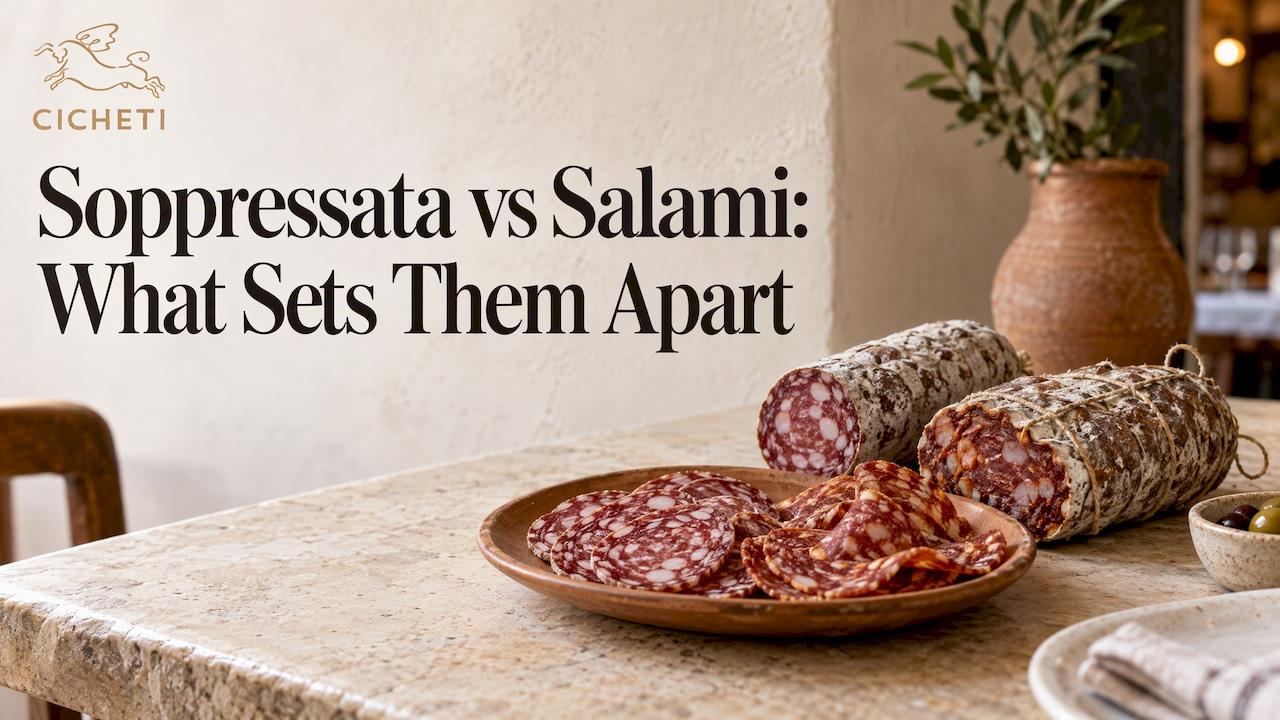
Soppressata is a salami, so the real question is what makes it a particular kind of one. In short: soppressata is usually coarser, leaner, pressed flatter and spicier than the smooth, fattier salami most of us grew up slicing onto crackers. The details change from region to region, though, and one Italian product with the same name is something else entirely. This guide covers all of it, so you can read a label, order from a board or choose a topping with confidence.
TL;DR
- Soppressata is a specific style of Italian dry salami. All soppressata is salami, but not all salami is soppressata.
- It is typically coarsely ground or knife-cut, made from leaner pork, lightly pressed into an oval shape and often seasoned with black pepper or chilli.
- Standard salami is generally finer in grain, fattier, more cylindrical and milder.
- Soppressata di Calabria carries a protected designation (DOP). The Tuscan soppressata is a different, cooked product.
- Spicy soppressata is a natural partner for pizza and for medium-bodied Italian reds such as Barbera or Chianti.
Table of Contents
- The short answer: one family, two personalities
- Meat and fat: where the difference starts
- Grain, pressing and shape
- Flavour, heat and texture
- Names, regions and one very different sausage
- How to spot the real thing
- How to serve and pair them
- Our view from Kandahar Street
- Plan a table at Cicheti
- FAQ
- Sources
The short answer: one family, two personalities
"Salami" is the umbrella term. It covers cured sausages made from ground meat, fat and salt, fermented, stuffed into a casing and dried until firm. Fermentation gives salami its tangy depth and slow drying concentrates the flavour, and soppressata follows the same basic logic. Soppressata is a specific type of Italian dry salami, most associated with Calabria, Basilicata and Puglia in the south.
So when someone asks whether soppressata is better than salami, the fair reply is that you're comparing a style with its own category. If you like a smooth, mild slice, a classic salami will suit you. If you like a chunkier bite with more pepper, soppressata is the one to reach for.
Here's the comparison at a glance. Treat the figures as typical rather than fixed, because makers differ.
| Soppressata | Typical salami | |
|---|---|---|
| Meat | Leaner cuts such as shoulder, thigh and ham trimmings | Lean pork plus a larger share of fat |
| Grain | Coarse, often knife-cut or coarsely minced | Finer, usually machine-ground |
| Shape | Oval or slightly flattened from pressing | Round and cylindrical |
| Flavour | Peppery, often spicy, fuller-bodied | Milder, rounder, richer in fat |
| Colour | Bright to deep red | Paler red with fine white flecks of fat |
| Home region | Calabria, Basilicata, Puglia | Throughout Italy, with many regional styles |
Meat and fat: where the difference starts
The biggest difference sits in the mixture. According to Mashed, salami's lean-to-fat ratio ranges between 60:40 and 70:30, while soppressata uses leaner cuts. Because there's less fat to soften the flavour, the spices come through more clearly, which is why soppressata tends to taste fuller-bodied.
The Calabrian specification is a useful benchmark. Soppressata di Calabria uses lean meat from the shoulder, leg and fillet, with lard of between 4 and 15% per kilo of meat. It's minced to a medium grain and seasoned with salt, black pepper and, optionally, wine and natural flavourings. Other makers lean on fennel, garlic and red wine, so there's no single recipe.
A note on fat: lean doesn't mean dry or austere. A good soppressata still has visible pieces of fat and meat. The difference is in how they sit. Fat in soppressata tends to come in larger, less evenly spread pieces, while in a fine-grained salami it's distributed so smoothly that you hardly see it.

Grain, pressing and shape
The name gives the game away. Soppressata comes from the Italian for pressing, and traditional makers weigh the sausage down while it cures, squeezing it into a slightly flattened, rustic shape. Mashed notes that the pressing, usually with a wooden plank, releases air bubbles and gives it an oblong form. Salami, by contrast, stays round.
The grain is the other tell. In Italy, producers describe the split in terms of how the meat is cut. Salumificio Santoro explains that salame is ground mechanically, giving a fine grain, while soppressata is cut with a knife, giving a coarse grain. Not every modern soppressata is truly knife-cut, but the coarse, chunky look is the point.

For scale, the Calabrian version is cylindrical and slightly flattened, 10 to 18 centimetres long and 4 to 8 wide, with a compact and fairly soft slice. That's a fairly stout sausage, which is part of why the slices look so wide on a board.
How long they cure
You'll see different numbers depending on whom you ask, because curing time depends on the diameter, the climate of the room and the maker. The same Italian producer describes soppressata as ageing for around 40 days and salame for up to four months, which is one of the reasons for their different flavours. Other sources quote anything from several weeks to a few months. The useful takeaway is that thickness and style, not a single fixed schedule, set the timing.
What curing does is well documented. When meat is dry-cured, it loses roughly 30 per cent of its weight in water, which is why the flavour becomes so dense. The same piece explains that good bacteria and mould protect the meat and deepen its fermented character.
Flavour, heat and texture
Is soppressata just spicier salami? Often, yes, though not always. Traditional soppressata is meant to be spicy, akin to pepperoni, but mild or sweet versions are not uncommon, while a typical salami is generally milder. The colour follows the seasoning: soppressata is usually bright red and can go darker with certain spices, with a robust peppery aroma.
Texture matters more than most people expect. As Jimmy Wilson of Charcuterie Lab puts it, coarse grinding changes the eating experience more than the seasoning does: finely ground salami tastes uniform, while soppressata's larger pieces make each bite slightly different. That's the reason soppressata can feel more handmade, even when it's produced at scale.
The heat usually comes from chilli. In Calabria that often means the local red pepper. If you enjoy that profile, our note on Calabrian chilli, its heat and how to use it explains what to expect and how it behaves on a hot pizza.
Names, regions and one very different sausage
The word covers more ground than people realise, so a quick tour helps.
- Calabria. Locally the sausage goes by names such as suppizzata or surpressata, and comes mainly in a hot (piccante) version, with a sweeter (dolce) one less often. The specification for Soppressata di Calabria sets out three types: hot, sweet and white, which has neither pepper.
- Basilicata. Soppressa lucana is described as smoked and savoury, traditionally cut with a knife and eaten on its own.
- Puglia. In Martina Franca the local soppressata is called subburséte, and it comes in sweet and spicy versions.
- Veneto. Sopressa is the northern cousin. The Istituto Valorizzazione Salumi Italiani lists Sopressa Vicentina among the Italian salumi with DOP status. We mention it because Venetian cooking is close to our own small-plate repertoire, and our guide to Venetian food specialties shows how the region likes to eat.
- Tuscany and Liguria. Here is the one that trips people up. Soppressata Toscana is a very different product, made from leftover pig parts, often including the head and tongue, set in a gelatin-rich cooking liquid. It's a cooked, head-cheese-style sausage, not a dry-cured one. If a menu or deli counter says soppressata, check which style it means.
How to spot the real thing
In Singapore, most soppressata reaches you through importers, delis or restaurant menus, so the label is your guide. Three habits help.
- Read the full name. A regional word on a pack doesn't always mean a protected product. Where origin matters to you, look for the full registered name, such as Soppressata di Calabria, and the official DOP or PGI logo.
- Know what DOP means. According to the Istituto Valorizzazione Salumi Italiani, DOP applies to products whose quality is essentially due to their geographical environment, with the whole production taking place in the delimited area. For Soppressata di Calabria, that covers the pigs' breeds and origin and processing in Calabria.
- Look at the cut surface. A genuine dry-cured soppressata shows distinct pieces of meat and fat, not a uniform paste. The Tasting Table guide to the PDO notes the rules call for ham and shoulder with loin fat at around 12% to 15% fat content, which explains the chunky marbling.
None of this makes a non-DOP soppressata a poor one. Plenty of good soppressata is made outside the protected area. The designation simply tells you where and how it was made.
How to serve and pair them
Both cure well at room temperature, so take them out of the fridge about twenty minutes before eating. Slice soppressata a touch thicker than a fine salami, because the coarse grain holds together and the flavour opens up with a little more bite.
The pairings differ because the personalities do.
- On pizza. Spicy soppressata is a natural stand-in for pepperoni, and it works well as a topping because the heat and fat bloom in a hot oven. In a wood-fired oven, the edges crisp and curl while the pepper aromas intensify. Pair it with something creamy such as mozzarella, and our comparison of burrata and mozzarella will help you choose the cheese.
- In pasta or risotto. It's often sliced thicker than salami, so it holds its own in substantial dishes such as risotto or pasta.
- On a board. Mild salami and silky ham sit well together. If you're weighing cured meats for a platter, our guide to prosciutto crudo versus cotto covers the other half of the board.
- With wine. The principle from sommelier Curt Tudor at Sommy.ai is to match intensity: bold, spicy meats like soppressata need a wine that can stand up to them. Waterfront Gourmet suggests that Chianti Classico has enough acidity and medium tannins to cope without bulldozing the meat, while Barbera d'Asti is a softer pick with bright cherry fruit.
If you're planning a whole evening around cured meats, it helps to think of it as one of several exquisite dining and culinary experiences you can shape, from the board to the wine to the table you sit at.
Our view from Kandahar Street
We cook with fire and we like food that has a clear point of view. That is why we find soppressata so easy to explain: it is salami with its sleeves rolled up. Coarser, leaner, a bit more peppery, a bit less polite.
At Cicheti, on 52 Kandahar Street, our all-local kitchen team cooks wood-fired Neapolitan pizzas and Venetian-style small plates, and we think the same rule applies to both. Good ingredients should taste like themselves, and the oven or the cure should add character rather than hide it. A spicy cured pork sits happily on a blistered pizza crust for the same reason a glass of something bright and a little unfamiliar sits happily beside it.
That second part is where our wine list comes in. We curate Italian wines from lesser-known varietals, because the grapes that rarely make the headlines are often the ones that cope best with pepper, fat and salt. If you're ever unsure what to drink, our Sommelier Selection of the day is there for exactly that question.
Cicheti
Plan a table at Cicheti
If this has made you hungry, you can see what's cooking on our food menu and browse the drinks menu, where the Sommelier Selection of the day is priced from $19 to $90. For a group, our festive set menus are served family-style: the Cicheti Family-Style Menu is $85 per person, and the Feast of the Seven Fishes is $95 per person. For pizza, pasta and shared plates with a larger party, our private events page explains the options. Browse the wood-fired pizzas and Italian wines and book a table when you're ready.

For current dishes, availability and dietary details, please check the menu pages before you visit, since our menus change.
FAQ
Is soppressata the same as salami?
Not exactly. Soppressata is a specific type of salami, so every soppressata is a salami but not every salami is a soppressata. It is usually coarser, leaner, flatter and spicier than a standard salami.
Does soppressata taste like salami?
It tastes related but bolder. Because it contains less fat, the pepper, chilli and other seasonings come through more strongly, and the coarse grain gives each bite more texture. Mild and sweet versions exist if you prefer less heat.
What do Italians call soppressata?
It depends on where you are. In Calabria you'll hear suppizzata, supprezzata or surpressata, in Puglia's Martina Franca it's subburséte, and in Veneto the related sausage is sopressa. Italians also distinguish salame, which is machine-ground and finer, from soppressata, which is coarser and often pressed.
Is soppressata good on pizza?
Yes, especially the spicy kind. It behaves much like pepperoni, releasing a little paprika-red fat as it cooks and crisping at the edges. Choose a version with some heat if you want it to stand out against mozzarella and tomato.
Is Tuscan soppressata the same thing?
No. Soppressata Toscana is a cooked, gelatin-bound sausage made from head and other cuts, closer to a head cheese than to a dry-cured salami. When you want the firm, peppery sausage, look for southern Italian styles such as Soppressata di Calabria.
Sources
- Salami vs Soppressata vs Capicola: A Buyer's Guide
- Soppressata (Wikipedia)
- The Fatty Difference Between Salami And Soppressata (Mashed)
- Soppressata di Calabria (Apulica)
- What Is Soppressata? (Gardner's Wisconsin Cheese)
- Tipi di salame (Salumificio Santoro)
- Salumi 101 (Serious Eats)
- Salami vs. Soppressata: What's the Difference? (Yummy Bazaar)
- Soppressata vs Salami: Differences, Taste & Heat (Charcuterie Lab)
- Cucina calabrese (Wikipedia)
- Salumi DOP e IGP (Istituto Valorizzazione Salumi Italiani)
- What's The Difference Between Capicola And Soppressata? (Tasting Table)
- Wine with Charcuterie (Sommy.ai)
- Wine and deli meat pairings (Waterfront Gourmet)
- Exquisite Dining and Culinary Experiences