
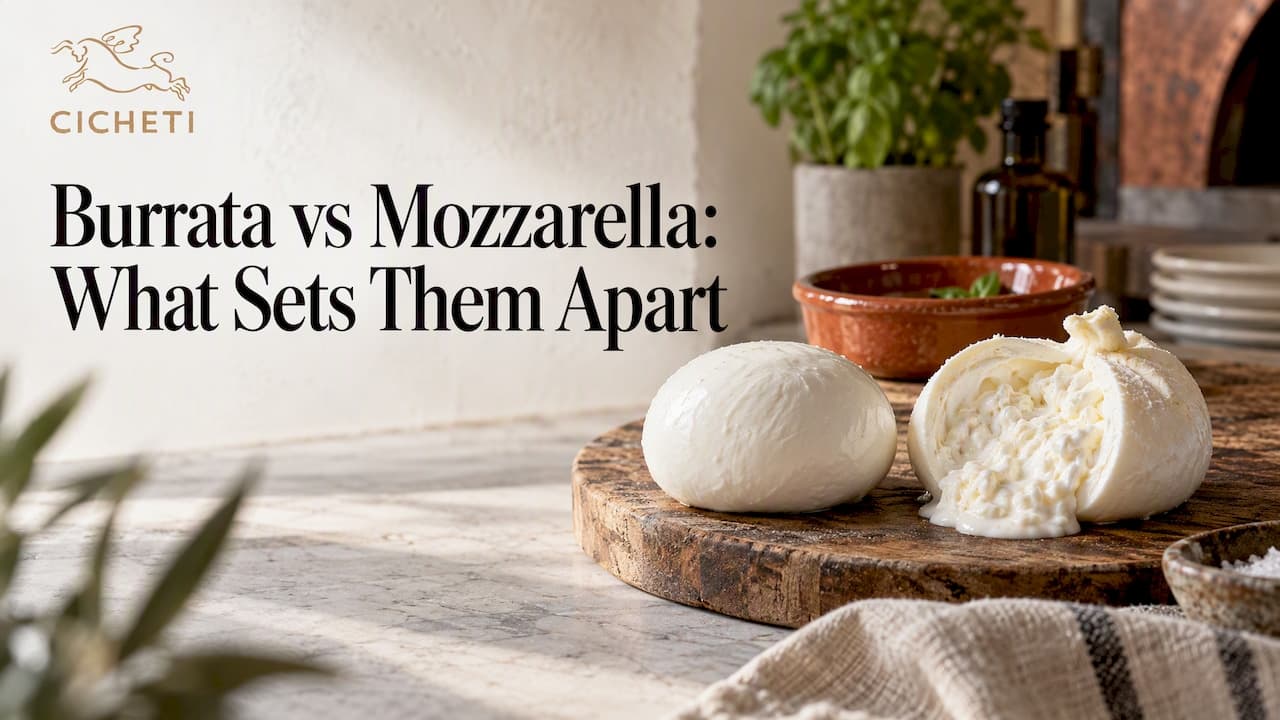
Burrata is mozzarella with a surprise inside. Both start as stretched, pulled curd, but mozzarella is solid and springy all the way through, while burrata is a thin mozzarella pouch holding soft, stringy curd and cream. Cut one open and you'll see the difference at once: mozzarella slices cleanly, burrata slumps across the plate. That single fact decides most of what follows, including which one belongs on a hot pizza and which one belongs beside it.
TL;DR
- Mozzarella is pulled curd throughout: firm, elastic, milky and mild. Burrata is a mozzarella shell filled with cream and curd, so it's softer, richer and almost buttery.
- For anything that goes in the oven, such as pizza, choose mozzarella. Melted burrata loses the contrast between shell and centre.
- Serve burrata at room temperature, or add it after cooking, with crusty bread or something sharp to cut the richness.
- "Buffalo" and "cow's milk" are a separate question from "burrata or mozzarella": either cheese can be made from either milk.
- Both are best fresh. Once opened, plan to finish them within a few days.
Table of Contents
- How the two cheeses are made
- Burrata vs mozzarella: texture and flavour side by side
- Is burrata the same as fresh mozzarella?
- Buffalo or cow's milk: a separate choice
- When to use mozzarella and when to use burrata
- How to serve and store them
- A note on nutrition
- Our view on burrata vs mozzarella
- Eating both at Cicheti on Kandahar Street
- FAQ
- Sources
How the two cheeses are made
Mozzarella and burrata belong to the same family, known as pasta filata, which simply means "spun paste". The curd is heated and stretched until it becomes smooth and elastic, then shaped. The Kitchn describes fresh mozzarella as a pulled-curd cheese with a firm, elastic texture and a delicate, milky flavour.
Burrata takes that same stretched curd one step further. According to America's Test Kitchen, it is made by stretching the curds, filling the resulting mozzarella with a mixture of shredded cheese and cream, and sealing it. The filling has its own name in Italian: stracciatella, from stracciare, to tear. In the case of Burrata di Andria IGP, the pouch is made from cow's milk and encloses stracciatella, which is fresh cream mixed with shredded mozzarella, as a Swiss food supplier's guide sets out.
The name gives the game away. Allrecipes points out that burro is the Italian word for butter, which hints at the cheese's rich character. So the short version of how burrata is made: it's mozzarella, wrapped around something softer and wetter than itself.

Burrata vs mozzarella: texture and flavour side by side
The flavours are close relatives. Allrecipes notes that burrata shares the notes of fresh mozzarella but has a richer, creamier texture. Where they part company is in the mouth.
| Fresh mozzarella | Burrata | |
|---|---|---|
| Structure | Stretched curd throughout | Mozzarella shell, creamy curd-and-cream centre |
| Texture | Firm, springy, a little squeaky | Soft, oozing, spoonable |
| Flavour | Delicate, milky, lightly salted | Richer, milky, buttery |
| Slices neatly? | Yes | No, it spills |
| Cooks well? | Yes, melts and stretches | Poorly, the contrast disappears |
| Best use | Pizza, bakes, caprese slices, salads | Served raw, as a starter or centrepiece |
A useful way to think about it: mozzarella is the supporting cast and burrata is the lead. Mozzarella lets tomato, basil and good olive oil do the talking. Burrata sits at the centre of a plate and asks for a little acidity, salt or bitterness to balance it. AP News food writer Katie Workman, quoted by AP, likens burrata to the cheese-world equivalent of a molten chocolate cake, which is a fair way of saying you shouldn't ask it to do a supporting job.
Is burrata the same as fresh mozzarella?
No. Burrata uses a shell of fresh mozzarella, but its filling of cream and curd is what makes it burrata. Fresh mozzarella is a solid, elastic mass of stretched curd from edge to centre, as Allrecipes explains. If a menu lists "fresh mozzarella" and "burrata" as two separate items, they genuinely are two different things, and burrata will usually cost more.
Fresh mozzarella also comes in several shapes. AP News lists large balls, bocconcini (small, bite-sized balls) and treccia (a braid), each suited to different jobs, from salads to a cheese platter centrepiece. The small ones are handy when you want an even bite in every forkful. The large ones are what you tear or slice.
Buffalo or cow's milk: a separate choice
People often set "buffalo mozzarella" against burrata as though they were two cheeses of the same kind. They're really answers to two different questions. One is the shape of the cheese (solid or filled). The other is the milk.
Cow's-milk mozzarella is sometimes called fior di latte, which America's Test Kitchen notes is to tell it apart from mozzarella made with water buffalo's milk. The Italian consortium for Mozzarella di Bufala Campana DOP explains the method: buffalo milk is coagulated with rennet, the curd is stretched in boiling water, then rested in cold, salted water. The consortium adds that buffalo milk is richer in proteins, fats and calcium than cow's or sheep's milk, which goes some way to explaining the fuller flavour.
Burrata can be made either way. Burrata di bufala is burrata made with buffalo milk. Tasting Table reports that buffalo milk has almost twice the fat and about 5% less water than cow's milk, making the cheese creamier and richer, with a sweet, tangy and sometimes faintly yeasty flavour. A Malaysian cheese importer's product listing similarly describes the burrata shell as made from buffalo and/or cow's milk mozzarella, with a filling of curd and fresh cream.
In practice, a buffalo burrata is the richest of the lot, so you'll want to leave it plain, or nearly so.
If you're buying genuine Mozzarella di Bufala Campana DOP, two details from the consortium are worth knowing. By law it must be sold in packaging created in its place of origin. And since pasteurisation breaks down possible bacteria, the consortium advises checking that the cheese was made with pasteurised rather than raw milk, which matters most for anyone pregnant or otherwise vulnerable. If that applies to you, your doctor or midwife is the right person to ask about soft cheeses.
When to use mozzarella and when to use burrata
The rule of thumb is simple: heat favours mozzarella, and plates served cool or just warm favour burrata.
On a pizza
The Kitchn is direct about this: fresh mozzarella is the better and cheaper choice for a cooked dish like pizza, because melted burrata loses the contrasting textures that make it worth buying. Mozzarella's stretched, elastic structure is what gives a baked pizza its pull. Burrata would simply collapse into a milky puddle.
This is also why a very hot oven suits mozzarella so well. In a wood-fired oven a Neapolitan pizza bakes quickly, so the cheese melts and blisters without drying out, and the tomato underneath stays bright. If you like the idea of burrata on pizza, do what the Kitchn suggests and add it after cooking. A torn half-ball laid on a hot pizza as it leaves the oven warms through gently and keeps its creamy middle. If you're curious about how crust and cheese work together, our guide to pizza crust styles from Neapolitan to New York covers the dough side of the equation.

On a plate
Burrata is at its best served raw, at room temperature, with crusty bread to catch the cream. Good partners are the following:
- Ripe tomatoes, with a pinch of salt and good olive oil
- Something bitter or peppery, such as rocket or grilled radicchio
- Salty cured fish or meats
- A little heat to cut through the cream. A few drops of chilli oil work well, and so does Calabrian chilli
- Grilled or roasted vegetables, which makes it an easy centrepiece for a vegetarian Italian meal
For plating inspiration, these food presentation ideas show how colour and height can turn a simple starter into the centre of the table. With burrata the principle is easy: keep it whole in the middle of the plate, and let your guest be the one to cut it open.
In a salad or caprese
Here you can choose either. Sliced mozzarella gives you tidy layers with tomato and basil. Burrata turns the same plate into something looser and richer, with the cream acting as a dressing. Buffalo mozzarella DOP, according to the Swiss supplier's guide, is served raw or added at the end of cooking, while burrata is used for raw service.
How to serve and store them
Temperature matters more than most people expect. Straight from the fridge, both cheeses taste muted and the texture is tight.
- Mozzarella di bufala: the consortium says to keep it in its protective liquid. If it has been refrigerated, bring it to 18 to 20°C about 30 minutes before serving, or warm it in water at 35 to 40°C for about 10 minutes.
- Eating it fresh: the consortium also advises that Mozzarella di Bufala Campana DOP should be eaten on the day it is bought.
- Once opened: Epicurious says fresh mozzarella or burrata will keep for five days in the fridge. Other guides are more cautious, so in Singapore's heat, treat that as the outer limit and eat sooner where you can.
- Burrata specifically: keep it in its liquid, tightly covered. Once cut, the filling is the first part to go off its best, so serve it in one sitting.
Can you freeze it?
You can, with a trade-off. A 2023 review of ice crystallisation in mozzarella reports that freezing can cause ice crystallisation and casein dehydration, with defects such as low cohesiveness and fat leakage, though effects vary with conditions. An Italian study found that freezing buffalo milk, curd and finished buffalo mozzarella for 11 months, when properly carried out, did not compromise microbiological quality and caused only slight changes in some physical properties. So a frozen mozzarella is fine on a pizza or in a bake, where texture matters less. Burrata, with its cream filling, isn't a candidate: buy it close to the day you plan to eat it.
A note on nutrition
We won't quote figures here, because they vary between producers and milks. The direction is clear enough, though: burrata's cream filling makes it richer than plain mozzarella, and buffalo milk is itself richer in fat and protein than cow's milk. Check the label of the product you're buying, and if you follow a specific diet for health reasons, ask your dietitian or doctor.
Our view on burrata vs mozzarella
We cook with wood fire, and that shapes how we think about cheese. A Neapolitan pizza spends moments in a very hot oven, and what goes on it has to be able to take that: mozzarella that melts, stretches and browns in patches. That's the job of mozzarella, and it does it well.
Cicheti's other half is the small plates of Venice, the cicheti that give the restaurant its name: small bites meant to be shared at the table with a glass of something. Cold, creamy things like burrata belong to that way of eating, where a single dish can be torn, passed round and mopped up with bread. Our approach is to match each cheese to what it's good at, rather than treating one as a luxury version of the other.
If you're deciding at the table, ask our team which cheeses are on the menu that day, since dishes change and we'd rather you hear it from the people serving you than from a guess in an article. Our kitchen team is entirely local, and we're happy to talk you through anything on the food menu. Pair the creamy dishes with something crisp. Our guide to Pinot Grigio or Sauvignon Blanc helps with the pour, and the wines of Veneto are a natural match for the small-plate side of the menu.
— Cicheti
Eating both at Cicheti on Kandahar Street
If you'd rather taste the difference than read about it, you can come to Cicheti at 52 Kandahar Street, in Singapore's Arab quarter, for wood-fired Neapolitan pizzas, Venetian-style small plates and a list of lesser-known Italian wines. Sharing is the natural way to eat here. Our Cicheti Family-Style Menu is $85 per person, and our Sommelier Selection of the day is priced from $19 to $90. Check the menu pages for what's currently on offer, as dishes and availability change.

To plan a table for a group, see our notes on family-style Italian dining in Singapore, or if you're celebrating, enquire about private events. Otherwise, you can see our menus and book a table.
FAQ
Is burrata better than mozzarella?
Neither is better; they do different jobs. Burrata is richer and softer, so it suits raw dishes where the creamy centre is the point. Mozzarella is firmer and melts well, so it suits pizza and baked dishes, and it's cheaper too.
Can I use burrata on pizza?
You can, but add it after the pizza comes out of the oven. The Kitchn advises that melting burrata loses its textural contrast, which is why fresh mozzarella is the better cheese for baking. Torn onto a hot pizza, burrata warms gently and keeps its creamy middle.
What is buffalo burrata?
Buffalo burrata, or burrata di bufala, is burrata made with buffalo milk instead of cow's milk. Buffalo milk has almost twice the fat of cow's milk, according to Tasting Table, so the cheese is creamier and richer, with a slightly tangy flavour.
How long does burrata keep once opened?
Epicurious gives five days refrigerated for opened fresh mozzarella or burrata, while other guides suggest two to three days. The safer approach is to eat burrata the day you open it, and keep it covered and chilled if you can't.
Can you freeze buffalo mozzarella?
Yes, with some change to texture. Research on frozen buffalo mozzarella found only slight changes in some physical properties when freezing was done properly, but reviews also note possible fat leakage and a less cohesive texture. Use thawed mozzarella in cooked dishes rather than serving it raw.
Sources
- Mozzarella vs. Burrata: What's the Difference? (The Kitchn)
- A Guide to Mozzarella and Burrata (America's Test Kitchen)
- What Is Burrata and How Is It Made? (Allrecipes)
- Mozzarella vs Burrata vs Buffalo Mozzarella PDO (LAPA)
- Discover the magic of fresh mozzarella (AP News)
- Why Burrata Made With Buffalo Milk Tastes Better (Tasting Table)
- Manufacture (Consorzio di tutela Mozzarella di Bufala Campana)
- Production (Consorzio di tutela Mozzarella di Bufala Campana)
- Nutritional values (Consorzio di tutela Mozzarella di Bufala Campana)
- Il decalogo per gustare al meglio la mozzarella di bufala (Consorzio)
- How to Buy and Store Mozzarella Cheese Like a Pro (Epicurious)
- Ice crystallization and structural changes in mozzarella (Taylor & Francis)
- Impact of Freezing on the Microbiological Quality of Buffalo Mozzarella (PMC)