
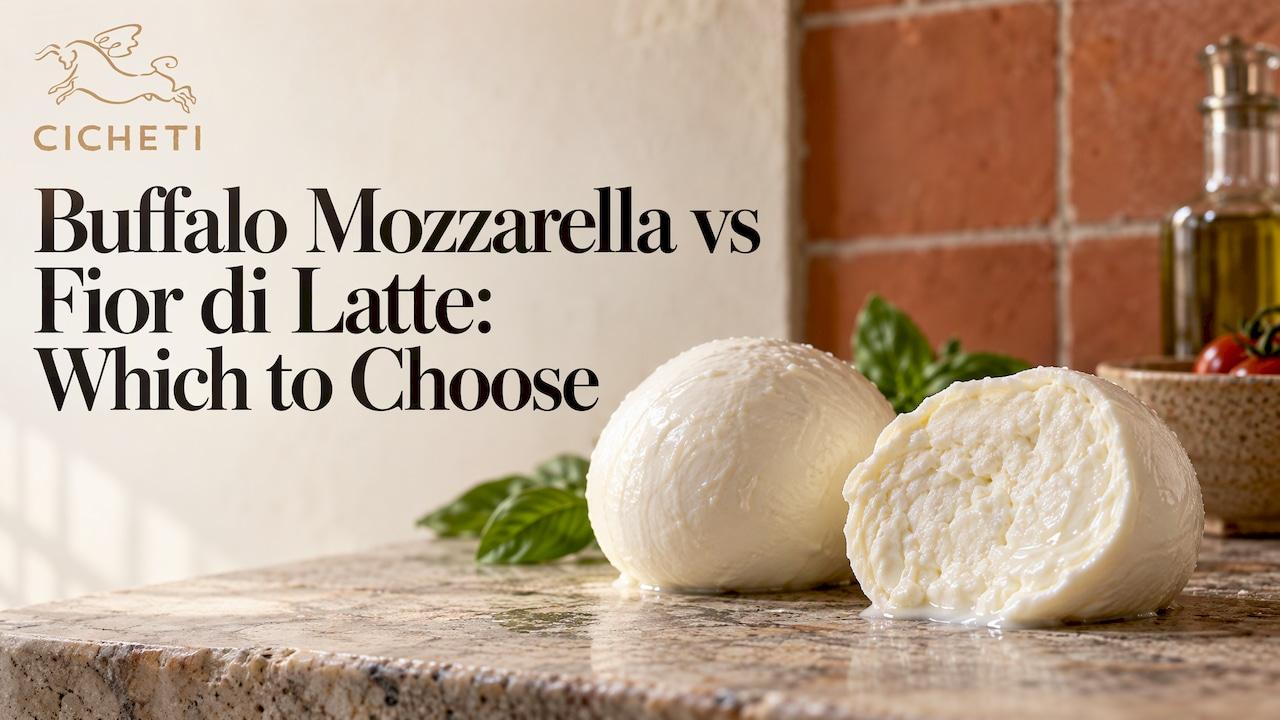
The short answer is the milk. Mozzarella di bufala is made from water buffalo milk, and fior di latte is made from cow's milk. Buffalo is richer, wetter and tangier, so it shines raw. Fior di latte is cleaner and holds together under heat, which is why many pizzaioli bake with it. If you're choosing for a pizza, fior di latte is the usual answer. For a plate with tomatoes, olive oil and bread, buffalo is the one to reach for.
Both are properly called mozzarella, which is where the confusion starts. This guide explains what separates them, how each behaves in a wood-fired oven, how to serve them, and how to read a menu or a shop label without second-guessing yourself.
TL;DR
- Milk is the whole difference: buffalo mozzarella uses water buffalo milk, fior di latte uses cow's milk, and everything else follows from that.
- Flavour: buffalo is creamier, softer and tangier. Fior di latte is milder, milky and slightly firmer.
- For pizza: fior di latte is the usual baking cheese because it releases less water. Buffalo is often added at the end or after baking.
- For eating raw: buffalo mozzarella suits Caprese, salads and simple plates, served at room temperature.
- Neither is the "lesser" cheese: they are two traditional cheeses with different jobs.
Table of Contents
- What each cheese actually is
- Buffalo mozzarella vs fior di latte side by side
- Why the milk changes everything
- Which mozzarella is better for pizza?
- What wood-firing does to the cheese
- Serving each cheese at its best
- Is buffalo mozzarella healthier?
- How to tell which one you're getting
- Our view on mozzarella and pizza
- Eat it where it's cooked properly
- FAQ
- Sources
What each cheese actually is
The word mozzarella describes a method, not a milk. Caseificio Perrusio explains that the curd is worked in hot water, stretched, and then cut off by hand, which is where the Italian verb mozzare (to cut off) comes from. Do that with cow's milk and you have fior di latte. Do it with buffalo milk and you have mozzarella di bufala.
So when a menu says "mozzarella" without more detail, it could mean either. Fior di latte, literally "flower of milk", names a style rather than a protected product. According to cheese.help, a 2022 European Commission decision reserved only the full name Mozzarella Tradizionale, while plain "mozzarella" can still be used by cheeses that don't follow that recipe.
Mozzarella di bufala has an extra layer of naming. Wikipedia notes that buffalo mozzarella is made across Italy, but only the selected Mozzarella di Bufala Campana is protected under EU law, made from the milk of Italian buffalo raised in designated areas of Campania, Lazio, Apulia and Molise. If you see PDO (or DOP in Italian) on the pack, that is the protected one.
Buffalo mozzarella vs fior di latte side by side
| Fior di latte | Mozzarella di bufala | |
|---|---|---|
| Milk | Cow's milk | Water buffalo milk |
| Flavour | Clean, milky, dairy-forward, sometimes gently buttery | Richer, tangier, with a slightly grassy edge |
| Texture | Slightly firmer, springy | Softer, creamier, very moist |
| Colour | Creamy white | Porcelain white |
| Behaviour in heat | Melts evenly, releases less water | Releases more water and fat |
| Best used | Pizza, baked pasta, aubergine parmigiana, toasties | Caprese, salads, a plate with bread and oil |
| Price | Usually lower | Usually higher |
The flavour and texture lines come from cheese.com's comparison, which also notes that buffalo is typically the more expensive of the two. Tasting Table's experts describe fior di latte as clean and dairy-forward, and Mozzarella di Bufala DOP as especially creamy and soft with a subtle tang and very high moisture.
Why the milk changes everything
Buffalo milk is simply richer. LAPA reports that it has around 8% fat against about 3.5% in cow's milk, and more protein too. That gives buffalo mozzarella its more intense flavour, grassy aroma and creamier structure. The Cheese Professor puts the difference in baking terms: fior di latte is the regular baguette, and mozzarella di bufala is the sourdough.
That richness is also why buffalo costs more. LAPA points to lower yield and costlier farming as real reasons the DOP cheese is roughly twice the price. You are paying for the animal and the area, not just a label.

The Mozzarella di Bufala Campana rules are strict about the milk. According to cheese.help, the PDO requires fresh whole water buffalo milk with at least 7.2% fat and 4.2% protein. Fior di latte has no equivalent rule that sets it apart as a protected cheese, which is part of why quality varies more widely from one maker to another.
Which mozzarella is better for pizza?
For most pizzas, fior di latte. The reason is water. Buffalo mozzarella holds a lot of moisture and fat, and when heat hits it, some of that ends up on your dough.
In an interview with La Cucina Italiana, pizzaiolo Francesco Capece says fior di latte is the right choice for pizza because it has a lower fat percentage and doesn't tend to burn, while buffalo loses a lot of weight in cooking and releases water onto the dough. His method is to add fior di latte two minutes before the end of the bake, and to put buffalo on only after the pizza leaves the oven.
Other voices agree on the practical point. LAPA's Paul Teodorescu says that for a classic Neapolitan Margherita, fior di latte releases less whey at 450°C and keeps its structure, while a "bufalina" gets buffalo added raw at the end or briefly baked in the wood oven. The Cheese Professor adds that much of buffalo's subtle flavour is lost once it is baked under tomato sauce, so many pizzaioli see little point in paying for it.
But buffalo does appear on Neapolitan pizza
Both cheeses have a place in the tradition. Saveur describes mozzarella di bufala as rich and milky and fior di latte as slightly less wet but full of intense flavour, and treats both as acceptable for Neapolitan pizza.
It works because of the speed of a wood-fired oven. cheese.help notes that the Pizza Napoletana rules allow 80 to 100 grams of sliced Mozzarella di Bufala Campana, with a bake of 60 to 90 seconds at about 485°C, and the cheese itself only reaches 65 to 70°C. In that short time even wet buffalo mozzarella just melts, rather than stewing the base.
There is a practical lesson here. A home oven that tops out at 250°C bakes for ten minutes or more, and buffalo will weep long before the crust is ready. A very hot oven forgives wetter cheese. A domestic one doesn't.
If you'd like to see how the base itself changes the picture, our guide to pizza crust styles from Neapolitan to New York is a good companion. And if you're deciding between the two classic Neapolitan toppings, margherita vs marinara explains why one has cheese and the other doesn't.
What wood-firing does to the cheese
A wood-fired oven runs far hotter than a home or standard commercial oven, and a Neapolitan pizza is done in around a minute and a half. Short, intense heat does three things for the cheese. It melts the surface without cooking the inside to rubber. It leaves less time for whey to escape. And it can leave a few blistered, lightly browned spots where the cheese meets the crust.
That's why the choice between buffalo and fior di latte matters less at 485°C than it does at 250°C, and why the choice of oven is part of the conversation about cheese. Cicheti's pizzas are wood-fired Neapolitan pizzas, and our food menu lists what is on offer at 52 Kandahar Street.
Serving each cheese at its best
Buffalo mozzarella: raw, at room temperature
Buffalo mozzarella is at its finest when you barely do anything to it. The Consorzio di tutela Mozzarella di Bufala Campana DOP recommends eating it on the day you buy it. If you keep it in the fridge, leave it at room temperature for at least an hour before eating, or immerse the sealed pack in hot water (35 to 40°C) for about five minutes.
The cheese should stay in its liquid. Qualigeo advises keeping it in a cool place in a glass or ceramic container with its liquid. If you plan to cook with it, remove it from the liquid and leave it in the fridge for several hours to drain off the excess.
Then keep it simple: ripe tomatoes, good olive oil, a little salt, bread. That's a Caprese, and it needs nothing else.

Fior di latte: where it meets heat
cheese.help suggests fior di latte for pizza, baked pasta, aubergine parmigiana, sandwiches and panini, where it slices cleanly and holds its shape. It is the sensible cheese for anything that goes in an oven.
Draining helps. Capece's advice is to cut fior di latte into strips and buffalo into slices, and to drain both in the fridge for 48 hours before use. It sounds fussy, but it's the difference between a crisp base and a damp one.
Using up leftovers
Fresh mozzarella doesn't keep long. If you have half a ball of buffalo left, it's better in tomorrow's lunch with a few leaves and oil than in tomorrow's pizza. Fior di latte is the more forgiving candidate for a bake, so tear it over a tray of vegetables or a pasta dish.
Is buffalo mozzarella healthier?
Neither is a health food or a problem food. They are fresh cheeses, and the difference is mostly about richness. Buffalo milk has more fat and protein than cow's milk, as the LAPA figures above show, so buffalo mozzarella tends to be the richer cheese. Italy At Home says buffalo mozzarella has a higher content of proteins and fats, while fior di latte has a lower calorie and fat content.
If you have a specific dietary need, such as a dairy allergy or a medical reason to limit fat, ask your doctor or a registered dietitian rather than choosing by cheese type. For anyone steering clear of lactose, these lactose-free meal ideas are a handy starting point for planning what to cook or order.
How to tell which one you're getting
A few quick checks help at the deli counter or on a menu.
- Read the name. Mozzarella di bufala or bufala campana DOP means buffalo milk. Fior di latte means cow's milk. Plain "mozzarella" is ambiguous, so look for the milk on the label.
- Look at the colour. Buffalo is a very white, almost porcelain colour. Fior di latte is a touch more creamy.
- Cut it. Buffalo weeps a milky, slightly fatty whey and feels soft. Fior di latte is springier and drier.
- Check the price. If it's cheap and labelled bufala, read the label again.
- Ask the kitchen. At a restaurant, asking which mozzarella is on a dish is a perfectly ordinary question.
And where does burrata fit? It is a different cheese: a pouch of mozzarella filled with cream and shreds of curd. Our guide to burrata vs mozzarella explains the distinction.
Our view on mozzarella and pizza
We cook wood-fired Neapolitan pizzas at Cicheti, and we think about cheese the way we think about everything on the menu: by what it does in the dish. A pizza that spends barely a couple of minutes in a very hot oven is a particular kind of cooking, and it rewards simple, well-judged toppings.
What we'd tell any guest is that neither mozzarella is the villain or the hero. Buffalo is lovely where it's left alone, and fior di latte is made for heat. Knowing which is which makes you a better judge of any pizza, ours included.
Our menu is built around Venetian-style small plates and regionally inspired Italian dishes, and it's cooked by a local kitchen team. Come and have a look at what's on the table, and bring your opinions about cheese.
Cicheti
Eat it where it's cooked properly
If this has made you curious about how a wood-fired Neapolitan pizza should taste, we'd love to have you at Cicheti, 52 Kandahar Street, in Singapore's Arab quarter. You'll find our wood-fired pizzas, Venetian-style small plates and a curated list of Italian wines, including lesser-known varietals.

See the Cicheti food menu or book a table and explore what we're serving. If you'd rather pair the cheese with a glass, our Sommelier Selection of the day is listed from $19 to $90. If you're planning a group meal, the Cicheti Family-Style Menu is $85 per person, and our private events page covers pizza-making workshops and wine tasting classes. For a lighter table, take a look at vegetarian Italian dishes to order.
FAQ
Is fior di latte the same as mozzarella?
It is a type of mozzarella. Mozzarella describes the stretched-curd method, and fior di latte is the version made with cow's milk. Mozzarella di bufala is the one made with buffalo milk, so on a menu "mozzarella" alone doesn't tell you which milk was used.
Which mozzarella is better for pizza?
Fior di latte is the usual choice because it has less fat and releases less water, so the base stays crisp. Buffalo can work on a Neapolitan pizza in a very hot wood-fired oven, or added fresh after baking. Neither is automatically better, they just do different jobs.
Is buffalo mozzarella worth the extra cost?
It is worth it when you eat it raw, where its creaminess and tang come through. On a baked pizza, much of its subtlety is lost under sauce and heat, so fior di latte often makes more sense there. The higher price reflects lower milk yield and costlier farming.
How should I store fresh mozzarella?
Keep it in its own liquid, ideally eaten on the day you buy it. If you refrigerate buffalo mozzarella, take it out at least an hour before serving, or warm the sealed pack in 35 to 40°C water for about five minutes.
Sources
- Fior di Latte Mozzarella vs Buffalo Mozzarella, cheese.help
- Fior di latte or mozzarella: the differences, Caseificio Perrusio
- Mozzarella, Wikipedia
- Fior di Latte vs Mozzarella di Bufala, cheese.com
- 8 Types Of Mozzarella Cheese, Explained, Tasting Table
- Mozzarella vs Burrata vs Buffalo Mozzarella PDO, LAPA
- Mozzarella on Pizza: Types, Advantages, Techniques, The Cheese Professor
- La migliore mozzarella per pizza: qual è?, La Cucina Italiana
- Real Neapolitan Pizza, Saveur
- Bufala Campana, Consorzio di tutela Mozzarella di Bufala Campana DOP
- Mozzarella di Bufala Campana PDO, Qualigeo
- Differences between mozzarella and fior di latte, Italy At Home