
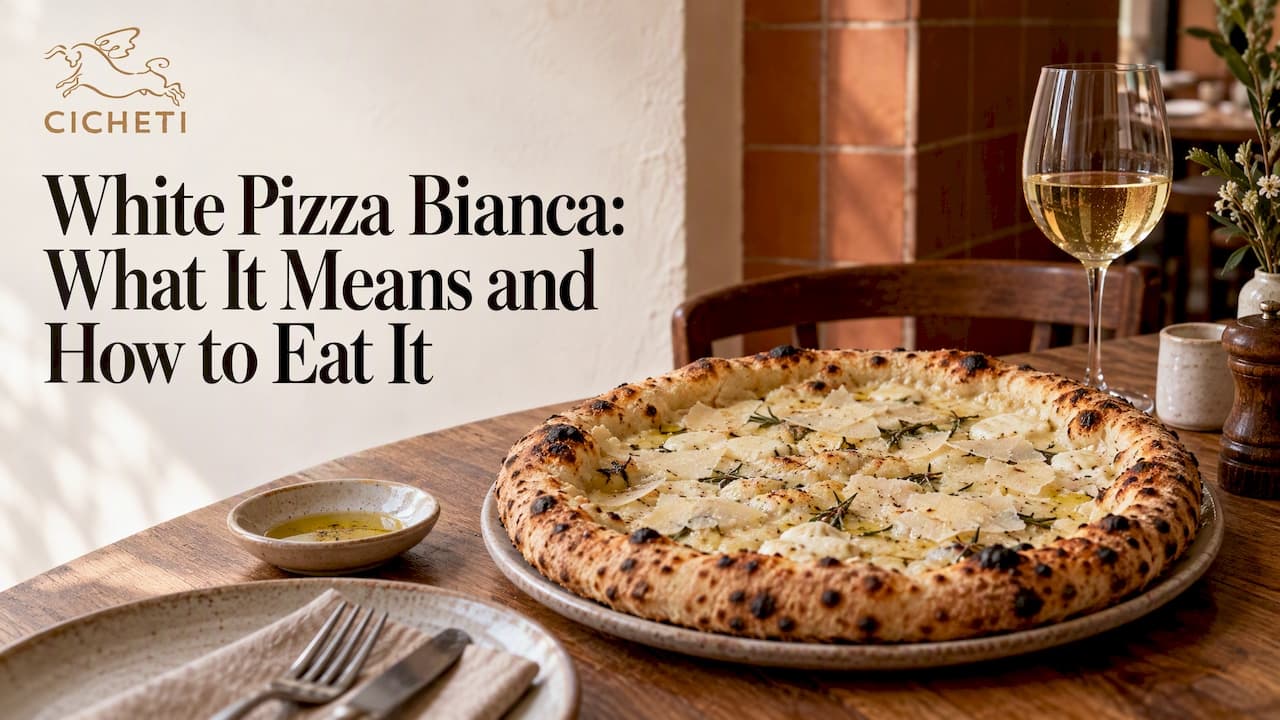
Pizza bianca means "white pizza", and it points to two different things depending on who is serving it. In Rome it is a plain, olive oil-slicked flatbread that sits closer to focaccia than to a cheese-covered pie. Elsewhere, "white pizza" usually means a topped pizza with no tomato sauce, often built on ricotta, mozzarella or cream. If you've ever ordered one and wondered why the plate looked so different from what you pictured, that's the reason.
This guide explains the name, the Roman original, the tomato-free pizzas you'll meet in restaurants, and how to order one with some confidence. We're Cicheti, a wood-fired Neapolitan pizza restaurant at 52 Kandahar Street, so we'll also say plainly where our own cooking fits in.
TL;DR
- Pizza bianca literally means "white pizza". In Rome it is a simple flatbread of flour, water, yeast, salt and olive oil, often sold from bakeries.
- The tomato-free "white pizza" served in many restaurants abroad is a related idea but a different dish: a topped pizza, usually with cheese.
- Roman pizza bianca is traditionally eaten warm and fresh, plain or split and filled with things like mortadella or ham and cheese.
- If you want a no-tomato pizza in Singapore, ask what the base is (cream, ricotta, olive oil) and whether the kitchen offers it on the day.
- Check our food menu for what's currently on, since menus change.
Table of Contents
- What does pizza bianca actually mean?
- Where pizza bianca comes from
- How Roman pizza bianca is made
- White pizza without tomato: the version you'll find in restaurants
- How pizza bianca is eaten in Italy
- Variations worth knowing
- Ordering a no-tomato pizza in Singapore
- Why wood-fire suits a pizza without tomato
- Perspective
- Plan your visit to Cicheti
- FAQ
- Sources
What does pizza bianca actually mean?
The words are simple. Pizza is pizza, bianca is the feminine form of "white". The "white" is a clue about what's missing: there's no red tomato sauce on top. That's where the agreement ends, because Italians and the rest of the world have attached the name to different foods.
In Rome, pizza bianca is a staple street food: a plain, oil-rich flatbread that behaves more like bread than like the cheese-topped pizza most of us imagine. You buy it by weight, in a rectangle cut from a long slab, and you eat it on the street or at your desk.
Outside Italy, the same two words often describe a restaurant pizza finished with cheese, garlic, herbs and sometimes vegetables, with the tomato simply left out. The glossary at PizzaHQ treats the two as different dishes that share a name, which is a tidy way to remember it.

Where pizza bianca comes from
Pizza bianca belongs to Rome, and its origin story is gloriously practical. Roman bakers used a small piece of dough to test the heat of the oven before baking their loaves. The piece baked quickly, and it turned into an affordable, ready-to-eat snack by mid-morning.
That explains a good deal about the dish. It was never meant to carry toppings or to be an evening meal. It was a baker's thermometer that happened to taste good, and the bakery (the forno) remains its natural home. The same AIFB article notes that the authentic version is found in those bakeries, and that it is eaten warm and fresh.
Turismo Roma, the city's official tourism site, points visitors to some historic bakeries serving pizza bianca around Campo de' Fiori and Piazza Navona. If you're ever in Rome, that's a sensible place to start.
How Roman pizza bianca is made
The ingredient list is short: flour, water, yeast, salt and extra-virgin olive oil. What gives it character is the handling and the heat.
According to the Italian bakers' association AIFB, the dough is high in hydration, up to 80%, and is baked directly on the oven floor at very high temperatures, above 300°C. The result is a crunchy, chewy structure with large bubbles and undulations rather than a uniform, tidy crumb.
That wet dough is the reason for the texture. More water means more steam in the oven, which blows open the crumb into those irregular holes. The olive oil then does two jobs: it flavours the crust and it helps the surface blister and crisp. A scattering of coarse salt finishes it.
Pizza bianca or schiacciata?
The Tuscan flatbread schiacciata is the cousin people often mix up with it. La Cucina Italiana describes schiacciata as a peasant dish, while Roman pizza bianca has a more urban history. They share similar base ingredients but differ in texture, so you can think of them as relatives who dress differently.
If you'd like a wider sense of how dough style changes a pizza, our guide to pizza crust styles from Neapolitan to New York walks through the main families.
White pizza without tomato: the version you'll find in restaurants
When someone searches for a "no tomato pizza", they usually want this: a round pizza base, topped, with no red sauce. It isn't the Roman bakery slab. The difference is not subtle. PizzaHQ notes a common misunderstanding is assuming Roman pizza bianca will arrive with cheese, when in a Roman forno it usually won't.
So here is a simple way to sort the two:
| Roman pizza bianca | Restaurant white pizza | |
|---|---|---|
| What it is | A plain flatbread, closer to focaccia | A topped pizza with no tomato sauce |
| Typical base | Olive oil and salt | Cream, ricotta, garlic oil or olive oil |
| Where you find it | Bakeries in Rome | Pizzerias and restaurants abroad |
| Eaten | Warm, fresh, as a snack | As a main or to share |
| Cheese | Usually none | Usually yes |
The popular recipes that top Google for this search show the restaurant style well. They lean on ricotta, mozzarella, mascarpone, crème fraîche, mushrooms, potatoes, goat's cheese and herbs. These are home recipes, and they are good ones, but they describe a pizza that's a cousin of the Roman bianca rather than the thing itself.
Why cheese choice matters
Without tomato, there is no acidity to cut through the dairy, so the cheeses carry everything. Mozzarella brings stretch and mild milkiness. Ricotta adds a soft, slightly sweet creaminess that melts into pools. If you enjoy comparing fresh cheeses, our piece on burrata versus mozzarella will help you decide which suits a white base. Something salty and sharp on top, such as cured meat or anchovy, tends to balance all that richness; we've written about why anchovies belong on pizza if that idea intrigues you.
How pizza bianca is eaten in Italy
Romans eat it simply. Turismo Roma's street food itinerary says pizza bianca may be filled with mortadella, ham and cheese, or served plain. The same page also mentions a pairing of raw ham and figs, which is a lovely contrast: salty, silky ham against the jammy sweetness of fruit, held in a warm, crackly bread.

The point is freshness. Local Aromas says pizza bianca is best enjoyed freshly baked and warm. Left to cool for hours, it stiffens and loses the contrast between crisp edge and soft interior that makes it worth eating.
If you're planning a Roman-style breakfast or mid-morning snack at home, a few small things help:
- Eat it the day it's baked, ideally within a short time of leaving the oven.
- Split it horizontally for a sandwich, and keep fillings simple: one cured meat, perhaps one cheese.
- Warm leftovers briefly in a hot oven rather than a microwave, so the crust crisps again.
- Cut with a sharp pizza cutter so the bubbled top doesn't collapse as you slice a large slab.
- Mid-morning is the traditional hour for a snack like this, and a strong Italian roast coffee is a natural companion.
For the cured meats, it helps to know what you're buying. Our explainer on prosciutto crudo versus cotto covers the difference between the raw, dry-cured ham and the cooked one.
Variations worth knowing
Roman pizza has not stood still. Turismo Roma describes the modern evolution of Roman pizza to include sweet and savoury variations, from Nutella and ricotta fillings to prosciutto and fig combinations. It also describes the city's pizza tradition as combining classic Roman flavours with innovative ingredients.
In practice, you'll meet a handful of broad patterns:
- Plain. Olive oil and salt on a blistered flatbread. The purest form.
- Filled. Split and stuffed with mortadella, or ham and cheese.
- Sweet and savoury pairings. Prosciutto with figs is the classic.
- Restaurant white pizza. A round base with cream or ricotta, mozzarella, garlic and herbs, with vegetables or cured meat added.
- Vegetable-led. Mushrooms, potato or onion with cheese, which suits guests who don't eat meat. Our guide to vegetarian Italian dishes has more ideas.
Ordering a no-tomato pizza in Singapore
Here's the practical part. If you see "bianca" or "white pizza" on a Singapore menu, three quick questions will tell you what's coming:
- What's the base? Olive oil, garlic oil, cream or ricotta each give a different pizza.
- Is it a bakery-style flatbread or a topped pizza? The name alone won't tell you.
- What's the cheese? Mozzarella is mild, while something like gorgonzola or pecorino shifts the whole thing towards salty and sharp.
Then think about the table. A rich, cheesy white pizza sits well beside something bright and acidic, such as a tomato-based pizza or a crisp salad, so the meal doesn't become one long note of cream. That's why we think of it as a sharing pizza, and why ordering family-style works so well.
One honest note on our own menu: we cook wood-fired Neapolitan pizzas, and the dishes on offer change. We don't want to promise a particular white pizza here that you may not find on the night, so please look at the current food menu or ask the team when you book.
Why wood-fire suits a pizza without tomato
Tomato sauce adds moisture and acidity, so a pizza without it behaves differently in the oven. Dairy and olive oil brown quickly, and a very hot oven gives them a fast, blistered finish before the crust dries out. That's the logic of the Roman bianca too, baked hot and fast on the oven floor. A wood-fired oven delivers intense heat and a faint smokiness in a short bake, which is what we use for our Neapolitan pizzas. The crust style is Neapolitan, softer and more pliable than the crunchy Roman slab, so the two are cousins rather than twins.
Perspective
We cook Neapolitan pizza, so we have a particular fondness for the simple end of the pizza spectrum, where there's nowhere to hide. A pizza bianca, in either sense, relies on dough that has been fermented properly, on good olive oil and on an oven hot enough to do its work in minutes.
That is how we think about everything at Cicheti, from the wood-fired pizzas to the Venetian-style small plates: let a few ingredients be what they are, and have a local kitchen team cook them with care. Our kitchen is made up entirely of local cooks, and the regional, Mediterranean-leaning dishes they prepare are theirs.
A no-tomato pizza also begs for a good glass. Our wine list leans towards lesser-known Italian varietals, and a white with some freshness is often a happier partner for creamy cheese than something heavy. Ask us what's pouring that day.
Cicheti
Plan your visit to Cicheti
If this has made you hungry for pizza with a bit of character, you'll find us at 52 Kandahar Street, in Singapore's Arab quarter. We serve wood-fired Neapolitan pizzas and Venetian-style small plates, with a curated list of Italian wines, and you can dine in or order delivery.

For groups, our Family-Style Menu is $85 per person, designed for sharing across the table. If you're thinking of a larger gathering, we also host private events, including pizza-making workshops and wine tasting classes. Browse the current food menu, or head to cicheti.com to book a table.
FAQ
What is white pizza?
In the restaurant sense, white pizza is a pizza made without tomato sauce, usually with cheese such as mozzarella or ricotta, plus garlic, herbs or vegetables. In Rome, "pizza bianca" is something else: a plain olive oil flatbread. The name is shared, but the dishes are not the same.
What does pizza bianca mean?
It translates directly as "white pizza". The word "white" refers to the absence of red tomato sauce. In Rome the term describes a simple bakery flatbread that historically helped bakers judge their oven's heat.
Is a no-tomato pizza the same as pizza bianca?
Not quite. A no-tomato pizza is a topped pizza that happens to skip the sauce. Roman pizza bianca is a standalone bread product sold in bakeries, usually with no cheese at all. If a menu says "bianca", check the description to see which one you're getting.
How is Roman pizza bianca usually eaten?
Warm and fresh, either plain or split and filled with something simple such as mortadella, or ham and cheese. Romans treat it as a snack rather than a full meal, and the bakery version is considered the authentic one.
Does Cicheti serve pizza bianca?
We cook wood-fired Neapolitan pizzas, and our menu changes, so the safest answer comes from our current food menu. If you're after a pizza without tomato, ask the team when you book and they'll tell you what's available.
Sources
- What is pizza bianca, Rome's white pizza? | Local Aromas
- La pizza bianca romana | AIFB
- Bianca (glossary) | PizzaHQ
- Tuscan Schiacciata Bread or Roman White Pizza? | La Cucina Italiana
- Street food in Rome: itinerary among the best recipes | Turismo Roma
- La pizza | Turismo Roma
- Pizza | Turismo Roma