
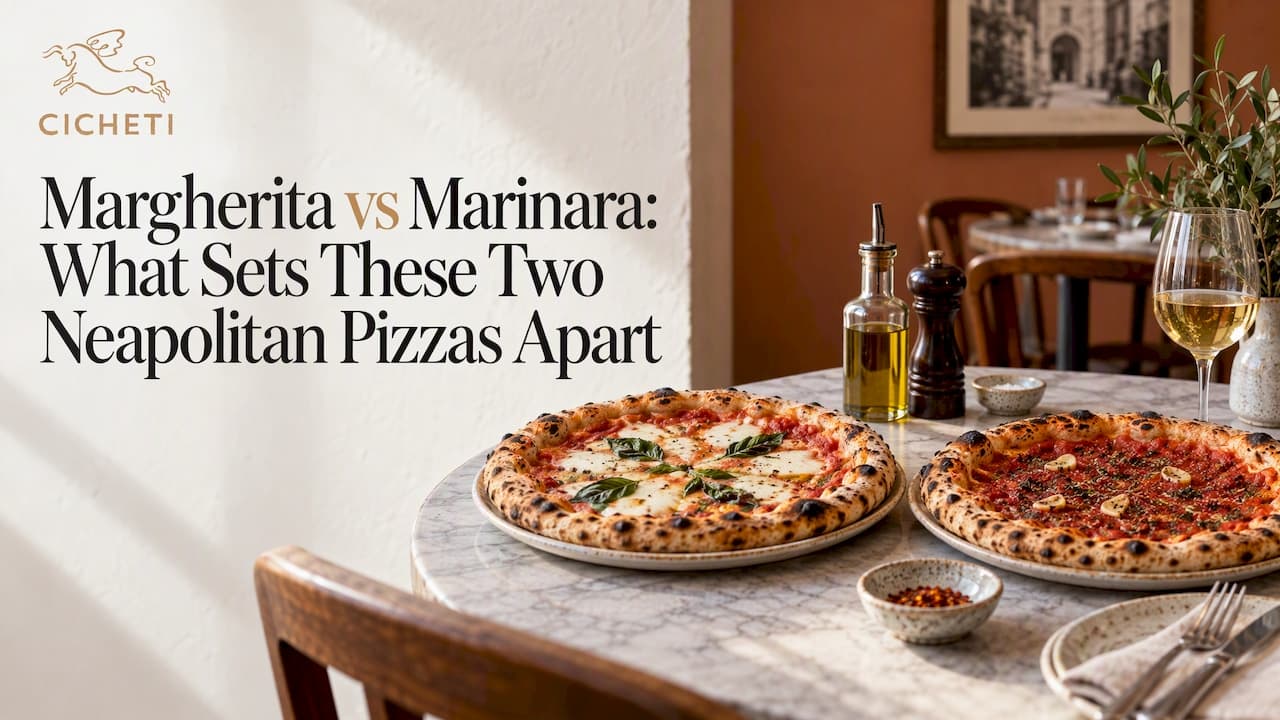
The short answer: a margherita has tomato, mozzarella, basil and olive oil, while a marinara has tomato, garlic, oregano and olive oil, and no cheese at all. That one missing ingredient changes the whole pizza, from how it looks to how it eats. At Cicheti, our wood-fired Neapolitan pizzas sit on Kandahar Street in Kampong Glam, and this is a question we're asked across the table more often than you'd think.
TL;DR
- Margherita: tomato, fior di latte or buffalo mozzarella, fresh basil and extra virgin olive oil, sometimes with a little grated hard cheese.
- Marinara: tomato, extra virgin olive oil, garlic and oregano. No mozzarella, so it tastes sharper and more savoury.
- Both are classic Neapolitan pizzas. They share the same soft, chewy dough and a raised crust edge, and only the toppings differ.
- Roman pizza is a different animal: thin, dry and crisp, often rolled out with a pin, rather than soft and puffy.
- Choosing: margherita if you want creamy and mellow, marinara if you want bright, garlicky and dairy-free. Order both and share if you can't decide.
Table of Contents
- The difference at a glance
- What goes on a margherita
- What goes on a marinara
- Why it's called a margherita
- What they share: the Neapolitan dough and oven
- How Roman pizza differs
- Which should you order?
- Eat it at Cicheti
- FAQ
- Sources
The difference at a glance
Before the detail, here is the comparison most people are really after. The ingredient lines come from the Michelin Guide's piece on Neapolitan and Roman pizza and the AVPN regulations, the rulebook of the association that protects traditional Neapolitan pizza.
| Margherita | Marinara | |
|---|---|---|
| Tomato | Crushed peeled tomato, 60 to 80 g | Peeled tomato, up to 100 g |
| Cheese | Fior di latte or buffalo mozzarella, 80 to 100 g | None |
| Olive oil | Extra virgin, 6 to 7 g | Extra virgin, 6 to 8 g |
| Herbs and aromatics | Fresh basil | Oregano and one garlic clove |
| Optional extras | A little grated hard cheese (5 to 7 g) | A few basil leaves |
| Character | Creamy, mellow, sweet-tangy | Sharp, savoury, aromatic |
| Dairy | Yes | None in the traditional recipe |
Those weights are the AVPN's reference quantities for a traditional pizza, not a rule every kitchen follows to the gram. They do show something useful, though: the marinara is built on tomato and garlic, and the margherita is built on tomato and a generous layer of mozzarella.
What goes on a margherita
A margherita is the pizza most people picture when they say "pizza". According to the AVPN, the traditional version uses crushed peeled tomato, extra virgin olive oil, fior di latte or buffalo mozzarella, fresh basil and, optionally, a little grated hard cheese. The regulations also say the mozzarella should be cut into slices, half-moons or strips and spread evenly, so every bite gets some. They allow chopped fresh tomatoes too, either alongside or instead of the peeled ones.
Two details are worth knowing.
Fior di latte or buffalo. Fior di latte is mozzarella made from cow's milk. It's milky and mild, and it melts into soft pools. Buffalo mozzarella is richer and tangier, and it releases more moisture, which is why it tends to appear on a pizza with a slightly wetter centre. If you'd like a proper comparison of mozzarella with its creamier cousin, our guide to burrata vs mozzarella goes through it.
When the basil goes on. The AVPN notes that basil is added fresh, and sometimes before baking so the leaves don't scorch. In a very hot oven, a leaf placed on top at the last second can blacken within moments, so cooks choose their moment carefully. The leaf that goes in early perfumes the cheese and tomato as it cooks. The one that goes on late tastes greener and fresher. Neither is wrong.
If you like to know what the DOP and IGP labels on Italian produce actually protect, this explainer on DOP and IGP labels is a good way in, and it's worth knowing when you read a menu that names a tomato or a cheese by origin.

What goes on a marinara
The marinara is the pizza that makes people ask whether something has been forgotten. Nothing has. The AVPN describes the historical Neapolitan marinara as peeled tomato, extra virgin olive oil, one clove of garlic and oregano, with a few basil leaves allowed. That's the full list.
Without cheese to cushion it, each ingredient has to earn its place:
- Garlic is the loudest voice. Used as a single clove (about 3 g in the AVPN reference), it's sliced or crushed so it perfumes the tomato rather than burning.
- Oregano brings a dry, warm, slightly peppery note. The AVPN reference is only 0.5 g, which tells you it's an accent, not a blanket.
- Olive oil carries the flavour of the garlic and oregano across the surface and gives the tomato its gloss.
- Tomato does the heavy lifting. A good, sweet tomato makes a marinara; a dull one has nowhere to hide.
The result is a lighter-looking pizza, with a bright red top and a crust that stays crisp-edged and chewy. Because the traditional recipe has no cheese or meat, it's often the easiest Neapolitan pizza to share around a table with mixed dietary needs. Do tell your server about any allergy though, since kitchens vary and we'd rather you asked. Our guide to vegetarian Italian dishes covers more of the menu on that front.
Is marinara just margherita without mozzarella?
It's a fair guess and nearly right, but not quite. A margherita carries basil and cheese; a marinara carries garlic and oregano. Take the mozzarella off a margherita and you'd have a tomato pizza with basil. The marinara is its own recipe, with its own balance, built so that garlic and oregano are the point rather than the afterthought.

Why it's called a margherita
The popular story says the pizza was named for Queen Margherita of Savoy, who visited Naples in 1889. Italy's national tourism site describes this as a legend, and notes that tomato-and-mozzarella pizzas were being made in Naples before her visit. A regional guide from Campania says much the same: the name probably reflects a style that already existed, and the queen's visit gave it a title.
As for the spelling, it's margherita, the Italian form of the name, with an h. The cocktail is a margarita. We have never been asked to put tequila on a pizza, but we like to be clear.
The marinara, meanwhile, is generally regarded as the older of the two tomato pizzas, and together with the margherita it is the typical pizza of Naples. Both sit within a tradition that UNESCO recognises as Intangible Cultural Heritage: the art of the Neapolitan pizzaiuolo, the pizza maker.
What they share: the Neapolitan dough and oven
Since both pizzas are Neapolitan, the base is the same, and it's a large part of why they taste the way they do.
The AVPN describes Neapolitan dough as soft, elastic and easy to fold, made from water, flour, salt and yeast. That's four ingredients, nothing else. It's baked for just 60 to 90 seconds, at roughly 380 to 430°C on the oven floor and about 485°C in the dome. The Michelin Guide describes the finished pizza as soft, chewy, fluffy and aerated, with a raised edge of 1 to 2 cm.
What does wood-firing add? Mostly speed and heat. A wood-fired oven reaches temperatures at which the dough puffs quickly, blisters in places and cooks through before the toppings dry out. That's why a Neapolitan base can be soft in the middle and still leopard-spotted at the rim. It also explains why a pizza goes from perfect to burnt in moments, and why the person at the oven watches it constantly. If you'd like the broader picture of how crusts differ around the world, our guide to pizza crust styles is a good companion read.
One small myth worth retiring: the idea that Neapolitan pizza only works because of Naples water. Italy's tourism site says the art rests on the skill of the pizzaioli and the kneading, not on unique local water. Technique travels.
How Roman pizza differs
Searching for the margherita-versus-marinara answer often leads on to Neapolitan versus Roman pizza, so here's the short version.
According to the Michelin Guide, Roman-style pizza is round, dry, crisp and very thin, and is often made using a rolling pin. Neapolitan pizza, by contrast, is soft, chewy and aerated with that raised edge. There is also pizza in teglia, a thicker, rectangular, pan-baked style that is a separate thing again, and often what people mean when they talk about Roman pizza sold by the slice.
| Neapolitan | Roman (round) | |
|---|---|---|
| Texture | Soft, chewy, fluffy | Dry, crisp, very thin |
| Edge | Raised, 1 to 2 cm | Flat, barely any rim |
| Shaping | By hand | Often with a rolling pin |
| Bake | 60 to 90 seconds in a very hot oven | Different oven and timing |
| Dough | Water, flour, salt, yeast | Often includes olive oil |
On the olive oil point, a company blog from Italy, Italy Segreta, explains that oil in Roman dough isn't found in traditional Neapolitan dough, and that it makes the dough easier to roll thin and helps give it its crispness. That tallies with the texture difference above.
Margherita and marinara are Neapolitan names, but you can find tomato-and-mozzarella toppings on Roman-style bases too. The distinction is about the dough and the way it's cooked, not which toppings are allowed. Neither style is better; they answer different moods. Neapolitan is a pizza to eat with a knife and fork or folded in your hands; Roman is crackly enough to snap.
Which should you order?
Think about what you want from the first bite.
- Choose a margherita if you want the classic: sweet tomato, milky mozzarella, a green note of basil. It's the easiest to love, and a very good test of a pizzeria's dough and oven.
- Choose a marinara if you want something sharper and more aromatic, or if you avoid dairy. Pair it with something creamy on the side and you'll get the best of both.
- Order both if you're sharing. Two pizzas with the same crust and different toppings show you exactly what the tomato and cheese are doing.
A few practical notes for the table:
- A marinara pairs well with salty, rich things. Cured meats and creamy starters take the edge off garlic, and the contrast works.
- A margherita pairs well with something crisp. A glass with some acidity cuts through the mozzarella. Our sommelier selection changes through the day, so ask what's open.
- Anchovies belong on neither by default, but if you like them, our piece on anchovies on pizza explains how to ask for them.
There's one more thing to say on the tomato. The AVPN's margherita reference uses crushed peeled tomato, and the pizza doesn't need a long-cooked sauce. Cooked pasta sauce, with its onion, herbs and long reduction, will make a different pizza from the bright, barely cooked topping you'd get in Naples. It can work at home, but it won't taste like a margherita or marinara.
Our view from Kandahar Street
We think a pizza menu is best read by its simplest items. A margherita or a marinara has nowhere to hide: it's dough, tomato, oil and a few quiet extras, so what you taste is the dough, the oven and the hands that stretched it.
That's the standard we hold ourselves to at Cicheti. Our pizzas are wood-fired and Neapolitan, cooked by a dedicated local kitchen team who shape our food around regionally inspired Italian dishes and Venetian-style small plates. We'd rather you judged us on a plain pizza and a good glass than on a long list of toppings.
If you're deciding between the two, our suggestion is to order one of each with a few small plates to share, then see which one disappears first. It's usually the one you didn't expect.
Cicheti
Eat it at Cicheti
If this has made you hungry, you'll find our wood-fired Neapolitan pizzas at 52 Kandahar Street, alongside Venetian-style small plates and a list of lesser-known Italian wines. Check the current food menu for what's on the pizza list today, since menus change. You can also book a table or order delivery through Cicheti.

Planning a group meal? Our private events page covers family-style sharing menus, pizza-making workshops and wine tasting classes, and you can enquire there for details.
FAQ
What's the difference between margherita sauce and marinara sauce?
On a Neapolitan pizza there is no real difference in the base: both use peeled tomato with olive oil. The difference lies in what goes with it. A margherita adds mozzarella and basil, while a marinara adds garlic and oregano. The word "marinara" also means a tomato sauce for pasta in many kitchens, which is often cooked longer and seasoned differently.
Is marinara pizza healthier than margherita?
Marinara has no cheese, so it has no dairy and is lighter in fat than a pizza topped with mozzarella. Both share the same dough, so the base is the same. If you have a medical or dietary need, tell your server and ask about the specific dish rather than relying on general rules.
Can I use pasta sauce instead of pizza sauce?
You can, but expect a different result. The AVPN's traditional recipes call for crushed peeled tomato with olive oil, and the topping cooks only briefly in a very hot oven. A pasta sauce that has simmered with onion and herbs will taste heavier and sweeter. If you do use one, spread it thinly.
Why is margherita pizza called margherita?
The tale credits Queen Margherita of Savoy's visit to Naples in 1889. Italy's tourism site calls it a legend and notes that similar pizzas existed earlier, so the name likely attached itself to an established recipe.
Is Roman pizza the same as Neapolitan pizza?
No. Neapolitan pizza is soft, chewy and puffy with a raised edge. Roman round pizza is thin, dry and crisp, often rolled out with a pin. They're two traditions with different doughs, textures and baking methods.
Sources
- Pizza Napoletana or Pizza Romana? (Michelin Guide)
- AVPN International Regulations 2024
- The world capital of pizza: Naples (Italia.it)
- Discover Campania: Pizza
- A Crusty Affair: Pizza Napoletana vs Pizza Romana (Italy Segreta)
- DOP and IGP labels explained