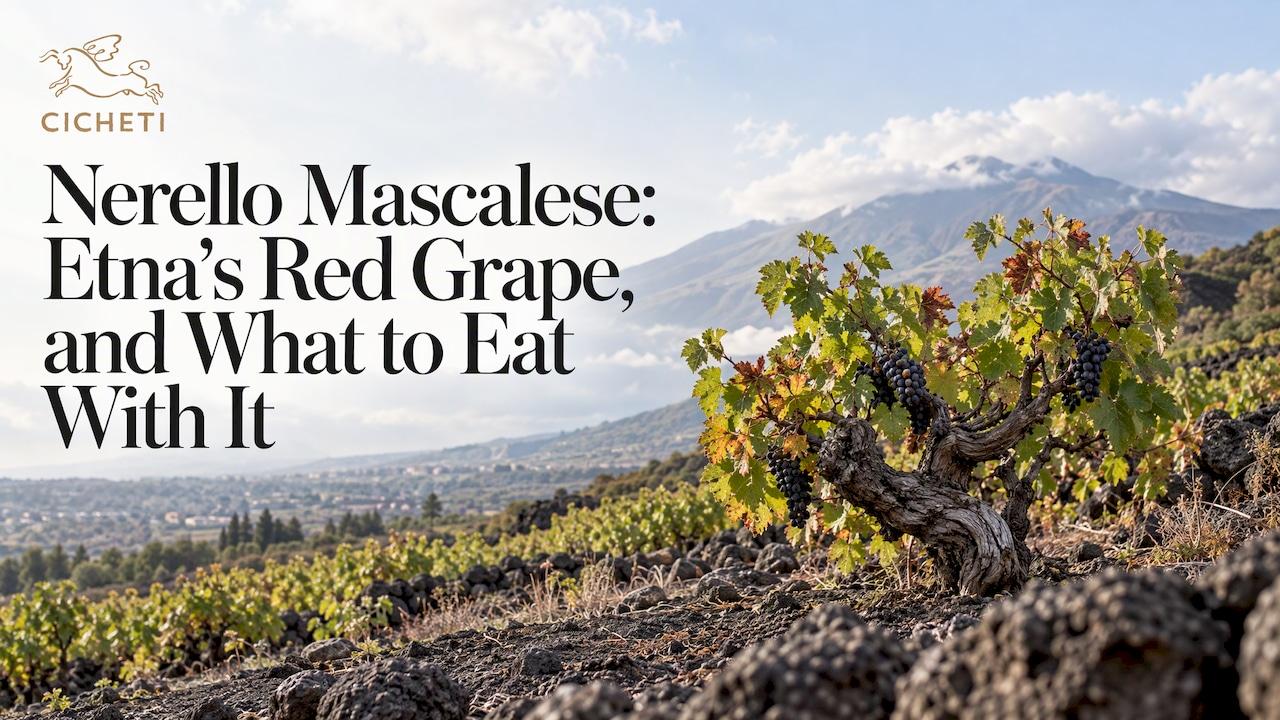
Nerello Mascalese (say it neh-REL-lo mah-ska-LAY-zeh) is a red grape from Sicily, grown above all on the slopes of Mount Etna. It makes pale, perfumed, high-acid wines that look light in the glass and taste surprisingly serious. At the table it behaves more like a friendly, versatile red than a heavyweight: it suits tomato sauces, grilled fish, pork and poultry, and the rosato style even stands up to a wood-fired pizza. Here is what the grape is, how Etna shapes it and how to choose a bottle or a glass. Cicheti, at 52 Kandahar Street, cooks the kind of food it suits.
TL;DR
- Nerello Mascalese is the most widespread indigenous grape on Mount Etna and the main variety in Etna Rosso, Etna Rosato and Etna spumante.
- Expect a light ruby colour, red-berry fruit, a mineral note, bright acidity and firm but fine tannins.
- Altitude and aspect matter: the cooler north tends to give more elegant, austere wines, the sunnier south more generous ones.
- It pairs widely: tomato pasta, grilled fish, pork, poultry, cheese and salumi. Serve it a little cool.
- Comparisons with Pinot Noir and Nebbiolo are useful starting points, not the whole story.
Table of Contents
- What the Nerello Mascalese grape is
- Why Etna matters so much
- What Nerello Mascalese tastes like
- Is it like Pinot Noir or Nebbiolo?
- Styles you will find
- How to serve it
- What to eat with Nerello Mascalese
- Choosing a bottle, a glass or a style
- Where Cicheti fits in
- FAQ
- Sources
What the Nerello Mascalese grape is
Nerello Mascalese is an indigenous Sicilian variety. The Consorzio Etna DOC, the body that represents the appellation's producers, describes it as the most widespread native grape on Etna's slopes. The name is thought to point to the Contea di Mascali, an old county that took in part of Acireale and most of Etna's eastern and north-eastern slopes. Note the word "supposedly" in the consorzio's account: the origin story is tradition rather than proof.
Sicilia DOC places it in the historic Nigrelli group of vines and says it is traditionally trained as a gobelet, which is a free-standing bush vine without wires. It ripens late and is found across the provinces of Catania, Messina, Agrigento and Enna.
So it is not an Etna-only grape. Decanter's 2025 profile notes it is also grown beyond the volcano, including at Feudo Montoni in central Sicily, at 500 to 750 metres. Still, Etna is where its reputation was made, and where most of the bottles you will meet come from.
You will often see it next to Nerello Cappuccio, a second local red. The New York Times' Etna Rosso guide describes the appellation's reds as made largely from Nerello Mascalese, often with some Nerello Cappuccio in the blend.
Why Etna matters so much
If you remember one thing about this grape, make it this: the place changes the wine more than almost any other factor. Etna is a working volcano, and its slopes are a patchwork of lava flows from different eruptions, each with its own soil, altitude and exposure.
Decanter reports that Etna's vineyards run from roughly 400 to 1,000 metres. Its 2015 Etna feature puts most plantings between 450 and 1,200 metres, with many vineyards facing north. At that height the harvest can stretch into November, long after most of Europe has finished picking.
North, south and the cool of the night
The broad rule from Decanter is simple. The cooler north produces more elegant, austere wines, while the sunnier south yields more generous, approachable ones. The World of Fine Wine adds the mechanism for the north side: a wide gap between day and night temperatures supports the grape's long ripening season while keeping its bright acidity.

Contrade and old vines
Etna producers increasingly label wines by contrada, a named vineyard district, much as Burgundy does with climats. The same report describes one parcel in Contrada Feudo di Mezzo with century-old bush vines, and two nearby plots at 630 and 670 metres planted on soils from separate eruptions. Two vineyards a short walk apart can taste distinctly different, and that is the appeal for anyone who likes to compare bottles side by side.
What Nerello Mascalese tastes like
Picture a glass the colour of a light ruby, sometimes with garnet at the rim. The Consorzio Etna DOC describes the wines as slightly intense ruby, with fruity and mineral notes, high acidity and alcohol, and medium structure, balance and astringency. Sicilia DOC describes ruby with garnet reflections, a tannic tendency and good structure, with aromatics that suit maturation.
In plainer terms:
- Colour: pale to medium. Do not mistake paleness for weakness. The grape simply carries less pigment than, say, Cabernet.
- Aroma: red fruit such as strawberry, raspberry and cherry, with floral and earthy notes as the wine ages.
- Palate: fresh and juicy, with a mineral, almost savoury edge. That edge is what many drinkers call volcanic.
- Tannin: present and grippy in young wines, finer and silkier with time.
- Acidity: high, which is why the wine feels lively with food and why it takes a little chill well.
Style varies by site. A bottle from higher, cooler vineyards usually reads as tighter and more floral. One from warmer ground leans fuller and rounder. If a label names the contrada or the altitude, that is a useful clue to which of the two you are holding.
Is it like Pinot Noir or Nebbiolo?
The comparison comes up constantly, and it is a fair place to start. The consorzio notes that the grape is often compared with Nebbiolo for its late ripening and Pinot Noir for its sensitivity to local conditions. If you enjoy a pale, perfumed red with real acidity, you are in the right neighbourhood.
Do not take it too literally. A Decanter-reproduced panel tasting in 2016 cautioned that Pinot Noir and Nebbiolo comparisons can be unfair, with one taster arguing that Etna reds deserve their own identity. The same panel stressed careful handling, warning that heavy extraction can overwhelm the grape's fruit. In short, treat Pinot Noir as a signpost and then judge the wine on its own terms.
Styles you will find
Nerello Mascalese is more than one kind of wine. According to the consorzio, it is the principal grape in:
- Etna Rosso: the standard red, from a single variety or blended with Nerello Cappuccio.
- Etna Rosso Riserva: the same red given longer ageing before release.
- Etna Rosato: a dry rosé with the grape's acidity and red-berry fruit.
- Etna spumante: sparkling wine, a good one to open before a meal.
The rosato is often the easiest way in. It is bright, dry and unfussy, and it suits the sort of evening where the table fills with small plates and nobody wants to commit to a heavy red.
How to serve it
Give it a little coolness. The New York Times suggests serving Etna reds cool rather than warm. In Singapore's climate, that advice matters more than usual: a red left at room temperature on a humid evening loses its freshness and its perfume. Twenty minutes in the fridge before pouring is a sensible habit, and the rosato and spumante should go in properly cold.
A wider, Burgundy-shaped glass lets the floral side open up. And if you are opening a bottle with a few years behind it, pour a small glass first and give it time. The fruit often shows more after a quarter of an hour than it does in the first sip.
What to eat with Nerello Mascalese
Here the grape earns its keep. Acidity, moderate body and fine tannin make it adaptable. The New York Times calls Etna Rosso a practical table wine and points to poultry, pork, salmon, tuna, pasta and tomato sauces, a more useful list than the red-meat-only rule many people assume.
Other pairings from the wider reading:
- Tomato and aubergine dishes. The wine's acidity meets the acidity of the tomato rather than being flattened by it. Think a slow-cooked ragù, or aubergine baked with tomato.
- Grilled fish, especially tuna or sardines. A fish stew works too. This is why a light red can sit happily beside seafood.
- Cheese and salumi. Fine tannin and freshness cut through fat and salt. Tomato bruschetta belongs in the same group.
- Red meat and roasts. An older, more structured Etna Rosso has the grip for them.
- Pizza and fried seafood, with the rosato. WineMag.it describes a Nerello Mascalese rosato as suited to pizza, fried seafood, flavourful fish and white meats.
Bringing it to a trattoria table
The pairings above map neatly onto a trattoria menu. A Neapolitan pizza has a blistered, slightly charred crust, tomato acidity and melted cheese. A bright, dry, high-acid wine handles all three. Handmade pasta in a tomato-led sauce is the classic case for the red. Venetian-style small plates, the cicheti that give our restaurant its name, are small bites built for sharing, so a wine with freshness and range keeps working through the whole spread. If you enjoy thinking about how a meal shapes what you pour, this guide to defining culinary experiences is a pleasant companion read.

If Italian reds with a sparkle appeal as well, our note on what to eat with Lambrusco follows the same logic of acidity meeting rich food. For drinkers curious about wines made with a lighter touch, there is also our guide to Italian natural wine, and for a different style altogether, orange wine from Italy. Vegetarian at the table? Our page on vegetarian Italian dishes shows what to order, and the tomato-and-aubergine pairing above works well with many of them.
Choosing a bottle, a glass or a style
A few habits make shopping and ordering easier:
- Decide the mood first. For an aperitivo or pizza night, look to the rosato or the spumante. For pasta, pork or grilled fish, an Etna Rosso. For a roast or a special dinner, a riserva.
- Read the label for place. "Etna DOC" tells you the appellation. A named contrada or a stated altitude tells you far more about the style.
- Look at the vintage and the producer's approach. Older vintages soften the tannin. Lighter-handed winemaking keeps the fruit intact.
- Ask for a pour by the glass. A single glass with your dish teaches you more than a bottle chosen blind.
When you dine with us, the simplest route is to ask about the Sommelier Selection of the day, which is listed from $19 to $90. Tell the team what you plan to eat and what style you like, and they can point you to a glass or bottle that suits the table. Cicheti's wine list is curated around lesser-known Italian varietals, so curiosity is welcome.
Where Cicheti fits in
Cicheti is a trattoria in Singapore's Arab quarter, at 52 Kandahar Street. Our kitchen is run by a local team and cooks wood-fired Neapolitan pizzas, Venetian-style small plates and regionally inspired Italian dishes, alongside a curated list of Italian wines. Wood-firing matters here because the high heat chars the crust's edges and brings a faint smokiness, exactly the sort of flavour a fresh, acidic wine is good at balancing.
If you would like to taste your way through, the Cicheti Family-Style Menu is $85 per person and is built for sharing, which suits a bottle of something versatile. Our Feast of the Seven Fishes is $95 per person. Groups can ask about private events, handmade pasta, pizza-making workshops and wine tasting classes. Look at the drinks menu before you come, and see the full offering on the Cicheti homepage.

Book a table, or enquire about an event, and tell us what you like to drink. We will take it from there.
Our view from the table
We think a wine list should make a table curious, not nervous. Nerello Mascalese is a good example of why. It looks delicate, it smells of red berries and flowers, and then it shows up with acidity and a mineral edge that make food taste better.
That is the quality we look for in the Italian wines at Cicheti: bottles with a clear sense of place, often from varieties less familiar to Singapore diners, chosen because they work with wood-fired pizza, handmade pasta and a table of shared plates. Our kitchen team is local and cooks with regional Italian dishes in mind, and we like wines that follow the same spirit.
If a grape like this catches your attention, come and talk it through with us over dinner. Pick a dish first, then let the wine follow.
Cicheti
FAQ
What grape is Nerello Mascalese most similar to?
The grape is most often compared with Pinot Noir for its pale colour and sensitivity to place, and with Nebbiolo for its late ripening. Gambino Winery's guide notes it more closely resembles Nerello Cappuccio and Frappato. Treat the comparisons as a guide to the style, not a promise.
Is Nerello Mascalese only grown on Mount Etna?
No. It is most famous on Etna, where the consorzio calls it the most widespread native grape, but Sicilia DOC lists it across Catania, Messina, Agrigento and Enna. Decanter also notes plantings at Feudo Montoni in central Sicily.
Is Nerello Mascalese a light or full-bodied wine?
It sits in between. The colour is light and the body medium, yet the acidity is high and the tannin noticeable. Cooler northern sites give a more austere, elegant wine, while warmer southern ones are rounder and more generous.
Should Nerello Mascalese be served chilled?
Serve the red slightly cool, as the New York Times advises for Etna reds, and the rosato and spumante properly cold. In Singapore's heat, a short rest in the fridge before pouring keeps the fruit lively.
What food goes best with Nerello Mascalese?
Tomato-based pasta, grilled fish, pork and poultry are reliable matches, as are cheese and salumi. The rosato also suits pizza and fried seafood.
Sources
- Wines, Consorzio Etna DOC
- The Grapes, Sicilia DOC
- Searching for the soul of Nerello Mascalese, Decanter
- Vineyards and wines of Mount Etna, Decanter
- Single-vineyard Sicily: Exploring the complexity of Etna's contrade, The World of Fine Wine
- Your Next Lesson: Etna Rosso, The New York Times
- L'Etna di Cantine La Contea, WineMag.it
- Defining Culinary Experiences: a Traveler's Guide