
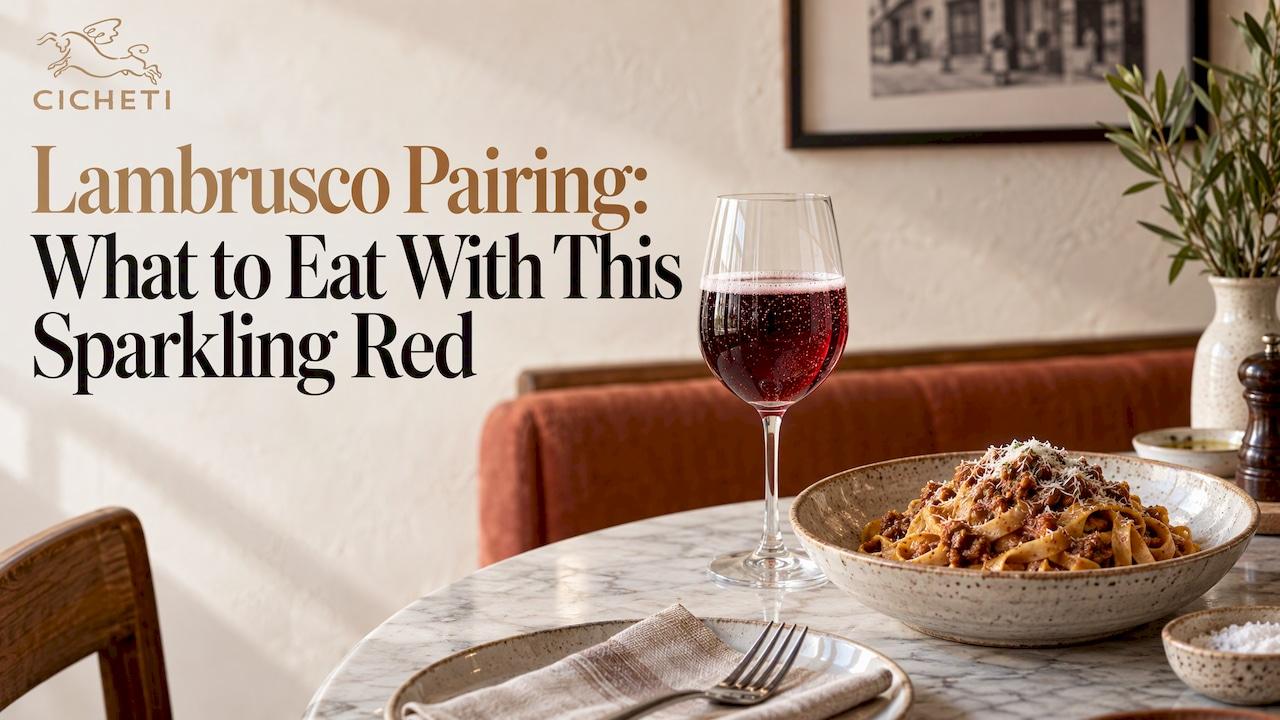
Pour Lambrusco with something salty, fatty or richly sauced and it does its best work: cured pork, Parmigiano Reggiano, baked pasta and a proper pizza. The bubbles and acidity cut through the richness, the red fruit meets the tomato, and the low alcohol keeps you reaching for another slice. The one thing that changes the answer is the style in the glass, so we've sorted the pairings by style, then by dish.
If you're planning a table at Cicheti, 52 Kandahar Street, this is the logic we'd use when choosing wine for wood-fired Neapolitan pizzas and a spread of small plates.
TL;DR
- Lambrusco is built for the food of Emilia-Romagna: salumi, Parmigiano Reggiano, tortellini, lasagne, tagliatelle al ragù and fried gnocco.
- Pizza is a natural partner, especially one with cheese, tomato sauce, prosciutto or salami.
- Pale, high-acid Sorbara suits lighter food and fried snacks. Darker, firmer Grasparossa suits richer, meatier dishes.
- Slightly sweeter bottles can handle chilli heat, so Lambrusco is a sensible choice for spicy food.
- Serve it chilled, around 13 to 16°C, in a white wine glass.
Table of Contents
- Why Lambrusco works with food
- Start with the style: Sorbara, Salamino or Grasparossa
- Cured meats, cheese and fried antipasti
- Pizza: Lambrusco's easiest partner
- Pasta, baked dishes and meat
- Spicy food and the surprise pairings
- Serving it properly
- How we'd think about it at Cicheti
- Planning a table with wine in mind
- A short ordering guide
- FAQ
- Sources
Why Lambrusco works with food
Lambrusco is a sparkling red wine from Emilia-Romagna, and it was made to sit next to a table of rich food. When Italy first protected it in law, it was given DOP status, the category used for Parmigiano-Reggiano and prosciutto, rather than the wine-specific DOC. That says a lot about how Italy sees it: as a wine that goes hand in hand with food.
Three things do the work. There are bubbles to scrub the palate, acidity to cut fat, and a little bitterness or tannin to reset your mouth between bites. It is also low in alcohol. Eater notes one widely sold bottle sits at 8 per cent, which keeps it light bodied. Its acidity means it holds its own with richer dishes without drowning lighter ones.
There is a reason some people write Lambrusco off. Sweet, mass-produced bottles dominated the 1970s and 1980s, and since the 1990s producers have returned to drier, artisanal styles. If your last glass tasted like sparkling grape soda, it's worth trying a dry bottle with a plate of salumi before you decide. A sommelier quoted in the Gazette in August 2026 puts the share of dry Lambrusco being produced now at around 90 to 95 per cent.
Start with the style: Sorbara, Salamino or Grasparossa
Most pairing mistakes come from treating Lambrusco as one wine. It is a family of grapes and appellations. The three most planted are Grasparossa (deep and firm), Sorbara (pale, with very high acidity) and Salamino (somewhere in between). Here is how they sort out at the table.
| Style | What it tastes like | Reach for it with |
|---|---|---|
| Lambrusco di Sorbara | Pale, floral, crisp, very high acidity | Delicate cured meats, fried snacks, lighter antipasti, an aperitivo, and, from a longer-aged bottle, sushi |
| Lambrusco Salamino di Santa Croce | Fragrant, in between, often with a little residual sugar | Cured meats, aged hard cheese and first courses seasoned with pork |
| Lambrusco Grasparossa di Castelvetro | Deeper colour, firmer tannin, richer and drier than other expressions | Ragù, lasagne, filled pasta, grilled sausages, smoked meats |
| Lambrusco amabile (off-dry) | Higher sugar, juicy fruit | Spicy food, and extra-old balsamic vinegar |
The general principle is simple. The paler and more acidic the wine, the lighter and more fried or briny the food. The darker and more tannic it is, the meatier the dish can be.
A practical note if you're shopping: labels say more than most people expect. Look for the grape or appellation name (Sorbara, Grasparossa, Salamino, or Reggiano) and for the words secco (dry) or amabile (off-dry). Those two cues tell you most of what you need to choose a dish.
Cured meats, cheese and fried antipasti
This is the classic, and the easiest place to begin. In Emilia-Romagna, the usual accompaniments are salumi such as salami, prosciutto, mortadella and bresaola, plus porchetta and fennel sausages. Decanter lists Prosciutto di Parma, Culatello di Zibello, Mortadella Bologna and Parmigiano Reggiano, traditionally served with gnocco fritto.
Gnocco fritto deserves a word if you haven't met it. It is a pillowy puffed fried bread, served hot and draped with slices of cured meat. The grease and salt are exactly what a cold, acidic, bubbly red is for. In The Guardian, sommelier Clark says he cannot think of a better match for gnocchi fritto with culatello than a glass of Lambrusco.

Why does it work? The acidity of an ancestral-method Sorbara balances the fat in cured meats without overwhelming their flavour. A more delicate cut, such as thin prosciutto crudo, wants the paler, lighter style. A fattier, peppery salami can take a darker one. If you want to know why the two kinds of ham taste so different, our guide to prosciutto crudo versus cotto explains it.
On a charcuterie board, olives and capers are welcome additions. If you're also drizzling oil over bread or burrata alongside the salumi, a guide to matching extra virgin olive oil with food helps you pick the right bottle for each dish.
Pizza: Lambrusco's easiest partner
If you only remember one pairing, make it this one. Eater suggests Neapolitan pizza topped with prosciutto among the best matches for the wine. The Guardian's Hannah Crosbie calls it a go-to pizza wine, because the red fruit meets the freshness of good tomato sauce.
The same logic applies to what comes out of a wood-fired oven. A Neapolitan pizza is baked fast at very high heat, so the crust blisters and chars at the edge while the middle stays soft. That char and the acidity of the tomato are exactly what a chilled, slightly tannic sparkling red answers well. Decanter's advice is to match richer pizzas with cheese, tomato sauce or salami to a bone-dry red Lambrusco Spumante, and to put dry Sorbara with crunchy pizza bianca topped with Mortadella Bologna or ham.
That gives you a useful way to choose:
- A red pizza with tomato, mozzarella or salami: a dry red Lambrusco with some body. See how margherita and marinara differ if you're deciding between the two classics.
- A white pizza with cured ham or mortadella: the paler, crisper Sorbara. Our piece on what pizza bianca is and how to eat it covers the style.
- A pizza with a salty topping such as anchovy: the acidity helps, and our note on why anchovies belong on pizza shows how to order it.
Pizza also needs something fresh beside it, and a few ideas for salads that go alongside a pie are easy to borrow for a sharing table.
Pasta, baked dishes and meat
The pasta of Emilia is rich, filled and meaty, and Lambrusco was practically designed for it. Decanter names tagliatelle al ragù, tortellini with cream or in capon broth, lasagne, tortelloni filled with ricotta and spinach, and bollito misto (a mixed boiled-meat dish) as the chief regional dishes it pairs with.
For those, Decanter's Raffaele Mosca says Grasparossa di Castelvetro Secco is the most versatile choice, because its smooth texture and light tannins let it stand up to the most savoury flavours. The Manual agrees that baked, cheesy pasta dishes are an excellent match. Wine Enthusiast pairs it with lasagne, spaghetti Bolognese and chicken parmigiano with crispy prosciutto.
A tidy rule for pasta: the thicker and meatier the sauce, the darker the Lambrusco. Tortellini in a clear broth is the opposite case. There the lighter, more aromatic Sorbara is the better guest, because it won't flatten the delicate filling.

For mains, the classic Modenese table runs to boiled meats such as zampone and cotechino with lentils or stewed beans. Zampone and cotechino are seasoned pork sausages, traditionally cooked slowly and served with something earthy and pulse-based. They are rich, and the wine's bubbles lift them. At home, grilled sausages and roast pork follow the same logic.
Spicy food and the surprise pairings
Here Lambrusco shows a side that surprises people who think of it as a pizza wine and nothing more. Chilli heat is tamed by a wine that is cold, low in alcohol and low in tannin. Vivino's guide explains that light reds such as chilled Lambrusco won't clash with spice, because their low tannins cool the heat while standing up to big flavours. It names Thai curry, spicy tacos, Szechuan stir-fry and Korean barbecue among the matches.
Sweetness matters here. Higher sugar levels let amabile Lambrusco pair with spicy food such as chilli con carne or tacos with beef and mole. Food & Wine goes as far as coconut curry with a slightly off-dry Lambrusco.
For Singapore's own flavours, the same reasoning carries over. A dry Lambrusco with a touch of residual sugar, according to one American sommelier, brings out the sweetness of grilled lemongrass pork, and its fizz cleans up the richness of fried spring rolls and banh mi. Ask for one with some tartness instead of a sugary one.

At the other end of the table, Decanter pairs a long-aged Sorbara Metodo Classico with salmon or tuna nigiri, and notes ramen is also a great match because it shares the sweet-and-savoury flavours of local Emilian broths. And for dessert, The Manual points to fresh, fruity sweets such as berry tarts, lemon meringue and key lime pie. Or finish the way Emilia does, with extra-old balsamic vinegar, which suits the sweeter amabile style.
Serving it properly
Get the glass and temperature right and half the work is done.
- Temperature: chill it to between 55 and 60°F, roughly 13 to 16°C. Colder than the fridge door suggests, warmer than an ice bucket. Thirty minutes in the fridge, or ten minutes in iced water, gets a room-temperature bottle there. In Singapore's heat, a bottle left on the table warms quickly, so keep it cool between pours.
- Glass: a white wine glass. The same source says Lambrusco should always be served in a white wine glass, which gives the fruit and floral notes room to open.
- Freshness: drink it young. This is a wine for the year it was bottled, not for the cellar.
How we'd think about it at Cicheti
At Cicheti, our kitchen team cooks wood-fired Neapolitan pizzas and Venetian-style small plates, and our wine list leans towards lesser-known Italian varietals. That is the same instinct behind a good Lambrusco pairing: choose the wine for the food on the table, not for the label.
Our small plates are made for sharing, which suits a wine like this. Salty, fatty, tomato-rich and charred dishes are what bright acidity and a little fizz were made for. A pizza that has spent moments in a wood-fired oven, with a blistered edge and a soft centre, asks for exactly that kind of freshness.
Choose the wine for the table, not the dish. When a group orders to share, the best bottle is one that keeps working from the first plate to the last. Tell our team what you're eating, and they can point you to something from the list that does the job.
Cicheti
Planning a table with wine in mind
If you'd like to put these ideas to work, start with the Cicheti food menu to see the pizzas and small plates, then look at the Sommelier Selection of the day, which is priced from $19 to $90. Our Cicheti Family-Style Menu is $85 per person and is built for sharing, which makes it easy to taste several dishes with one or two wines. For a group, the private events page covers handmade pasta, sharing set menus and wine tasting classes.

You can book a table at Cicheti at 52 Kandahar Street and ask the team which wines are pouring.
A short ordering guide
If you want one-line answers for the table:
- Salumi and cheese first: dry Sorbara or Salamino.
- Margherita or a tomato-based pizza: a dry red with some body.
- Rich pasta, ragù or lasagne: Grasparossa.
- Fried snacks and lighter bites: Sorbara, very cold.
- Spice: slightly off-dry, well chilled.
- Dessert with fruit: a sweeter, fruit-led style.
If you enjoy exploring other Italian regions, our guide to the wines of Veneto is a natural next read, and orange wine from Italy makes another interesting partner for a shared table.
FAQ
What is the best food to eat with Lambrusco?
Cured pork and Parmigiano Reggiano are the classic answer, with gnocco fritto if you can find it. Pizza, lasagne and tagliatelle al ragù follow closely. All of them are rich and salty, which is where a cold, acidic, bubbly red is at its best.
Does Lambrusco go with pizza?
Yes. Neapolitan pizzas topped with prosciutto are one of the pairings Eater recommends, and the red fruit suits tomato sauce. Choose a dry bottle with a bit of body for tomato and cheese, and a paler Sorbara for white pizza with ham.
Is Lambrusco always sweet?
No. Sweet, mass-produced bottles were common in the 1970s and 1980s, but producers have since returned to drier, artisanal styles. Look for secco on the label for dry, and amabile for a sweeter wine that suits spicy dishes.
What glass and temperature should I use?
Use a white wine glass and serve it chilled, between 55 and 60°F, which is roughly 13 to 16°C. Drink it young while it is lively and fresh.
Sources
- Food matching: Lessons in Lambrusco, Decanter
- Everything You Ever Wanted to Know About Lambrusco, Eater
- Think lambrusco is too sweet? Have another taste, The Guardian
- Everything you need to know about Lambrusco wine, The Manual
- Lambrusco: Styles, Grapes and Why It Is Back, NVWA
- Lambrusco: A Guide to the Basics, Food & Wine
- Wine pairing for spicy food: A how-to guide, Vivino
- Lambrusco Wine Ratings, Reviews and Basics, Wine Enthusiast
- Wine Guy: This year, Italy is my choice for summer bubbles, The Gazette
- A Seattle Tastemaker Wants to Change How You Pair Wines, VinePair