
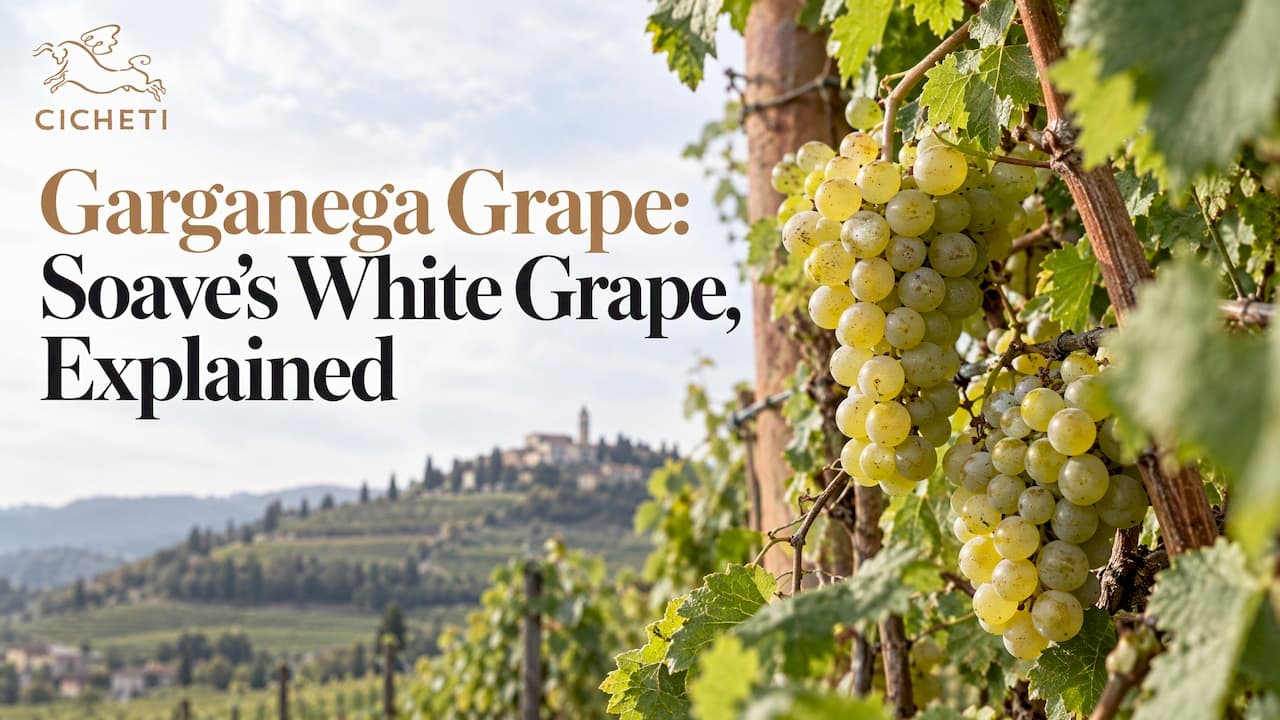
Garganega is a white grape from Italy's Veneto region, and it is the main grape in Soave. It usually makes a dry, light to medium-bodied wine with white flowers, apricot, apple and citrus, and a faint bitter-almond finish. It is a very good bottle to open with a plate of seafood pasta. Below you'll find what it tastes like, why Soave from volcanic soil behaves differently, and how to serve it.
TL;DR
- Garganega is a white grape native to the Veneto, grown mostly around Verona and Vicenza, and it is the backbone of Soave and Gambellara.
- Expect white flowers, apricot, sweet apple and citrus, with a slightly bitter-almond finish. Most bottles are dry.
- Soave must contain at least 70% Garganega. The rest is mostly Trebbiano di Soave, and Soave DOC also allows Chardonnay.
- Serve simpler bottles at around 8 to 10°C with risotto, pesto or clam spaghetti.
- In Sicily the same grape goes by Grecanico Dorato.
Table of Contents
- What is the Garganega grape?
- What does Garganega wine taste like?
- Is Garganega wine dry or sweet?
- How Garganega becomes Soave
- The same grape under another name
- What is Garganega similar to?
- How to serve Garganega
- What to eat with Garganega
- Buying and ordering tips
- Perspective: why we like quieter whites
- Tasting more Italian whites with us
- FAQ
- Sources
What is the Garganega grape?
Garganega (say it gar-GAN-eh-gah) is a white wine grape native to the Veneto in north-east Italy. Most of it grows in the provinces of Verona and Vicenza, where it underpins the Soave and Gambellara wine regions. The growers of Soave say it has been planted in the hills there for at least a thousand years, which makes it one of Italy's oldest varieties.
It is a quiet sort of grape. It doesn't announce itself with the loud tropical fruit or grassy punch of some better-known whites. It tends to be subtle at first, then reveals more as it opens in the glass, and that is much of its appeal at the table. A wine that doesn't shout leaves room for the food.
If you've seen "Garganega" on a menu in Singapore, it's usually because the bottle is a Soave. The grape name often doesn't appear on the front label at all, which is why many people have drunk plenty of it without knowing.
What does Garganega wine taste like?
The growers' consortium describes the aromas as varying with soil and winemaking: white flowers, apricot, sweet apple and citrus, finishing with a slightly bitter-almond note. That last detail is the quickest way to recognise it. It is a gentle bitterness, a bit like the skin of a fresh almond, and it makes the wine feel dry and clean after a mouthful of something rich.
The structure is just as characteristic. According to the Soave consortium's own press material, Garganega wines are usually light to medium-bodied with moderate acidity. Leave the wine on its lees, the spent yeast cells left after fermentation, and it can become creamy, even oily in the finest examples. So a single grape can give you two quite different glasses:
| Style | What to expect | Where it suits |
|---|---|---|
| Young, unoaked, stainless steel | Floral, citrus and green apple, light and crisp, almond finish | Aperitivo, fried or raw seafood, light pasta |
| Lees-aged or from low-yield vines | Rounder texture, riper stone fruit, a creamy or oily feel | Richer fish dishes, risotto, cream sauces |
| Dried-grape Recioto | Sweet, concentrated, rare | End of the meal, with cheese or on its own |
Why volcanic soil matters
Soave Classico is the historic heart of the zone, and there Garganega often grows on black basalt, volcanic rock. The growers say a Soave from basaltic soil can be steely and mineral. In practice that means a salty edge and a stony coolness rather than plump fruit. If you find ordinary supermarket-style Soave a little neutral, a wine from volcanic hills is the one to try next. Look for "Classico" on the label, which refers to the original hillside zone.
Is Garganega wine dry or sweet?
Mostly dry. Most Garganega is made in a dry style, though the grape is also used for Recioto di Soave, a rare and very sweet dessert wine. For Recioto, the bunches are dried on straw mats so the sugars concentrate before fermentation. Think honey, dried apricot and almond, with enough acidity to stop it feeling heavy.

If a bottle simply says Soave, it's the dry one. You would know if you had a Recioto in front of you: it arrives in a small bottle, in small glasses, at the end of dinner.
How Garganega becomes Soave
Soave is the wine most people meet this grape in. Under the rules, Garganega must make up at least 70% of Soave. Of the remaining 30%, the permitted partner is Trebbiano di Soave. Soave DOC also allows Chardonnay, and up to 5% of that 30% may be other non-aromatic white varieties typically grown in Verona.

So a Soave is Garganega with a small supporting cast. Some producers make theirs entirely from the grape, which is where the more precise, mineral bottles often come from.
The zone makes more than one kind of wine. The Soave consortium lists dry still wines, sparkling spumante and the sweet passito Recioto among them, as the Soave press kit explains. Many everyday bottles are for easy drinking, while the Classico and Superiore wines are where the grape gets more serious.
If you want to see where Soave sits among its neighbours, our guide to the wines of the Veneto, from Prosecco to Valpolicella puts it on the map.
The same grape under another name
In Sicily the grape is known as Grecanico Dorato, where it produces wines with tangy acidity. So if a Sicilian white appears on a list under that name, you are looking at a close cousin of a Soave, grown in a much warmer place. It is a nice experiment to taste the two side by side: the Veneto bottle tends to be more floral and mineral, the Sicilian more sun-bright.
What is Garganega similar to?
People often ask whether Garganega is like Sauvignon Blanc. There is some overlap in how fresh and citrusy both can taste, but Garganega leans towards blossom, stone fruit and almond rather than the sharp, herbaceous style that Sauvignon Blanc is known for. If you usually order Sauvignon Blanc and want something calmer, a Soave is a sensible step sideways. We've written about when each white earns its place in Pinot Grigio or Sauvignon Blanc, and the same logic applies here.
For Chardonnay drinkers, a lees-aged Garganega offers some of the same roundness without the weight. If that is your usual order, this piece on a fresh Chardonnay is a good companion to read before comparing glasses.
How to serve Garganega
The simple wines are best chilled to around 8 to 10°C. Colder than that and you flatten the blossom and apricot. Warmer and the almond bitterness starts to dominate. A practical trick: take the bottle out of the fridge ten minutes before pouring, so it can open up a little.
A few simple rules:
- Use a standard white wine glass rather than a flute. The aromas are delicate and need space.
- Don't over-chill a lees-aged bottle. It will taste thin and tight.
- Keep an open bottle sealed in the fridge. A simple Soave is a drink for the day it is opened, or the next.
What to eat with Garganega
The usual pairings are risotto, pesto and seafood pasta such as spaghetti with clams. The reasoning is easy to follow. The wine is dry, moderately acidic and light, so it cleans the palate without overwhelming delicate food. The almond note also sits well with anything herby or nutty.
At a trattoria table, here is how we'd think about it:
- Venetian-style small plates. The lagoon tradition behind them is built on small bites with a glass of white, which is why the idea suits this grape so well. Our piece on cicchetti and the bacaro ritual explains the custom.
- Vegetable-led dishes. Light, herbal flavours work with a wine that doesn't overpower them. See our notes on vegetarian Italian dishes.
- Pizza. A white pizza or a margherita with a chilled, dry white is a classic combination, with the acidity cutting through melted cheese. We cook ours in a wood-fired oven, and the char on the crust finds a counterpoint in the wine's stony, salty side.
- Before dinner. A cold glass of something dry and light is an easy aperitivo. If you are curious about the evening ritual, we cover it in aperitivo and digestivo.
Buying and ordering tips
A few habits that help when you're faced with a wine list or a shop shelf:
- Look for "Soave Classico" when you want more mineral character, as that is where the volcanic hillsides sit.
- The grape isn't always on the label, so check the back or ask whoever is pouring.
- For a first taste, choose the youngest, simplest bottle and serve it properly chilled. Move up to lees-aged wines afterwards.
- Don't be put off by the price of an entry-level Soave. Its job is to be easy, and it does that well.
Perspective: why we like quieter whites
We think a good list should have a few bottles that reward curiosity, and that is why we lean towards lesser-known Italian varietals rather than the names everyone already knows. Garganega is a good example of that way of thinking: a grape with a very long history in the Veneto, and a wine that tastes best with food.
Our kitchen is run by a local team, and the food at Cicheti is built around wood-fired Neapolitan pizzas and Venetian-inspired small plates. That style asks for wines that refresh rather than dominate. Light, dry and mineral whites do that job beautifully, and they make it easy to keep going from one plate to the next.
If you'd like to try something unfamiliar, tell us what you usually drink and we'll point you towards something in the same spirit. Our drinks list changes, so ask which bottles are open on the day.
Cicheti
Tasting more Italian whites with us
We're at 52 Kandahar Street, in Singapore's Arab quarter, serving wood-fired Neapolitan pizzas and Venetian-inspired small plates, alongside Italian wines chosen for their character. You can look through the drinks list before you come, or see the Sommelier Selection of the day, which is priced from $19 to $90. Whether Garganega or a Soave is open on a given day depends on the list, so please ask when you book.

For a group, the Cicheti Family-Style Menu is $85 per person, and our private events page covers handmade pasta, family-style sharing set menus, pizza-making workshops and wine tasting classes. If you'd rather start at the table, you can see the full food menu or book through our home page. BOOK A TABLE, or ENQUIRE TODAY about a group tasting.
If you're exploring more styles, we've also written about orange wine from Italy and where to taste Italian natural wine.
FAQ
Is Garganega the same as Soave?
Not quite. Garganega is the grape, and Soave is the wine and the place it comes from. A Soave must contain at least 70% Garganega, with Trebbiano di Soave the usual partner. Many people have tasted Garganega without realising, because it rarely appears on the front label.
What does Garganega wine taste like?
Typically white flowers, apricot, sweet apple and citrus, with a slightly bitter-almond finish. The body is usually light to medium, and the acidity moderate. Wines from volcanic soil can taste more stony and salty, while lees ageing can add a creamy texture.
Is Garganega wine dry or sweet?
Most of it is dry. The grape is also used for Recioto di Soave, a rare and very sweet dessert wine made from grapes dried on straw mats. If the bottle simply says Soave, it is the dry style.
What should I eat with Garganega?
Try risotto, pesto or seafood pasta such as spaghetti with clams, and serve the wine at about 8 to 10°C. It also works with vegetable dishes and lighter small plates, since its acidity is moderate and it won't overpower delicate flavours.
Is Garganega the same as Grecanico Dorato?
Yes. Grecanico Dorato is the name the grape goes by in Sicily. The Sicilian wines are described as having tangy acidity, and are a useful comparison with a Veneto Soave if you want to taste how place changes the same grape.
Sources
- THE GRAPES, Consorzio Soave
- Soave press kit 2024, Consorzio Soave
- What is Garganega? BBC Good Food
- Garganega, Wikipedia
- Not Your Nan's Chardonnay: the fresh, local bottle