
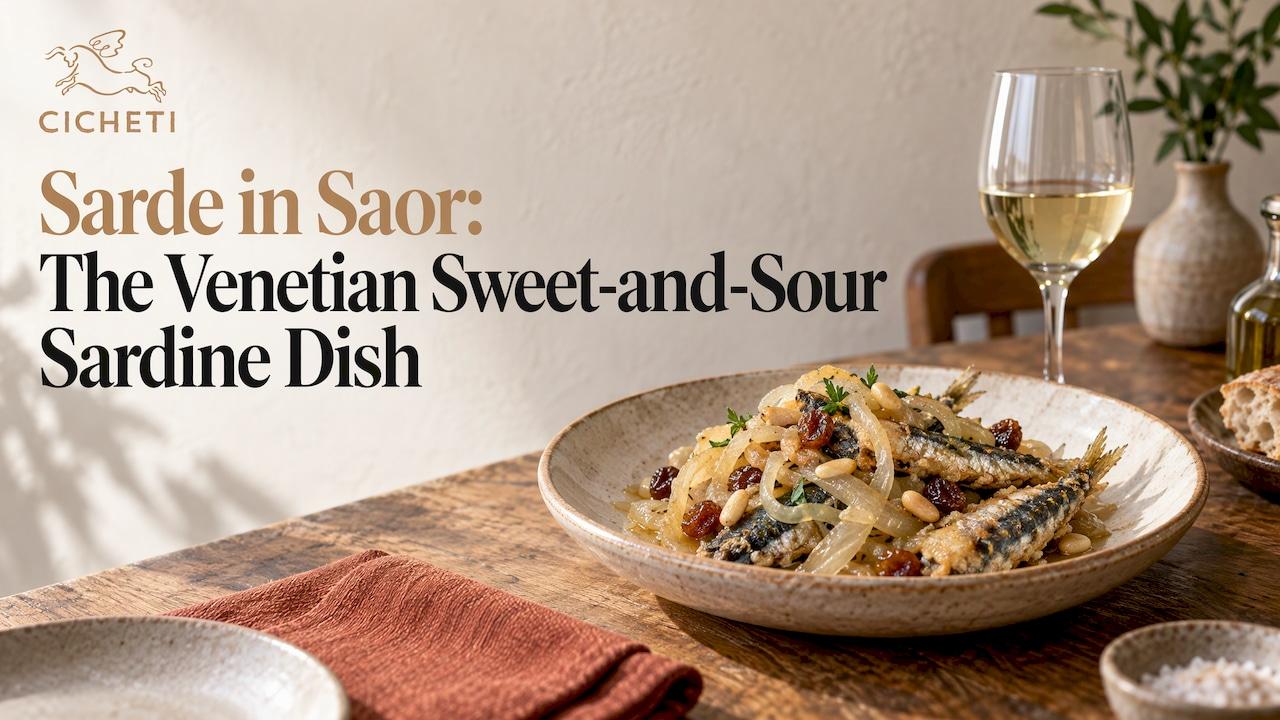
Sarde in saor is a Venetian cicchetto of flour-dusted fried sardines layered with slow-cooked onions, vinegar, raisins and pine nuts, then left to rest for at least a day before anyone eats it. That rest is the whole trick: the sharpness of the vinegar softens, the onions turn silky and the fish takes on a gentle sweet-and-sour edge. Below you'll find what the name means, where the dish comes from, how to make it at home, how to serve it, and what to drink with it.
We'll be straight about one thing too. At Cicheti, 52 Kandahar Street, we cook wood-fired Neapolitan pizzas and Venetian-style small plates, so this dish is very much in our neighbourhood. Check our current food menu for what is on the table this week.
TL;DR
- Sarde in saor means sardines in saor, a Venetian word for flavour: fried sardines marinated with onions, vinegar, raisins and pine nuts.
- It began as a way to keep fish edible at sea, and it is still made ahead because it tastes better after a day or more.
- At home: fry the sardines briefly, stew the onions until translucent, layer everything, and refrigerate for at least 24 hours.
- Serve at room temperature with toasted bread or grilled polenta, and a cold glass of Prosecco or Pinot Grigio.
- Cicheti serves Venetian-style small plates and Italian wines in Kandahar Street, with dine-in and delivery.
Table of Contents
- What is sarde in saor?
- Where sarde in saor comes from
- The ingredients, and why each one is there
- How to make sarde in saor at home
- How to serve it
- A dish for a season
- Our point of view
- Eat Venetian-style at Cicheti
- FAQ
- Sources
What is sarde in saor?
Sarde is the Italian word for sardines: Cambridge Dictionary gives "sardine" as the meaning of Italian sarda. Saor is Venetian dialect for flavour, a cousin of the Italian sapore. La Cucina Italiana describes the dish as flour-dusted fried sardines preserved in vinegar and onions, growing more flavourful the longer they sit, with raisins and pine nuts reflecting Venice's Silk Road trading history.
So the name is a plain description. Sardines, in flavour. Venetians don't tend to over-explain their food.
It isn't pickled in the aggressive sense. The fish is fried first, so it keeps some body and a golden, slightly crisp memory of its coating, and the onions are cooked slowly in oil until soft, then loosened with vinegar. The result is closer to a gentle marinade than a brine: sweet from the onions and raisins, sharp from the vinegar, with pine nuts adding a buttery crunch.
Is it a starter, a snack or a main?
All three, depending on the room. The Art of Eating is not needed here; the simpler answer is that in Venice it appears as a cicchetto, a small bar snack served with a glass of wine, and in restaurants as an antipasto or a light main alongside polenta, as La Cucina Italiana notes. If you'd like the bigger picture of those little plates, our guide to cicchetti and the bacaro ritual walks through it.
Where sarde in saor comes from
The dish is a preservation method that learned to taste good. La Cucina Italiana places the first evidence of the recipe around 1300, born from Venetian sailors' need to keep fish edible on long sea crossings. Vinegar and onions did the work that a refrigerator does now. Older versions leaned on spices such as clove, cinnamon, pepper and coriander.
The raisins and pine nuts tell a second story. Venice's role as a trading hub on the Silk Road is the usual explanation for why dried fruit and nuts ended up in a sailor's fish dish. A salty, sour, sweet and nutty plate is a tidy map of where Venetian ships went.
There is also a calendar. According to La Cucina Italiana, it is traditionally prepared on the eve of the Feast of the Redeemer (Festa del Redentore), the third Sunday of July, when Venice celebrates with fireworks and feasting on the water. Because the dish improves with time, cooking it the day before suits the occasion perfectly.

It isn't only sardines
Sardines are the classic, but the technique is flexible. SBS notes that saor is also used with scampi, sole, prawns, freshwater fish such as carp and trout, chicken, and vegetables such as radicchio. The same source likens the method to Portuguese escabeche and Japanese nanbanzuke, which is a handy comparison if you've met either.

The ingredients, and why each one is there
The list is short, which means each item matters.
- Sardines. Fresh, whole, then gutted, scaled and opened out. Small, oily fish stand up to vinegar without disappearing.
- White onions. The real quantity of the dish. Recipes use roughly as much onion as fish by weight, and some use more. Great Italian Chefs uses 1 kg of each; GialloZafferano uses 1.5 kg of onions to 1 kg of sardines.
- White wine vinegar. It gives the sour note and the preserving power. Quantities are modest, around 110 to 120 g per kilo of fish in the recipes above.
- Raisins and pine nuts. Sweetness and a soft crunch. Soak the raisins briefly so they plump.
- Bay leaves. A quiet, resinous background note.
- Flour and frying oil. A light dusting of flour gives the sardines a thin crust that holds up in the marinade.
Households argue over the details. Some add white wine, some a touch of cinnamon, some a little sugar. That's normal: the recipe is a method, not a formula.
How to make sarde in saor at home
The version below follows the quantities in La Cucina Italiana's recipe, which serves six to eight, and the onion timing from Table Magazine. Fresh sardines can be a scramble to find in Singapore, so ask your fishmonger to gut, scale and butterfly them for you.
You'll need: 1 kg sardines, 1 kg yellow or white onions, 120 g white wine vinegar, 40 g pine nuts, 40 g raisins, 4 tsp sugar, 4 bay leaves, flour, frying oil, olive oil and salt.
- Prepare the fish. Gut, scale and remove the heads, then open the sardines flat. Pat them dry so the oil doesn't spit.
- Soften the onions. Slice them thinly and cook gently in olive oil with the bay leaves. Table Magazine puts this at 40 to 45 minutes over low heat, until the onions are soft and translucent. Colour them as little as possible.
- Add the vinegar. Stir in the vinegar, sugar, soaked raisins and pine nuts and let them settle together for a few minutes.
- Fry the sardines. Dust lightly in flour and fry. La Cucina Italiana's recipe fries them for about a minute in peanut oil at 175 to 180°C. Drain on paper and salt lightly.
- Layer. In a glass or ceramic dish, alternate onions and sardines, finishing with onions. Pour over any cooking liquid.
- Rest. Cover and refrigerate. Table Magazine advises at least 24 hours, ideally 48 or more.
Where it goes wrong
- Rushing the onions. Browned onions taste bitter-sweet and heavy. Keep the heat low and be patient.
- Over-frying the fish. A minute is enough. Anything longer dries the sardines, and they'll turn leathery in the marinade.
- Eating it too soon. Straight from the pan it tastes sharp and disjointed. Great Italian Chefs and others call for a full 24 hours.
- Serving it fridge-cold. Cold dulls everything. La Cucina Italiana suggests taking it out 30 minutes before serving.
How long does it keep?
The sources vary, so go by the cautious end. GialloZafferano says 3 to 4 days in the fridge and advises against freezing; SBS says up to a week. In a Singapore kitchen, with the fridge opened often, treat three to four days as the limit and keep it covered.
How to serve it
Simply. Take the dish out of the fridge about half an hour ahead so the oil loosens and the flavours open. Spoon sardines and onions onto toasted white bread, or onto a slice of grilled polenta, which is the classic partner. La Cucina Italiana mentions both.
A few ideas for the table:
- Put it out with other small things: olives, a little cheese, something fried. Our piece on Venetian food specialties lists classics that sit well beside it.
- If a crisp fried dish is more your style, fritto misto is the other great Venetian fried fish tradition, and it works as a contrast on the same table.
- Keep portions small. The flavours are concentrated, and a few sardines with a generous spoonful of onion go a long way.
What to drink with it
The acidity in the dish calls for something cold, crisp and not too fussy. Table Magazine suggests chilled Pinot Grigio or Prosecco. Both come from north-eastern Italy, and Veneto's own whites and sparklers are the natural neighbours. For a closer look at the region's bottles, see our guide to the wines of Veneto. It also fits neatly into the early-evening habit we cover in Italian aperitivo.
A dish for a season
Sarde in saor belongs to a particular moment in the Venetian year, and that is part of its charm. Seasonal and festival cooking is a big part of how any place builds its food identity, a theme explored in this piece on local gastronomy and food culture. In Venice the festival is the Redentore in July. In Singapore, our own festive table runs in December, as you'll see below.
Our point of view
We think sarde in saor is the best argument for Venetian small plates: simple ingredients, cooked with patience, made better by waiting. It rewards the cook who plans ahead and the guest who lets a plate sit for a minute before diving in.
That patience is how we like to cook at Cicheti. Our kitchen team is entirely local, and they work from regionally inspired Italian cooking: wood-fired Neapolitan pizzas, Venetian-style small plates and handmade pasta. We pair the food with Italian wines chosen for lesser-known grape varieties, because a good plate deserves a glass with something to say.
If you enjoy the idea of sharing several small dishes with a glass in hand, you're already thinking like a Venetian at a bacaro. Come and eat the way that tradition intends: unhurried, together, and a little curious.
Cicheti
Eat Venetian-style at Cicheti
If the idea of small plates and a glass of something Italian appeals, Cicheti at 52 Kandahar Street is built for it. We serve wood-fired Neapolitan pizzas and Venetian-style small plates, with Italian wines by the glass and bottle. You can dine in, or order delivery or takeaway.

For groups, our Family-Style Menu is $85 per person, and the Feast of the Seven Fishes, a seafood-led festive menu, is $95 per person. Our Sommelier Selection of the day runs from $19 to $90. Planning a gathering? See our private events, or browse the dine-in menus. BOOK A TABLE through our website.
FAQ
What does saor mean in sarde in saor?
Saor is Venetian dialect for flavour, from the same Latin root as the Italian sapore. La Cucina Italiana gives this meaning. In the dish it refers to the sweet-and-sour mix of onions and vinegar the fish is dressed in.
What do sarde mean in Italian?
Sarde is the plural of sarda, the Italian word for sardine. Cambridge Dictionary lists sardina as a synonym. So sarde in saor is, literally, sardines in flavour.
How long should sarde in saor marinate?
At least 24 hours in the fridge, and many cooks prefer 48 hours or more. Table Magazine recommends this window. Bring it out about half an hour before serving so it's eaten at room temperature.
Can I use fish other than sardines?
Yes. The saor method is also used for prawns, sole, trout, chicken and even radicchio. Sardines remain the classic, though, and the oily flesh holds up best against the vinegar.
Is sarde in saor vegetarian?
The classic version is not, as the fish is the point. If you're looking for meat-free Italian plates, our guide to vegetarian Italian dishes covers what to order.
Sources
- Sarde in Saor aka Venice on a Plate, La Cucina Italiana
- Sarde in Saor: All the Flavor of Venice in One Dish, La Cucina Italiana
- Sarde in Saor, Table Magazine
- Sweet-and-sour fried sardines (Sarde in saor), SBS Food
- Sarde in Saor Recipe, Great Italian Chefs
- Sarde in Saor, GialloZafferano
- Sarda, Cambridge Dictionary
- What Is Local Gastronomy? A Food Culture Guide