
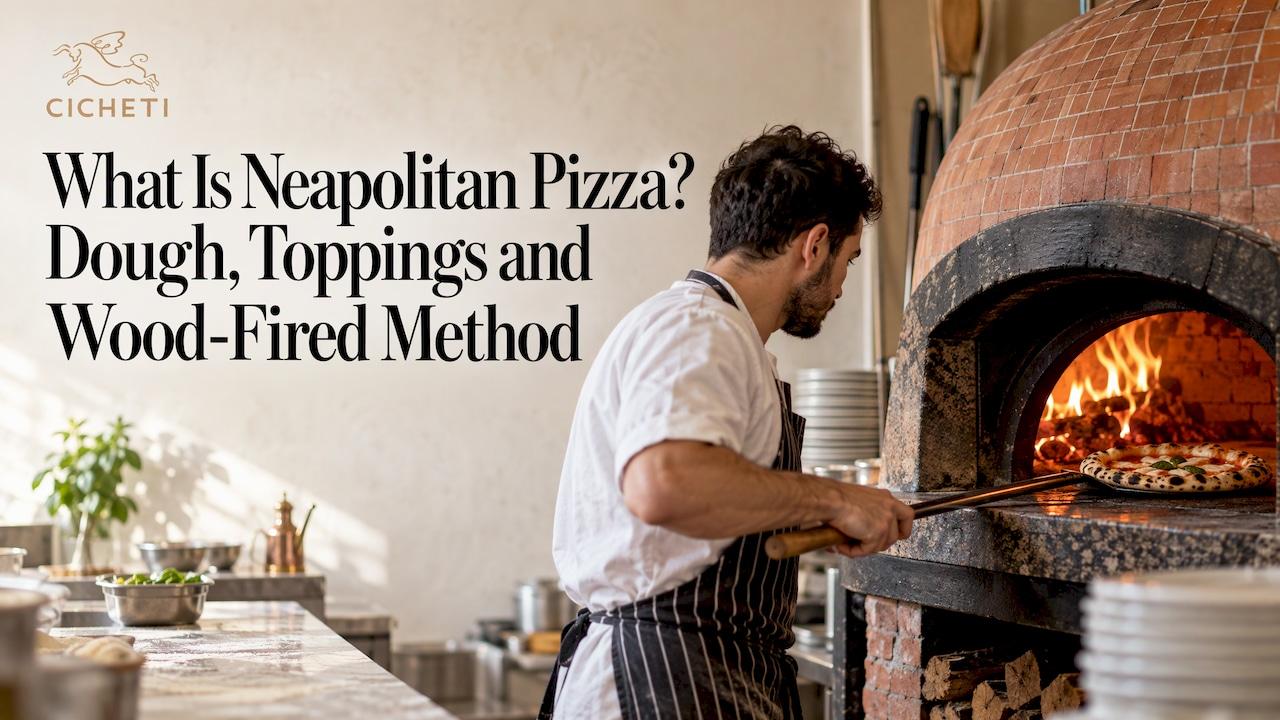
Neapolitan pizza is the pizza of Naples: a hand-stretched round of simple yeasted dough, topped with tomato and (usually) mozzarella, and baked for around a minute in a wood-fired oven. The result has a soft, slightly wet centre and a puffed, blistered rim. That's the short answer. The longer one is about why each of those details matters, and how to tell whether the pizza on your table follows them.
We cook wood-fired Neapolitan pizzas at Cicheti, 52 Kandahar Street, so we have a vested interest in this topic. We'll try to keep it useful rather than evangelical.
TL;DR
- Neapolitan pizza (pizza napoletana) comes from Naples. The dough is flour, water, salt and yeast, shaped by hand with no rolling pin.
- It bakes in a wood-fired oven for roughly a minute or so, which gives a leopard-spotted rim and a centre that stays soft.
- The two classic toppings are Marinara (tomato, garlic, oregano) and Margherita (tomato, mozzarella, basil).
- Toppings are kept restrained, so the dough and tomato do most of the talking.
- Expect to eat it with a knife and fork, or folded, straight from the oven.
Table of Contents
- What Neapolitan pizza means
- Where Neapolitan pizza comes from
- The characteristics that define the style
- How the dough is made
- Why wood-firing matters
- Neapolitan pizza toppings
- How Neapolitan pizza differs from other styles
- How to spot Neapolitan pizza on a menu
- Eating it properly (no rules, just habits)
- Our view on Neapolitan pizza
- Eat Neapolitan pizza at Cicheti
- FAQ
- Sources
What Neapolitan pizza means
The word is simply an adjective: Neapolitan means "from Naples" (Napoli). BBC Bitesize states that this style originated in Naples, and the Italian reference encyclopaedia Treccani describes pizza napoletana as a product of Naples and Campania. In Treccani's definition, the dough uses soft wheat flour, yeast, water and salt, is shaped with a raised rim called the cornicione, takes a filling of peeled and/or fresh tomato with extra virgin olive oil, is worked by hand and is cooked in a wood oven after a double rising.
So when a menu says "Neapolitan", it's making a claim about method as much as place. It's a style with a recognisable set of habits: a short list of ingredients, hand shaping, a long rest for the dough and a very hot, very brief bake.
Where Neapolitan pizza comes from
Pizza in some form is old, but the version most people picture, with tomato, mozzarella and basil on yeasted dough, is generally tied to Naples. The associated craft, the pizzaiuolo (the person who makes the pizza), is treated as living know-how. The UNESCO culture project on the art of the Neapolitan pizzaiuolo describes it as knowledge passed down through generations, and splits it into four phases: kneading and shaping the dough balls, spreading the dough and forming the cornicione, topping it in a spiral, and baking it in a wood-fired oven.

That last point is worth remembering. Neapolitan pizza is as much a way of working as a recipe. Two kitchens can use the same flour and still produce different pizzas if the stretching and the fire are different.
The characteristics that define the style
The Associazione Verace Pizza Napoletana (AVPN), an Italian body that certifies Neapolitan pizzerias, publishes a decalogue for recognising a true Neapolitan pizza. It's a useful checklist even if you never visit a certified place, because it describes what the style looks like when it's done properly.
| Feature | What AVPN's decalogue describes |
|---|---|
| Shape | Round, up to 35 cm in diameter |
| Rim (cornicione) | Raised and puffed, 1 to 2 cm high |
| Centre | No more than 4 mm thick |
| Bake | Wood-fired, 60 to 90 seconds |
| Crust colour | Golden, with very few burns or bubbles |
| Texture | Soft and easy to fold |
The figures above come from AVPN's own rules, not from a universal law of pizza. Plenty of excellent wood-fired pizzas sit a little outside them. But they explain why a Neapolitan pizza feels the way it does: a thin middle that carries the topping, and a tall airy edge that holds the whole thing up.
Why the centre is soft and a little wet
A centre that thin, baked for that short a time, doesn't have the chance to dry out and crisp up like a cracker. It stays tender and slightly damp where the tomato and cheese sit. That's deliberate. If you're expecting a rigid slice that holds out horizontally, this isn't it. A Neapolitan pizza is usually folded, or eaten with cutlery.
Why the rim is blistered
The dark flecks on the rim, often called leopard spotting, are small patches where the dough has charred in the intense heat. Done well, they add a faint smoky bitterness that balances the sweetness of the tomato. AVPN's description asks for very few burns, so the aim is spots and freckles, not a blackened crust.
How the dough is made
The dough is the quiet star. AVPN's International Regulations describe it as made from water, salt, yeast and flour, shaped by hand, with a recommended proofing time of between 8 and 24 hours. BBC Bitesize adds that the dough has no fat or sugar, and that no rolling pin is used.
Those four ingredients are doing a lot of work, so here's what each contributes:
- Flour gives structure. Fine, soft wheat flour (the kind commonly sold as "00") is typical for the style.
- Water hydrates the flour so the dough can stretch thinly without tearing.
- Salt seasons the dough and tightens the gluten a little.
- Yeast produces the gas that inflates the rim. Time does the rest, because a long, slow rise develops flavour as well as lift.
Why no rolling pin
AVPN's decalogue specifies that the dough is stretched exclusively by hand, using a movement that pushes air from the centre outwards so the edge stays puffy and forms the crust. A rolling pin would flatten that air out. It's a simple mechanical reason, not a point of snobbery.

The regulations also mention that after the dough comes out of the mixer, it rests under a damp cloth so the surface doesn't harden. A dried-out skin on the dough would resist stretching and bake into a tougher rim.
Why wood-firing matters
The oven is half of the recipe. AVPN's regulations specify cooking only in a wood-fired oven that has reached 430 to 480°C, with the pizza in for 60 to 90 seconds. BBC Bitesize describes a bake of just over a minute, producing a texture that is crispy and chewy at once.
What does the fire actually contribute?
- Speed. At that heat, the water in the dough turns to steam almost instantly and inflates the rim before the crust sets.
- Char. The flames and the hot oven floor mark the dough in spots, which is where the slightly smoky edge comes from.
- A moist centre. Because the bake is so short, the toppings cook through but the middle doesn't dry out.
- Aroma. Wood smoke lightly perfumes the crust. It's subtle, but it's the whiff you notice when you walk past a working oven.
A domestic oven tops out far below those temperatures, which is why a good Neapolitan pizza is hard to reproduce at home and why people go out for it.
Neapolitan pizza toppings
The classic Neapolitan topping list is short. That's the point: there's nowhere for a weak ingredient to hide.
Marinara
The simplest of the two. BBC-style summaries and the Pizza Napoletana overview give the base as tomato, with garlic and oregano, and olive oil. There's no cheese. Despite the name, there's no seafood either: marinara here refers to a sauce-style preparation, not fish. If you're ordering for someone who avoids dairy, it's the one to look at, though it's worth asking your server about the specifics of any dish.
We've written more about the pair in Margherita vs Marinara.
Margherita
Tomato, mozzarella and basil, plus olive oil. AVPN's decalogue says the peeled tomato should be crushed by hand and stay chunky rather than dense, and that fresh tomato, if used, is chopped into slices. The cheese is either buffalo mozzarella (sliced) or fior di latte, which is mozzarella made from cow's milk (cut into strips), spread evenly across the pizza.
If you're unsure how the cheeses differ, our short guide to burrata and mozzarella covers it.
Can toppings go beyond those two?
Yes. AVPN's decalogue says that besides Margherita and Marinara, other kinds of pizza are allowed provided they respect AVPN regulation and Italian gastronomy, and it says that products should preferably come from Campania. So the style has room, but it has a spirit: a few well-chosen ingredients, not a pile.
Some good principles when you're picking a topping on a Neapolitan base:
- Keep it to two or three components. A thin, soft centre can't carry a heavy load without going soggy.
- Choose ingredients with their own flavour. Cured, salty or briny things, like anchovies, season the pizza as well as topping it.
- Think about moisture. Watery vegetables release liquid in a hot, fast bake. Use them sparingly.
- Consider going without tomato. A white pizza, or pizza bianca, swaps the tomato for something creamier or oil-based.
- Look at the vegetarian options. Our notes on vegetarian Italian dishes will help you plan around a meat-free table.
How Neapolitan pizza differs from other styles
BBC Bitesize ties the distinctiveness of Neapolitan pizza to strict guidelines on ingredients and process, namely hand shaping and a very short wood-fired bake, and links those rules to whether a pizza can officially be called Neapolitan. In practice, that makes it different from several better-known styles:
| Neapolitan | A typical thick or pan-style pizza | A typical thin, crisp pizza | |
|---|---|---|---|
| Shaping | By hand | Often pressed into a tin | Often rolled or tossed |
| Centre | Thin and soft | Thick and bready | Thin and firm |
| Rim | Tall, airy, blistered | Even, golden | Slim, crisp |
| Bake | Around a minute, very hot oven | Longer, moderate heat | Medium heat, longer |
| Eaten | Knife and fork, or folded | By the slice | By the slice |
Those last two columns describe common patterns, not strict categories. For a fuller comparison, see our guide to pizza crust styles from Neapolitan to New York.
How to spot Neapolitan pizza on a menu
You don't need a certificate. Look for these:
- A wood-fired oven that you can see, or a menu that says so plainly.
- A short pizza list. Neapolitan kitchens tend to focus on a handful of pizzas.
- A puffed rim with some char, and a centre that looks tender rather than crisp.
- Simple topping descriptions, naming ingredients rather than listing eight of them.
- A pizza that arrives quickly once it's in the oven. A minute-long bake means it should reach you hot.
If the pizza stays stiff when you lift a slice, or the base has an even, dry crunch from edge to edge, it's likely a different style. That's not a fault, just a different pizza.
Eating it properly (no rules, just habits)
There are no pizza police. But a soft centre does change how you approach it. Most people cut it into wedges with a knife and fork, or fold a wedge in half and eat it with their hands. Eat it while it's hot: the centre firms up and the rim loses its spring as it cools. Share a few between the table rather than ordering one each, and you can taste more than one.
A note on sharing. Pizza is easy to split, and so are the small plates we serve beside it. If you're booking for a group, our guide to family-style Italian dining in Singapore explains how to order so the table doesn't end up with five of the same thing.
Our view on Neapolitan pizza
We cook wood-fired Neapolitan pizzas at Cicheti because we like what the method does: a fast, hot bake that leaves the centre tender and the rim light, with the toppings kept simple enough to taste properly.
Our kitchen team is entirely local, and they cook regionally inspired Italian food, from the pizzas to the Venetian-style small plates. We think a pizza tastes best when it sits in a proper meal, so we pair it with small plates and with Italian wines chosen for their character, often from lesser-known grape varieties.
That's our approach, and we'd rather you came to judge it with a fork in your hand than took our word for it.
Cicheti
Eat Neapolitan pizza at Cicheti
If you'd like to try the style, Cicheti is at 52 Kandahar Street, in Singapore's Arab quarter. We serve wood-fired Neapolitan pizzas alongside Venetian-style small plates and a curated list of Italian wines, and our rustic dining room suits a relaxed table of two or a longer one of eight. You can also order for delivery or takeaway if you'd rather eat at home.

For groups, our dine-in menus and food menu show what's currently on offer. For a celebration, take a look at our private events and pizza-making workshops, or see the full range at Cicheti's wood-fired pizzas. BOOK A TABLE online, and we'll look after the rest.
FAQ
Where is Neapolitan pizza from?
It's from Naples, in the Campania region of Italy. BBC Bitesize states that the style originated in the city, and Treccani describes pizza napoletana as a product of Naples and Campania.
What toppings go on a classic Neapolitan pizza?
The two classics are Marinara (tomato, garlic, oregano and olive oil) and Margherita (tomato, mozzarella and basil). Other toppings are accepted by AVPN as long as they respect its regulation and Italian gastronomy, with ingredients preferably from Campania.
How hot does the oven need to be?
AVPN's regulations specify a wood-fired oven that has reached 430 to 480°C, with the pizza baking for 60 to 90 seconds. A home oven can't match this, which is one reason the texture is hard to copy at home.
Is Neapolitan pizza thin crust?
The centre is thin, up to 4 mm according to AVPN's decalogue, but the rim is tall and airy at 1 to 2 cm. So it isn't a cracker-thin crust. It's soft and pliable in the middle with a puffy edge.
How is Neapolitan pizza different from regular pizza?
It's shaped by hand without a rolling pin, baked very briefly at very high heat, and kept simple on top. The result is a softer, more tender pizza than styles baked longer at lower temperatures.
Sources
- World Pizza Day: Different takes on pizza from around the world, BBC Bitesize
- Pizza, Enciclopedia Treccani
- The decalogue to recognize the true Neapolitan pizza, AVPN
- AVPN International Regulations
- The art of Neapolitan Pizzaiuolo, UNESCO Beni Culturali