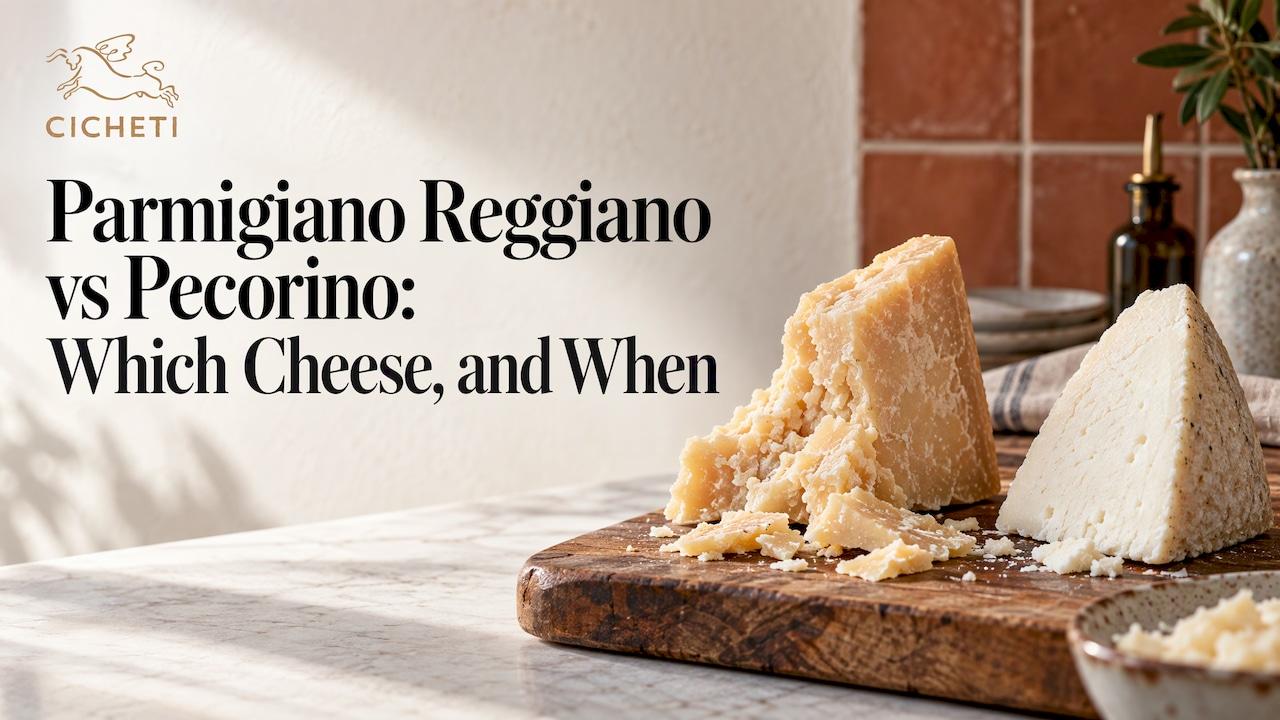
If you only remember one thing, make it this: Parmigiano Reggiano is made from cow's milk and tastes nutty, fruity and rounded, while pecorino is made from sheep's milk and tastes sharper, saltier and more peppery. Reach for Parmigiano when you want depth and a gentle sweetness. Reach for pecorino when you want a bite that stands up to black pepper, cured pork or a bold tomato sauce. At Cicheti, on Kandahar Street, the same thinking guides how we pair wood-fired pizzas, small plates and wine, so this is a guide written from the table rather than the textbook.
TL;DR
- Milk: Parmigiano Reggiano is a raw cow's-milk cheese. Pecorino is the Italian word for a family of sheep's-milk cheeses, and Pecorino Romano is the one most people mean.
- Flavour: Parmigiano is buttery, nutty and fruity. Pecorino Romano is saltier, tangier and more assertive.
- Pasta: Pecorino Romano belongs in carbonara, amatriciana and cacio e pepe. Parmigiano suits filled and baked pasta such as lasagne and cannelloni.
- Swapping: You can substitute one for the other, but cut back the salt when pecorino goes in.
- Name: In Singapore, a 2023 High Court ruling treated "parmesan" as a translation of "Parmigiano Reggiano".
Table of Contents
- The short answer: two cheeses, two personalities
- Is Parmigiano Reggiano the same as Parmesan?
- How the two cheeses are made
- Saltiness, strength and texture
- Which cheese for which dish
- Can you swap one for the other?
- Pairing them with wine
- How to buy and store them in Singapore
- What we think, at Cicheti
- Come and taste the difference at Cicheti
- FAQ
- Sources
The short answer: two cheeses, two personalities
Put a shard of each on a board and the difference is clear before you taste. Parmigiano Reggiano is pale gold and grainy, and it breaks into jagged flakes. Pecorino Romano is whiter to straw-coloured, a little firmer and more compact. Taste them and the milk does most of the talking.
Food & Wine's guide to essential Italian cheeses credits Pecorino Romano's punchier profile to sheep's milk and to dry-salting the cheese before brining, and contrasts it with the nuttier, fruitier notes of Parmigiano. Fine Dining Lovers puts it in similar terms: Pecorino Romano is the saltier of the two, and Parmigiano Reggiano is more buttery and complex.
The quick comparison below covers what most cooks and diners want to know.
| Parmigiano Reggiano | Pecorino Romano | |
|---|---|---|
| Milk | Raw cow's milk | Whole sheep's milk |
| Where it is made | A defined area of northern Italy | Sardinia, Lazio and the province of Grosseto in Tuscany |
| Flavour | Nutty, fruity, buttery, more rounded | Salty, tangy, sharper, sometimes spicy |
| Texture when aged | Crystalline, with crunchy grains | Compact and firm |
| Classic dishes | Lasagne, filled pasta, risotto, shaved over salads | Carbonara, amatriciana, cacio e pepe |
Is Parmigiano Reggiano the same as Parmesan?
In Singapore, this is the question behind the most popular version of the search, so it deserves a straight answer. Parmigiano Reggiano is the name of a protected Italian cheese. "Parmesan" is how the name is rendered in English, and plenty of cheeses on supermarket shelves use the word.
In 2023, the Singapore High Court ruled that "parmesan" is a translation of "Parmigiano Reggiano", as The Straits Times reported. The case concerned a geographical indication, a legal label tying a product to its place of origin. The same report notes that whether "parmesan" can ever be a generic term in Singapore was not decided in that case.
For your kitchen or your order, the practical point is simple. If the label says Parmigiano Reggiano, you are buying the protected cheese from its home region. If it only says parmesan, check the rind and the label to see what you actually have.
How the two cheeses are made
Parmigiano Reggiano
Parmigiano Reggiano is made in a defined northern Italian area and must mature for at least 12 months, according to the Parmigiano Reggiano Consortium. The Consortium describes it as a raw cow's-milk cheese made with milk, salt and rennet, using a whey starter. There are no additives, which is part of why long ageing matters so much: the flavour comes from time.
That time shows up in the texture. Fine Dining Lovers notes that aged Parmigiano develops a distinctive crystalline texture. Those small crunchy grains you sometimes feel are part of the pleasure.
Pecorino Romano
Pecorino Romano is a sheep's-milk cheese with protected (PDO) status, made in Sardinia, Lazio and the province of Grosseto in Tuscany, according to Fine Dining Lovers. The same guide says the Pecorino Romano Consortium specifies whole sheep's milk, which may be thermised (gently heat-treated) but not pasteurised, together with lamb rennet.
The cheese is sold at two stages. Pecorino Romano aged for at least five months can be sold as a table cheese, while cheese for grating must be aged for eight months, according to the Italian agriculture ministry's entry on Google Arts & Culture. The same entry describes the table cheese as aromatic, slightly spicy and tangy, and the grating cheese as intensely spicy. The wheels are cylindrical and weigh between 20 and 35 kilograms.
Pecorino is a family, not one cheese
This catches people out. Food & Wine explains that pecorino is a broad category of Italian sheep's-milk cheeses rather than a single cheese. Pecorino Romano, Pecorino Sardo, Pecorino Siciliano and Pecorino Toscano are all distinct PDO examples. A young Pecorino Toscano is mild and sliceable. Pecorino Romano is the hard, salty grater. When a menu or a recipe says only "pecorino" for a pasta, it almost always means Romano.
Saltiness, strength and texture
Pecorino Romano is the stronger and saltier of the pair. Cookist, an Italian food site, says longer maturation generally makes pecorino more intense and sometimes spicy, while Parmigiano tends to stay more delicate, though its flavour becomes more pronounced with age.
Two things follow from that:
- Parmigiano is easier to eat on its own. Aged chunks, broken rather than cut, work as a nibble with a glass of wine. Pecorino can be eaten this way too, but a little goes a long way.
- Pecorino seasons the dish. Because it is salty, it often does the work of salt. That is useful in a pasta where the pasta water is already seasoned and the other ingredients are cured pork.
Both cheeses can be served in chunks, shaved or grated, as Fine Dining Lovers points out, so the choice is about taste rather than technique.
Which cheese for which dish
Here the debate gets lively, because Italians have firm views. The guidance below follows what Italian and international food writers broadly agree on.
Carbonara, amatriciana and cacio e pepe
Cookist associates Pecorino Romano with carbonara, amatriciana and cacio e pepe. These are all Roman pastas built on few ingredients, so a cheese with a sharp edge is what stops them tasting flat. Cacio e pepe is nothing but pecorino, black pepper and pasta water, which is why the choice of cheese matters so much there.

Carbonara has a famous compromise. Serious Eats' recipe uses equal amounts of Pecorino Romano and Parmigiano Reggiano, to balance pecorino's salty tang with Parmigiano's sweeter, fruitier flavour. It stirs the grated cheeses into eggs, yolks and black pepper, then loosens the mixture with reserved pasta water to make a creamy sauce. It also suggests seasoning with salt only if needed, which is sensible advice when two salty cheeses and cured pork are already in the pan.
So which is better for carbonara? Pecorino Romano is the traditional pull. A blend is the gentler route if you find pecorino alone too sharp.
Lasagne, filled pasta and baked dishes
Cookist links Parmigiano Reggiano with filled and baked pasta, such as lasagne, cannelloni and rosette. This makes sense. In a baked dish, the cheese melts into béchamel and ragù and needs to add savoury depth without shouting. Parmigiano's rounded, nutty character does that. Pecorino could turn a baked dish too salty before it reaches the table.
Salads, risotto and finishing
Shaved Parmigiano on rocket, or stirred through a risotto at the end, is a classic. The Spruce Eats describes Pecorino Romano as a grating cheese for pasta, pizza, salads, soups and stews, and also as a salty finishing condiment for bread, potatoes and roasted vegetables. So it is not only for pasta: a little grated over roast potatoes or hot bread is a quiet pleasure.
On pizza
A Neapolitan pizza is built on dough, tomato and mozzarella, so a hard cheese is a finishing touch rather than a foundation. The salty edge of pecorino can sit well on a pizza with tomato, while Parmigiano brings a softer savoury note. If you are curious about how simple Neapolitan pizzas differ, our guide to Margherita vs Marinara is a good place to start.
Can you swap one for the other?
Yes, with one adjustment. The Spruce Eats says Parmigiano Reggiano can stand in when Pecorino Romano is unavailable, but advises adjusting the salt in the recipe when using pecorino because it is salty. Here is how that works in practice:
- Pecorino in place of Parmigiano: use a little less, and taste before adding any salt. Expect a sharper, tangier result.
- Parmigiano in place of pecorino: use the same amount, and add pepper or a pinch of salt if the dish tastes rounded and sweet rather than sharp.
- Mixing both: half and half is a sound default for anything creamy, as the carbonara recipe above shows.
In short, the swap is forgiving. What changes is the personality of the dish, not whether it works.
Pairing them with wine
The cheeses suggest different glasses, and this is where a good wine list earns its keep.
Parmigiano's nutty richness sits well with fresh, high-acid whites and with light, savoury reds, which cut through the fat without overpowering the cheese. Pecorino's salt and spice ask for something with a little more freshness or fruit to balance it. These are general pairing principles rather than rules, and a good pairing is mostly a matter of contrast: acidity against richness, fruit against salt.
If you enjoy that line of thought, our notes on Pinot Grigio or Sauvignon Blanc and the wines of Veneto show how we think about lighter Italian whites. For vegetarian readers, our list of vegetarian Italian dishes is worth a look, though note that traditional pecorino uses lamb rennet and so is not vegetarian, as the Pecorino Romano specification described above shows.

How to buy and store them in Singapore
A few habits make a noticeable difference at home.
- Read the label. Parmigiano Reggiano is the protected name. A wedge labelled only "parmesan" may be something else, as the High Court case above shows.
- Buy wedges, not tubs. Pre-grated cheese loses aroma quickly. Grating a small piece at the last moment gives you far more flavour.
- Keep the rind. A Parmigiano rind dropped into a pot of minestrone or a ragù adds savoury depth as it simmers.
- Wrap, don't seal. Hard cheeses keep best wrapped in baking paper and then loosely in foil in the fridge, so they can breathe in Singapore's humidity. This is a kitchen habit rather than a rule from any consortium.
- Grate pecorino finely. It is sharp, so a fine grate melts it more evenly into a hot sauce and spreads the salt.
What we think, at Cicheti
We cook wood-fired Neapolitan pizzas and Venetian-style small plates, and our kitchen team is entirely local. That shapes how we think about cheese. Good Italian cooking is mostly about knowing which ingredient does which job, and then not fussing over it.
The Parmigiano and pecorino question is a good example. One gives roundness and the other gives edge. Neither is better, and the best cooks use both on purpose. We would rather you understood why a dish tastes the way it does than followed a rule because someone shouted it across a kitchen.
The same logic runs through our wine list. We choose lesser-known Italian varietals because they often have the freshness and character to sit alongside salty, savoury food, and our Sommelier Selection of the day is a good way to try a few without committing to a bottle. If you would like to talk through which dishes work with which glass, our team is happy to guide you.
Cicheti
Come and taste the difference at Cicheti
Reading about cheese only goes so far. At Cicheti, at 52 Kandahar Street in Singapore's Arab quarter, you can sit down to wood-fired Neapolitan pizzas, handmade pasta and Venetian-style small plates, with Italian wines chosen to go with them. Our Sommelier Selection of the day runs from $19 to $90, and our drinks menu shows what is currently pouring. You can see what is on offer on our food menu, or book a table at Cicheti and ask the team which wine suits the dish you choose.

If you would rather bring the table to a group, our private events page covers family-style sharing set menus, pizza making workshops and wine tasting classes. For a celebration, our Feast of the Seven Fishes and Family-Style Menu are priced at $95 and $85 per person respectively.
FAQ
Is Parmigiano Reggiano the same as Parmesan?
Parmigiano Reggiano is the protected name of the Italian cheese, and parmesan is its English rendering. In 2023, the Singapore High Court ruled that "parmesan" is a translation of "Parmigiano Reggiano", as The Straits Times reported. Whether the word can be generic in Singapore was left open in that case.
Which is stronger, Parmesan or pecorino?
Pecorino Romano is stronger, saltier and tangier, because it is made from sheep's milk and dry-salted. Parmigiano Reggiano is nuttier, fruitier and more rounded, though its flavour deepens with age.
Which is better for carbonara?
Pecorino Romano is the traditional choice for carbonara, with its salty tang. Many cooks blend it with Parmigiano Reggiano in equal parts for a softer, sweeter finish. Season only after tasting, since both cheeses and the cured pork already carry salt.
Can I use Pecorino Romano instead of Parmigiano Reggiano?
Yes, in most recipes. Use a little less, expect a sharper flavour, and reduce the salt elsewhere in the dish. In baked pasta such as lasagne, Parmigiano gives a more rounded result.
Sources
- ‘Parmesan’ is translation of ‘Parmigiano Reggiano’, High Court rules, The Straits Times
- Pecorino Romano vs Parmigiano Reggiano: how to tell them apart, Fine Dining Lovers
- 14 Essential Italian Cheeses, Food & Wine
- Tutte le differenze fra pecorino e parmigiano, Cookist
- Parmigiano Reggiano vs Pecorino Romano, Parmigiano Reggiano Consortium information
- Spaghetti With Carbonara Sauce Recipe, Serious Eats
- Pecorino Romano Cheese, The Spruce Eats
- Pecorino Romano, Ministry of Agricultural, Food and Forestry Policies, Google Arts & Culture